




English translation of the Japanese article.
- Key points
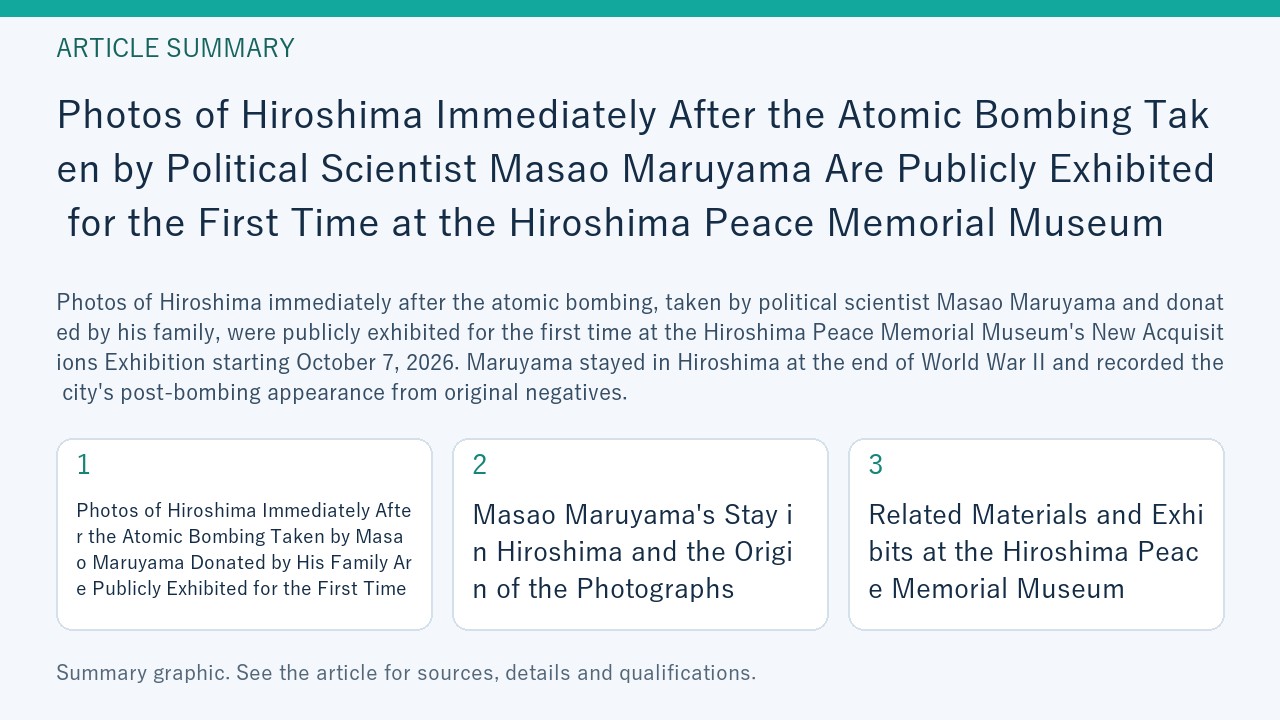
- Photos of Hiroshima Immediately After the Atomic Bombing Taken by Masao Maruyama Donated by His Family Are Publicly Exhibited for the First Time
- Masao Maruyama's Stay in Hiroshima and the Origin of the Photographs
- Related Materials and Exhibits at the Hiroshima Peace Memorial Museum
- Sources and references
Key points
Photographs taken by the late political scientist and intellectual historian Masao Maruyama immediately after the atomic bombing of Hiroshima were donated by his family to the Hiroshima Peace Memorial Museum and publicly exhibited for the first time at the New Acquisitions Exhibition beginning October 7, 2026. Maruyama stayed in Ujina, Hiroshima, as a member of the army in the year the war ended, and the photos are prints from original negatives capturing the cityscape he actually witnessed after the bombing. These valuable materials will be on display until February 23, 2027. The museum also exhibits drawings depicting survivors' experiences and materials showing the city before the bombing, conveying the memory of the bombing from multiple perspectives. [1] [2]
Photos of Hiroshima Immediately After the Atomic Bombing Taken by Masao Maruyama Donated by His Family Are Publicly Exhibited for the First Time
The late political scientist and intellectual historian Masao Maruyama preserved photographs of Hiroshima immediately after the atomic bombing until the end of his life. These photos were donated by his family to the Hiroshima Peace Memorial Museum. They were publicly exhibited for the first time starting October 7, 2026, at the New Acquisitions Exhibition and are scheduled to be on display until February 23, 2027. Thanks to the donation by Maruyama's family, these valuable photos are now accessible to the general public. Visitors to Hiroshima are encouraged to view these important photographs at the museum. [1]
Maruyama stayed in Ujina, Hiroshima, as a member of the army in the year the war ended. The photos now publicly exhibited are prints made from original negatives that Maruyama himself saw, depicting the cityscape of Hiroshima after the atomic bombing. He later received these negatives from a superior officer. These photographs are highly valued as precious records documenting Hiroshima immediately after the bombing. Although Maruyama rarely spoke about his experiences in Hiroshima after the war, his continued possession of these photos suggests the depth of his feelings. [1]
Masao Maruyama's Stay in Hiroshima and the Origin of the Photographs
Masao Maruyama stayed in Ujina, Hiroshima, as a member of the army in 1945, the year the war ended. The photographs he took are prints from original negatives that recorded the cityscape of Hiroshima after the atomic bombing, capturing scenes he personally witnessed. Maruyama later received these negatives from a superior officer. These photos serve as valuable historical materials conveying the situation in Hiroshima immediately after the bombing. Although Maruyama seldom spoke about his experiences in Hiroshima after the war, he preserved the photographs to keep the memory alive. [1]
These photographs are highly regarded as important testimonies conveying the reality of the Hiroshima bombing. Through Maruyama's experiences and records, they play a role in passing on the conditions of Hiroshima at that time to future generations. Because the photos are prints from original negatives, their value as materials is high. Their public exhibition at the Hiroshima Peace Memorial Museum is significant for preserving the memory of the bombing. It is hoped that such materials will continue to be used to convey the horrors of nuclear weapons and the importance of peace. [1]
Related Materials and Exhibits at the Hiroshima Peace Memorial Museum
In addition to Masao Maruyama's photographs, the Hiroshima Peace Memorial Museum holds numerous other photographs taken in Hiroshima city after the bombing. These photos can be viewed through the museum's photo search database, allowing a multifaceted understanding of the bombing's reality. The museum also exhibits drawings created by survivors depicting their experiences, titled "Drawings of the Atomic Bomb by Citizens," as well as drawings showing the cityscape and daily life before the bombing, titled "My Nostalgic Hiroshima." Through these diverse materials, the museum conveys the memory of the bombing. These exhibits are valued as precious testimonies illustrating the human impact of nuclear weapons. [3] [2]
The museum's exhibits use various forms of materials such as photographs and paintings to communicate the devastation caused by the bombing and changes in citizens' lives. This enables visitors to engage not only with historical facts but also with individual survivors' experiences and emotions, providing a profound understanding of the horrors of nuclear weapons and the importance of peace. The Hiroshima Peace Memorial Museum continues to collect and publicly exhibit such materials, fulfilling its role in passing on the memory of the bombing to future generations. [2]
Sources and references
- [1] 遺された記憶を、次の世代へ。広島平和記念資料館 新着資料展にて|2030年、被爆85年へ。長編アニメ「ヒロシマ・夏の名残のバラ」制作に挑む — camp-fire.jp
- [2] 原爆の絵 – 広島平和記念資料館平和データベース — hpmm-db.jp
- [3] 写真 – 広島平和記念資料館平和データベース — hpmm-db.jp
This English edition was translated and reviewed using AI against the Japanese original and cited sources. Source titles remain in their original language.
コメント