





English translation of the Japanese article.
Key points
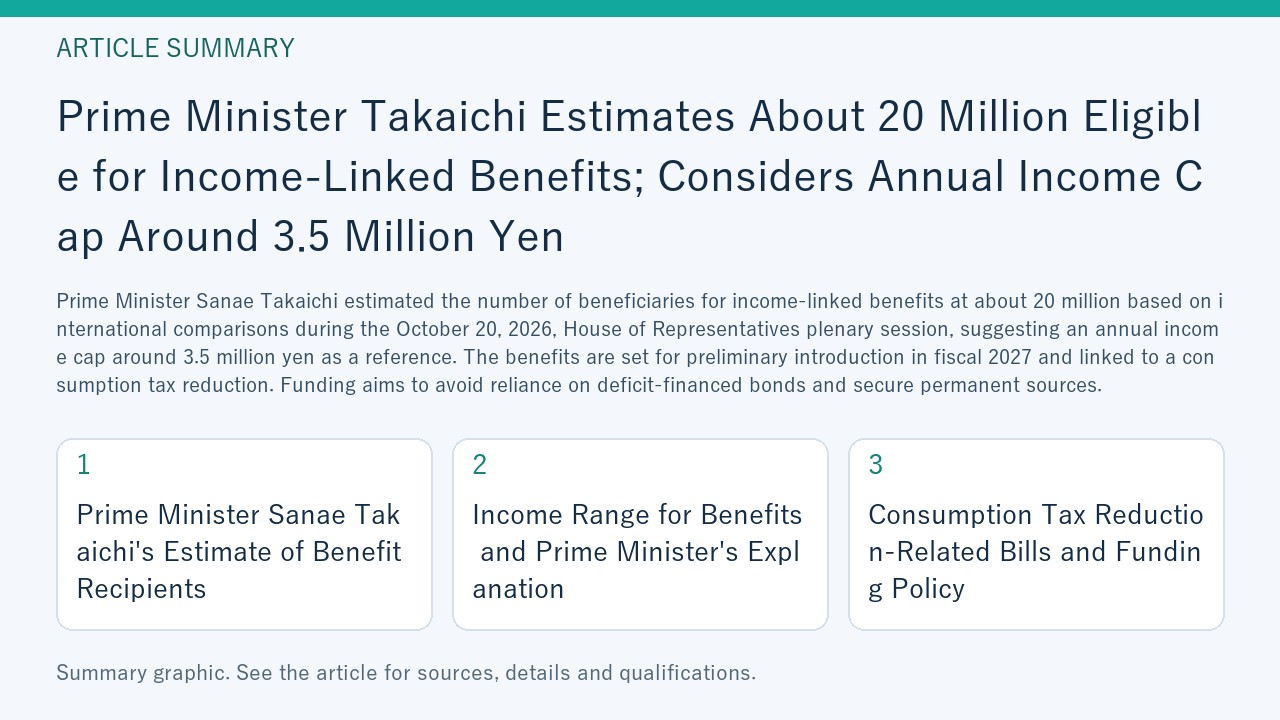
On October 20, 2026, during the House of Representatives plenary session, Prime Minister Sanae Takaichi estimated the number of beneficiaries for income-linked benefits, introduced in conjunction with a consumption tax reduction on food and beverages, at about 20 million based on international comparisons. She indicated an annual income cap of approximately 3.5 million yen as one reference point, stating that the specific scope will be decided through parliamentary deliberations. The benefit system is scheduled for preliminary introduction in fiscal 2027, with the consumption tax rate reduced by 1 percentage point for two years. The funding is planned to avoid reliance on deficit-financed bonds and aims to secure permanent sources. Prime Minister Takaichi's explanation has become a focal point in parliamentary discussions. [1] [2] [3]
Prime Minister Sanae Takaichi's Estimate of Benefit Recipients
During the October 20, 2026, House of Representatives plenary session, Prime Minister Sanae Takaichi stated that the number of beneficiaries for the income-linked benefits was estimated at about 20 million based on international comparisons. A government reference proposal presented to ruling and opposition parties also estimated the annual income cap in the 3 million yen range, with about 20 million beneficiaries. Multiple reports consistently conveyed these details, making the approximate 20 million beneficiaries a key focus of parliamentary deliberations. In particular, it was noted that about 30% of the approximately 60 million employed persons would be eligible. [1] [2] [6]
This estimate is based on similar systems in other countries applied to Japan's income distribution among workers. The government regards this figure as a reference value, with the final scope to be determined through parliamentary deliberations. The benefit system aims to reduce burdens on low- and middle-income groups, and income floor proposals presented by the National Council on Social Security are also being considered. Careful examination is required from the perspective of securing funding. [1] [2]
Income Range for Benefits and Prime Minister's Explanation
Prime Minister Takaichi clearly stated that no decision has been made to set an annual income cap at 3 million yen but explained that the income range from 1 million to 3.5 million yen is a reference for beneficiaries. This explanation aligns with estimates applying the proportion of workers eligible in similar foreign systems to Japan. The specific upper limit will be decided based on parliamentary deliberations. Regarding the lower limit, the National Council on Social Security has proposed options of 530,000 yen, 740,000 yen, and 1,060,000 yen. The benefit system aims to alleviate burdens on low- and middle-income earners. [3]
The Prime Minister emphasized that the income range for eligibility has not yet been finalized and that parliamentary discussions are being prioritized. The benefit system is scheduled for full implementation starting fiscal 2029, with preliminary introduction in fiscal 2027 and 2028 linked to the consumption tax reduction. This approach aims to provide prompt support to low-income groups. The funding is intended to be permanent, avoiding reliance on deficit-financed bonds. [3]
Consumption Tax Reduction-Related Bills and Funding Policy
The consumption tax reduction-related bill, which entered deliberations in the House of Representatives plenary session on October 20, 2026, proposes lowering the consumption tax rate on food and beverages to 1% for two years starting April 2027. Simultaneously, the income-linked benefit called the "Employment Burden Reduction Support Payment" for low- and middle-income earners will be introduced preliminarily. For the first two years, the support payment corresponds to the 1% consumption tax reduction and is scheduled for full implementation from fiscal 2029. Prime Minister Takaichi explained the bill's purpose, emphasizing that it is the best method from the perspectives of adequacy and promptness of support. [4]
Prime Minister Takaichi reiterated the policy to secure permanent funding for the benefit system without relying on deficit-financed bonds. Details of the specific funding sources are expected to be examined based on parliamentary deliberations. The Prime Minister also stated the intention to revert the consumption tax rate to its original level after two years and indicated no plan to include provisions for revision based on economic conditions. The government and ruling parties regard this bill as the most important legislation of the current Diet session, aiming for passage in the House of Representatives by early November. However, approval in the House of Councillors remains uncertain, with negotiations with opposition parties being a key issue. [5] [4]
Sources and references
- [1] 給付対象、国際比較当てはめると2000万人程度=高市首相(ロイター) – Yahoo!ファイナンス — finance.yahoo.co.jp
- [2] 新給付対象2000万人、年収上限300万円 政府「参考」提示 — home.kingsoft.jp
- [3] 高市首相、支援金の給付対象「年収300万円を上限と決めた事実ない」 | TBS CROSS DIG with Bloomberg — newsdig.tbs.co.jp
- [4] 高市首相、財源・給付詳細を示さず=消費減税法案、衆院審議入り — www.nippon.com
- [5] 高市総理 食料品税率の引き下げと支援金給付の組み合わせが「最善」 消費税減税法案めぐり強調 財源は赤字国債に頼らず | TBS CROSS DIG with Bloomberg — newsdig.tbs.co.jp
- [6] 給付対象、国際比較当てはめると2000万人程度=高市首相 | ニューズウィーク日本版 オフィシャルサイト — www.newsweekjapan.jp
This English edition was translated and reviewed using AI against the Japanese original and cited sources. Source titles remain in their original language.

コメント