




English translation of the Japanese article.
Key points
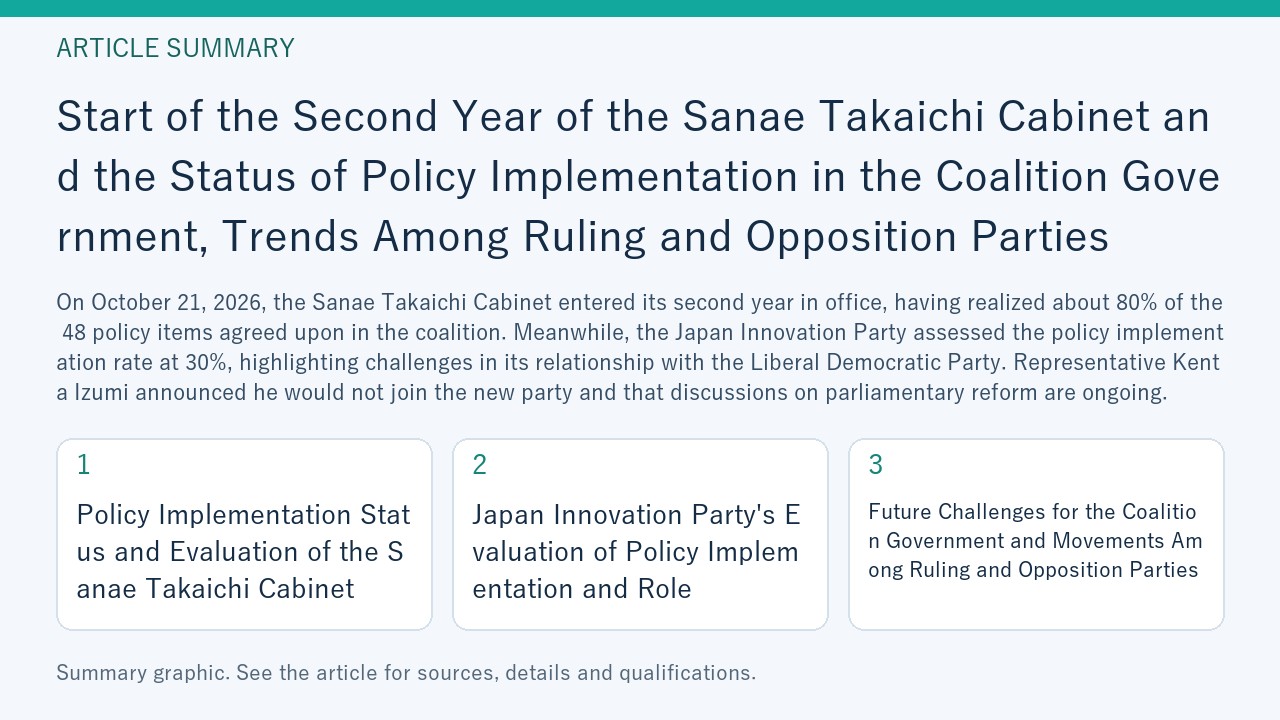
The Sanae Takaichi Cabinet marked its second year in office on October 21, 2026. Of the 48 policy items agreed upon in the coalition government formed by the Liberal Democratic Party and the Japan Innovation Party, 21 were set within the deadline, and 17 of those (approximately 80%) were realized. Bunbu Fujita, co-leader of the Japan Innovation Party, evaluated the policy implementation rate at about 30%, pointing out the slow pace of the Liberal Democratic Party. Representative Kenta Izumi declared he would not participate in the new political group and would continue activities as an independent. These developments illustrate the current state and future challenges of the coalition government as of October 22, 2026. [1] [2] [4] [3]
Policy Implementation Status and Evaluation of the Sanae Takaichi Cabinet
The Sanae Takaichi Cabinet entered its second year on October 21, 2026. Established last autumn, the cabinet, based on the coalition agreement between the Liberal Democratic Party and the Japan Innovation Party, set 21 of the 48 policy goals within the deadline and realized 17 of those (approximately 80%). These achievements have been recognized as demonstrating a commitment to fulfilling promises. Notably, measures against rising prices, the enactment of the National Intelligence Council Establishment Act, the Deputy Capital Creation Bill, and revisions to the Imperial Household Law were passed. Prime Minister Takaichi stated to the press that steadily fulfilling campaign promises is her mission and emphasized the challenges of the second year. [1]
The key to a long-term administration is considered to lie in policy realization during the second year, with past prime ministers also striving to implement important policies at this stage. Prime Minister Takaichi formed the coalition under difficult circumstances at the start of her administration and has begun policy shifts and execution based on the public's mandate. Going forward, she aims to continue investments in crisis management and growth to protect citizens' livelihoods and open a hopeful future. Strengthening security policies, such as establishing the National Intelligence Agency, remains a work in progress, with intentions to continue implementation. She also acknowledged that there is room for discussion regarding the prime minister's use of time and attendance customs in the Diet. [1] [5]
Japan Innovation Party's Evaluation of Policy Implementation and Role
Bunbu Fujita, co-leader of the Japan Innovation Party, assessed the coalition government's one-year policy implementation rate at about 30%. While pointing out the slow pace of the Liberal Democratic Party, Fujita stated that the Innovation Party serves as the accelerator in the coalition, driving policy realization. The party has promoted policies such as reducing the number of House of Representatives members and the Deputy Capital Creation Bill, emphasizing reforms that involve self-restraint. Reports indicate dissatisfaction within the Liberal Democratic Party regarding the Innovation Party's proactive policy proposals. Approximately one month after shifting to cabinet cooperation, the Innovation Party is seeking to demonstrate its presence in policy implementation. [2] [4]
On October 14, 2026, during the House of Representatives Budget Committee, Fujita advocated for progress on the 48 policy items across 12 areas agreed upon in the coalition and stressed the need for parliamentary reform. He also discussed the prime minister's use of time in the Diet, pointing out that the current situation, where the prime minister is detained for long hours in the Diet, is unusual internationally. Fujita proposed parliamentary reforms to concentrate the prime minister's responses on critical national issues while delegating other matters to responsible ministers. Prime Minister Takaichi refrained from commenting on attendance customs but acknowledged the importance of the prime minister's time management to maximize national interests. [5]
Future Challenges for the Coalition Government and Movements Among Ruling and Opposition Parties
Representative Kenta Izumi announced in September 2026 that he would not join the new political group and would operate as an independent for the time being. He cited dissatisfaction with the handling of political party subsidies as the reason for declining participation. Izumi criticized the distorted and insufficiently explained system of party subsidies and emphasized the importance of decisions from the public's perspective. He expressed a desire to increase allies while seeking the ideal form of political parties. His affiliation with a parliamentary group remains undecided, with plans to assess future developments. [3]
Within the coalition government, while the Japan Innovation Party actively promotes policies, dissatisfaction is evident within the Liberal Democratic Party. The Innovation Party has proposed policies difficult for the Liberal Democratic Party to endorse, such as raising medical co-payments for the elderly and reviewing the Three Non-Nuclear Principles, aiming to remain an unforgettable presence among Osaka voters. Prime Minister Takaichi has expressed gratitude toward the Innovation Party and instructed the Liberal Democratic Party to respond to their demands. However, voices within the Liberal Democratic Party argue that the ruling party should fully commit to policy realization. Parliamentary reform and accelerating policy implementation remain challenges for the coalition government moving forward. [4] [5]
Sources and references
- [1] 高市首相、2年目へ「公約を一つずつ実現」連立合意8割達成も長期政権の鍵は政策実現 — nihonnews.jp.net
- [2] 連立1年 維新・藤田氏「政策実現3割」 定数削減でけん制も(ANNニュース) — www.nagoyatv.com
- [3] 今後の政治活動についてのご報告|泉健太|泉健太公式サイト — izumikenta.pecori.jp
- [4] 「維新カラー」で存在感狙う=閣内協力1カ月、自民は不満―高市政権 (時事通信社 – 10月22日 07:31) — news.mixi.jp
- [5] 【総理の時間の使い方、外国人政策における量的マネジメントの必要性など】2026年10月14日 衆議院予算委員会 藤田文武|日本維新の会 — note.com
This English edition was translated and reviewed using AI against the Japanese original and cited sources. Source titles remain in their original language.

コメント