




English translation of the Japanese article.
Key points
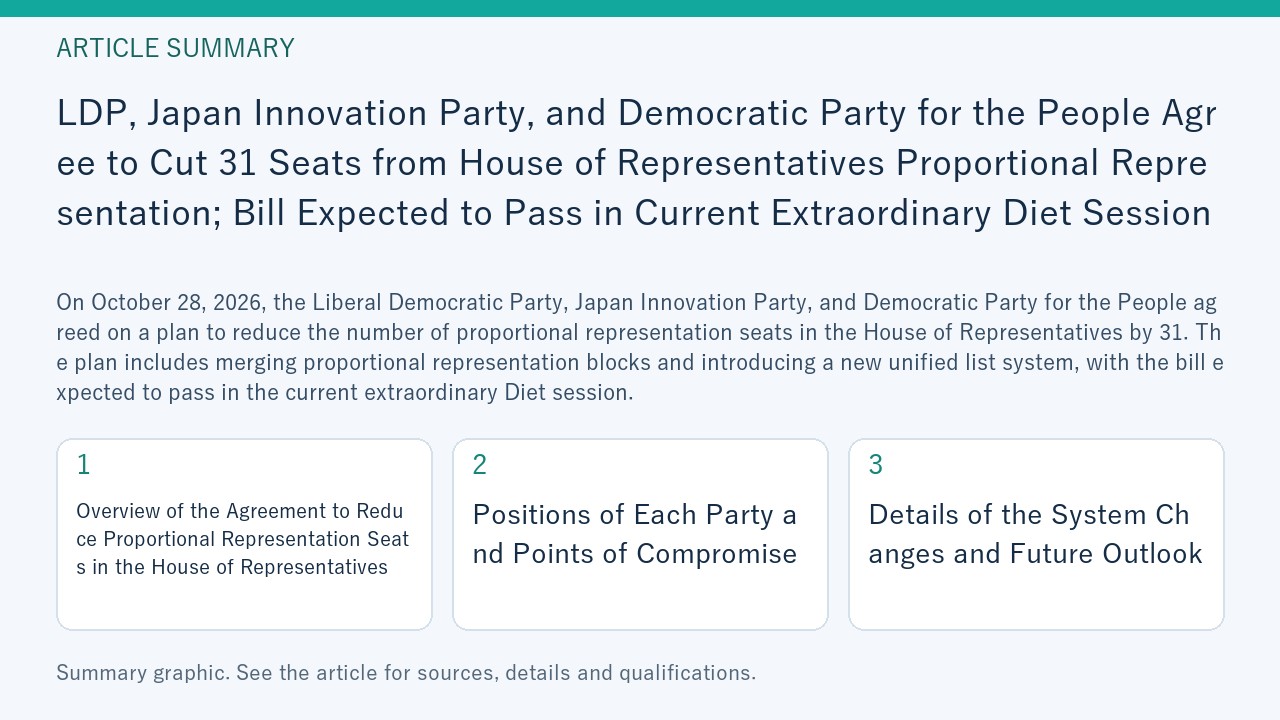
On October 28, 2026, working-level representatives from the Liberal Democratic Party (LDP), Japan Innovation Party, and Democratic Party for the People reached an agreement to reduce the number of proportional representation seats in the House of Representatives by 31. This reduction will decrease the proportional representation seats from 176 to 145, lowering the total number of seats in the House of Representatives from 465 to 434. The number of single-member district seats will remain unchanged. The three parties plan to submit related legislation during the current extraordinary Diet session, aiming for its enactment. The agreement also includes merging proportional representation blocks, introducing a unified list system allowing multiple parties to run on a common proportional list, and changing the seat allocation method. [1] [2] [3]
Overview of the Agreement to Reduce Proportional Representation Seats in the House of Representatives
On October 28, 2026, working-level representatives from the Liberal Democratic Party, Japan Innovation Party, and Democratic Party for the People agreed on a plan to reduce the number of proportional representation seats in the House of Representatives by 31. This will reduce the proportional representation seats from 176 to 145, and the total number of seats in the House of Representatives from 465 to 434. The number of single-member district seats will be maintained. The three parties plan to submit related legislation during the current extraordinary Diet session, aiming for its enactment. Specifically, the plan includes merging the "Chugoku Block" and the "Shikoku Block" in proportional representation to mitigate the exclusion of minority opinions in local areas caused by the seat reduction. [1] [2] [3]
This agreement represents the largest reduction in the number of House of Representatives seats since World War II. The reduction of proportional representation seats corresponds to approximately a 6.7% decrease in the total number of seats and will be implemented as part of a package reform including electoral system revisions. The seat allocation method will change from the traditional D'Hondt method, which favors large parties, to the modified Sainte-Laguë method, which also considers medium and small parties. This change is expected to increase the chances for medium and small parties to gain seats. The bill is anticipated to pass during upcoming Diet deliberations. [2]
Positions of Each Party and Points of Compromise
The Democratic Party for the People evaluated the introduction of the unified list system positively and supported the plan to reduce 31 proportional representation seats. The unified list system allows multiple parties to create a common proportional list and combine votes, supporting seat acquisition by centrist and minority parties. On October 26, the Democratic Party for the People had indicated that a reduction of 19 proportional representation seats was preferable but had not taken a clear stance on the 31-seat reduction plan. The Japan Innovation Party initially advocated for a 45-seat reduction but compromised on the 31-seat reduction plan and expressed readiness to move to the next step. [2] [4] [5]
Co-leader Fujita of the Japan Innovation Party stated that although the goal was a 45-seat reduction, realizing it alone was difficult, so they accepted the 31-seat reduction plan. The Liberal Democratic Party proposed the 31-seat reduction based on a future population decline rate of 6.7%, and with the Democratic Party for the People's agreement, the three parties reached a consensus. This has increased the likelihood of the bill's enactment. Some opposition parties have criticized the reform for lacking sufficient principles and for favoring the ruling parties. The three parties plan to submit the related bill during the extraordinary Diet session and aim for its passage. [1] [2] [3] [4] [5]
Details of the System Changes and Future Outlook
The agreement includes merging the proportional representation "Chugoku Block" and "Shikoku Block" into a new "Chugoku-Shikoku Block." This aims to alleviate the disadvantage of excluding minority opinions in local areas caused by the seat reduction. Additionally, the unified list system will be introduced, allowing multiple parties to run on a common proportional list, supporting seat acquisition by centrist and minority parties. Furthermore, the seat allocation method will change from the D'Hondt method, which favors large parties, to the modified Sainte-Laguë method, which also considers medium and small parties. These system changes are expected to significantly impact election outcomes. [2]
With the three-party agreement, the ruling coalition holds a majority in both the House of Representatives and the House of Councillors, making it highly likely that the related bill will be submitted and enacted during the current extraordinary Diet session. This will realize the largest reduction in the number of Diet members since World War II. Attention will now focus on debates with other opposition parties in the Diet and the impact on the next House of Representatives election. [1] [2] [3]
Sources and references
- [1] 自維国、衆院定数「比例31削減」で実務者合意 維新・藤田共同代表「大変悔しいが次のステップに」|FNNプライムオンライン — www.fnn.jp
- [2] 衆院比例31削減案とは?内容や自民・維新・国民の合意理由まとめ|たろ速 — tarosoku.jp
- [3] 「比例31減」自民・維新・国民が合意 衆院の議員定数 法案提出へ|FNNプライムオンライン — www.fnn.jp
- [4] 「大変悔しいが次のステップに進む」維新・藤田共同代表、比例定数31議席削減案容認の方針 (TBS NEWS DIG – 10月28日 13:54) — news.mixi.jp
- [5] 国民民主、議員定数19減 自民案への賛否明言せず — www.kobe-np.co.jp
This English edition was translated and reviewed using AI against the Japanese original and cited sources. Source titles remain in their original language.

コメント