





English translation of the Japanese article.
Key points
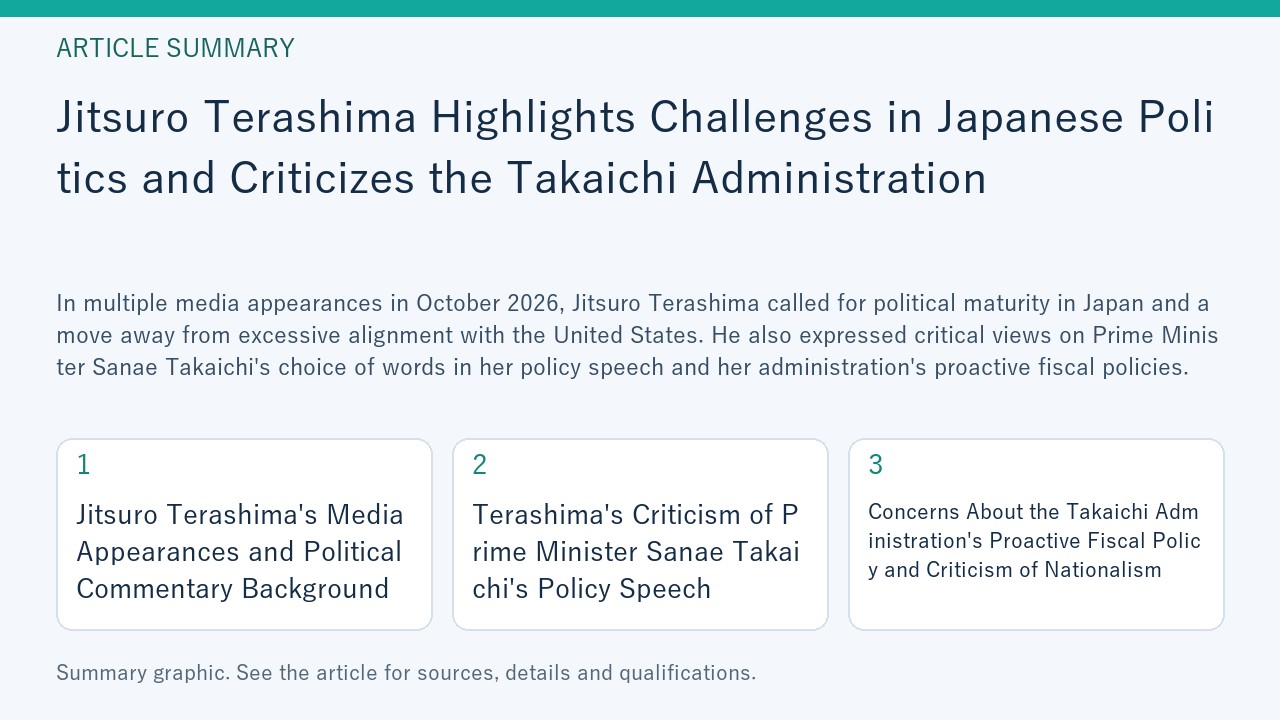
In October 2026, Jitsuro Terashima appeared on several television programs to discuss the current state and challenges of Japanese politics. He particularly addressed the meaning of the term "keisei saimin" (経世済民) used in Prime Minister Sanae Takaichi's policy speech, expressed concerns about the Takaichi administration's proactive fiscal stance, and advocated for Japan to transition from excessive alignment with the United States toward a more mature political stance. These remarks have also been introduced on the official website of Tama University. Terashima's views provide important insights for considering the future direction of Japanese politics. His statements were mainly featured on TOKYO MX1's "Jitsuro Terashima's Power to Understand the World 2.0" broadcast on October 18, 2026, and the TBS network's "Sunday Morning." [1] [3] [4]
Jitsuro Terashima's Media Appearances and Political Commentary Background
In October 2026, Jitsuro Terashima appeared on TOKYO MX1's program "Jitsuro Terashima's Power to Understand the World 2.0" episode 73 (broadcast on October 18) and on a special collaboration segment of the news program "Hori Jun Live Junction" on October 5. In these appearances, he provided structural explanations of international politics and economic conditions. Information about these appearances has been published on the official website of Tama University. Terashima discussed the crisis in the Japan-US-China triangle and the path Japan should take during this historic turning point. These programs aim to help viewers understand the essence of international affairs. [1] [2] [5]
Through these media appearances, Terashima has advocated that Japanese politics should move away from excessive alignment with the United States and aim for independence as a more mature nation. His remarks reflect changes in domestic and international political and economic conditions and contain important implications for considering Japan's future political direction. He also delved into historical perspectives on the imperial system and the nature of the state. According to official announcements from Tama University, Terashima plans to continue making media appearances. [1] [5]
Terashima's Criticism of Prime Minister Sanae Takaichi's Policy Speech
On the October 18, 2026 broadcast of the TBS network's "Sunday Morning," Jitsuro Terashima expressed critical views regarding Prime Minister Sanae Takaichi's use of the term "keisei saimin" (経世済民) in her policy speech on October 5. Terashima pointed out that this term originates from Chinese classical texts and carries an imperial connotation of an emperor governing the world and saving the people, making it inappropriate for a democratic leader to use. He described the term as having a "strongly top-down perspective" and stated that it is not suitable for a prime minister elected by popular vote to use such language. [3]
Terashima did not assert that Prime Minister Takaichi is acting like an emperor but suggested that she might not fully understand the original meaning of the term. This criticism reflects concerns about the political stance and language used by the Takaichi administration and has attracted attention as part of a broader discussion on political maturity. Terashima's remarks imply that the choice of words by political leaders can affect the trust relationship with the public. The October 18, 2026 broadcast serves as the basis for these statements. [3]
Concerns About the Takaichi Administration's Proactive Fiscal Policy and Criticism of Nationalism
Jitsuro Terashima has also expressed critical views on the proactive fiscal policies of the Sanae Takaichi administration. He characterized these policies as "state-led capitalism" and voiced caution about the government's leadership role in the economy. Specifically, he pointed to the policy aiming to create demand through massive public-private investments totaling approximately 370 trillion yen, indicating that it strengthens nationalist tendencies. Terashima expressed concern about the disregard for democracy and the strong inclination toward statism. These remarks were made during media appearances broadcast on October 18, 2026. [4]
Additionally, Terashima criticized the Takaichi administration's slogan "Make the Japanese Archipelago Strong and Prosperous," stating that it should instead be "Make the Lives of the Japanese People Strong and Prosperous." He questioned the policy stance that does not prioritize citizens' livelihoods. These criticisms suggest the risk that state-led economic policies may diverge from the well-being of the people and represent important points of debate for future political governance. Terashima's statements can be seen as a warning from the perspective of protecting political transparency and democratic values. [4]
Sources and references
- [1] 寺島学長 メディア出演情報についてのお知らせ | 多摩大学 ニュースリリース | 多摩大学 — www.tama.ac.jp
- [2] 堀潤 Live Junction 10月5日|寺島実郎の特別コラボ・出演者・視聴方法 – キニナル — terukosan.com
- [3] 高市首相は「経世済民」の意味を知らないのか 寺島実郎氏が「サンモニ」で痛烈批判「中国では皇帝が使う超上から目線の言葉」 — www.j-cast.com
- [4] 高市首相は「経世済民」の意味を知らないのか 寺島実郎氏が「サンモニ」で痛烈批判「中国では皇帝が使う超上から目線の言葉」 — www.j-cast.com
- [5] 寺島実郎氏のメディア出演情報 | 物産会 — bussankai.jp
This English edition was translated and reviewed using AI against the Japanese original and cited sources. Source titles remain in their original language.
コメント