




English translation of the Japanese article.
Key points
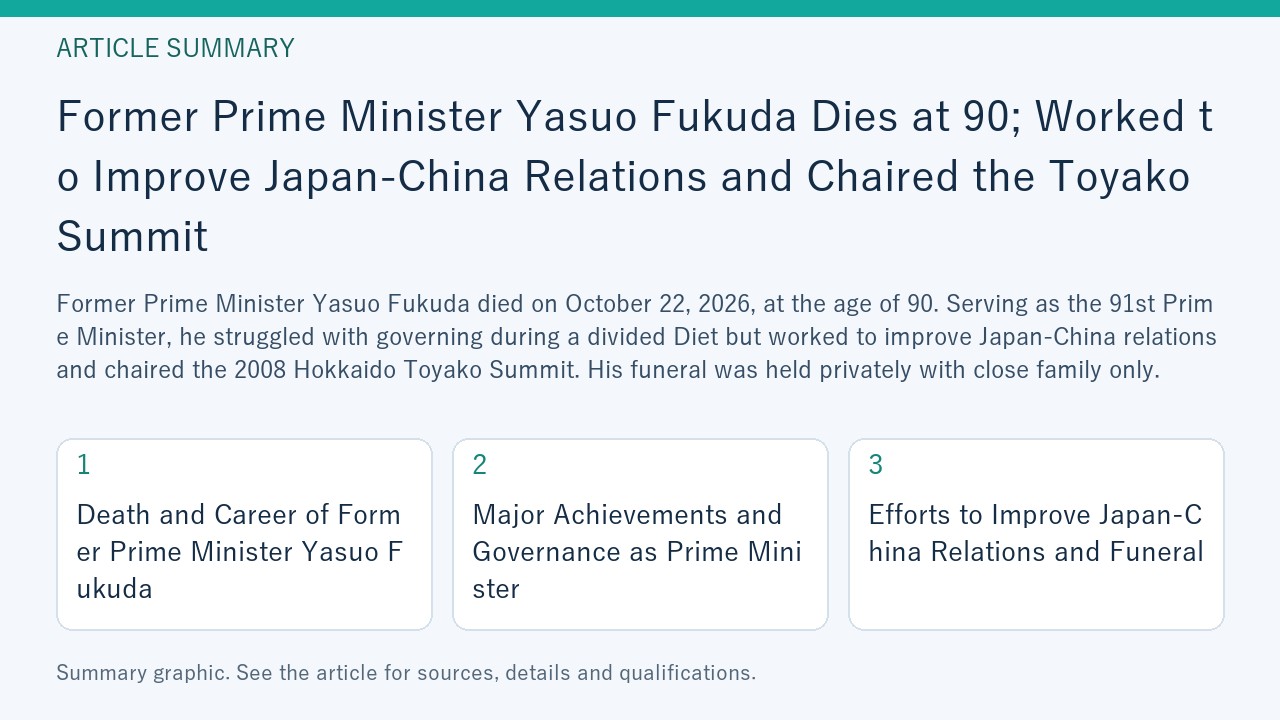
Former Prime Minister Yasuo Fukuda passed away on October 22, 2026, at a hospital in Tokyo at the age of 90. First elected in 1990 from the former Gunma 3rd district, he was re-elected seven consecutive times. In September 2007, he was elected president of the Liberal Democratic Party and became the 91st Prime Minister. Known as the first father-son duo to both serve as prime ministers, Fukuda had a long political career. During his tenure, he chaired the Hokkaido Toyako Summit, focusing on global warming measures, but struggled with a divided Diet where the opposition held a majority in the House of Councillors, leading to his resignation after about one year. [1] [2] [3]
Death and Career of Former Prime Minister Yasuo Fukuda
Former Prime Minister Yasuo Fukuda died on October 22, 2026, at a hospital in Tokyo at the age of 90. Born in 1936, he was first elected to the House of Representatives in 1990 from the former Gunma 3rd district and was re-elected seven consecutive times. In September 2007, he was elected president of the Liberal Democratic Party and became the 91st Prime Minister. He was the first in constitutional history to serve as prime minister following his father. After graduating from Waseda University, he worked at Maruzen Oil and then entered politics as a secretary to his father, former Prime Minister Takeo Fukuda. Although his political career started relatively late, he built a long tenure. [1] [2] [3]
Fukuda served as Chief Cabinet Secretary under the Mori and Koizumi administrations, holding the position for 1,289 days, which was the second longest at the time. As Chief Cabinet Secretary, he was the government's public face in press conferences and led diplomacy and security policies. In the 2007 Liberal Democratic Party leadership election, he defeated Taro Aso and became prime minister. His tenure lasted about one year. He retired from politics in 2012. His funeral was held privately with close family only, with his eldest son, Tatsuo Fukuda, serving as chief mourner. Tatsuo Fukuda inherited his father's political base and continues political activities. [1] [2] [3]
Major Achievements and Governance as Prime Minister
Yasuo Fukuda chaired the 2008 Hokkaido Toyako Summit, focusing on measures against global warming. The summit's leaders' declaration included a goal to halve global greenhouse gas emissions by 2050. For the first time, the declaration explicitly mentioned the abduction issue by North Korea. Domestically, he worked to establish the Consumer Affairs Agency and advanced legislation preparations for the Public Records Management Law. These policies were carried forward by subsequent administrations. Fukuda advocated "reforms from the citizens' perspective" and proposed converting road-specific funds into general funds. [1] [2] [3]
In governance, he struggled with a "divided Diet" where the opposition held a majority in the House of Councillors. In November 2007, he sought a grand coalition with Ichiro Ozawa, leader of the Democratic Party, but internal opposition within the Democratic Party prevented this. A no-confidence motion against the prime minister was passed in the House of Councillors, and cabinet approval ratings declined. On September 1, 2008, he announced his resignation and the cabinet resigned on September 24. His resignation press conference included the notable phrase "I am different from you." Although his administration was brief, he emphasized strengthening the Japan-US alliance and Asian diplomacy, promoting what he called "sympathetic diplomacy." [1] [2] [3]
Efforts to Improve Japan-China Relations and Funeral
After stepping down as prime minister, Yasuo Fukuda continued dialogue with China and worked to strengthen Japan-China relations. In 2014, he met with Chinese President Xi Jinping and made several visits to China. In 2008, he hosted Chinese President Hu Jintao as a state guest and issued a joint statement promoting a "strategic mutual benefit relationship" between Japan and China. The Chinese Ministry of Foreign Affairs expressed condolences upon his death, recognizing his active contributions to improving and developing Japan-China relations. Fukuda was regarded as having long prioritized Japan-China friendship and upheld a correct view of history. [1] [3] [4]
Fukuda's funeral was held privately with close family only, with his eldest son Tatsuo Fukuda serving as chief mourner. A public funeral is planned for a later date. Tatsuo Fukuda has inherited his father's political base and remains active within the Liberal Democratic Party. Fukuda's death was reported domestically and internationally, with Chinese state media covering his achievements. Japan-China relations remain strained, and attention is focused on who will succeed Fukuda's role in dialogue. How Fukuda's legacy will influence future Japanese diplomacy toward China remains a key issue. [1] [2] [4]
Sources and references
- [1] 福田康夫元首相が死去、90歳=洞爺湖サミットで議長 — www.nippon.com
- [2] 福田康夫元首相が死去、90歳 「あなたとは違うんです」の辞任会見、父・赳夫と親子2代の首相、退任後の日中外交まで歩みを振り返る — mediadogs.jp
- [3] 福田康夫元総理が死去 日中関係改善に尽力 退任会見で「あなたと違うんです」 森・小泉内閣で官房長官 初の親子2代総理|FNNプライムオンライン — www.fnn.jp
- [4] 中国外務省が福田元首相の死去に哀悼の意「日中関係の改善と発展に貢献」 日本の現政権には「深く反省すべき」|FNNプライムオンライン — www.fnn.jp
This English edition was translated and reviewed using AI against the Japanese original and cited sources. Source titles remain in their original language.
コメント