


English translation of the Japanese article.
Key points
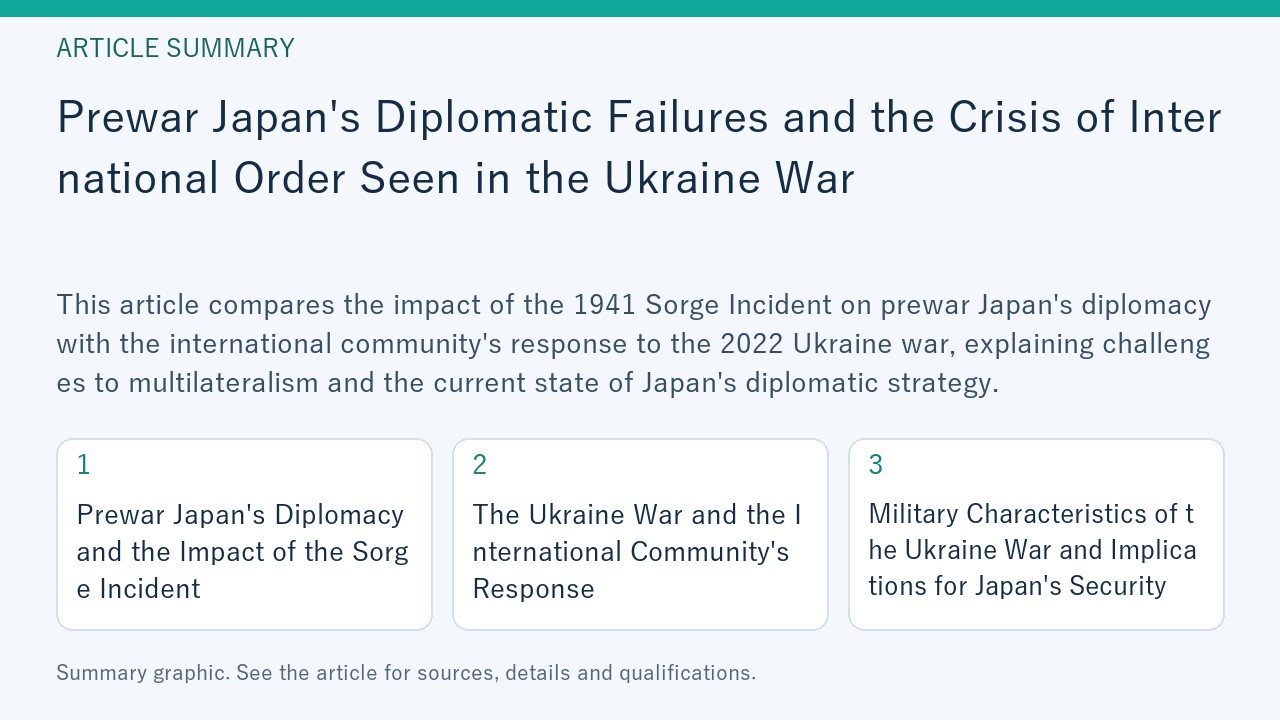
The 1941 Sorge Incident had a significant impact on prewar Japan's diplomacy and security, symbolizing the tense international situation just before the outbreak of the Pacific War. Meanwhile, the 2022 Ukraine war has tested multilateralism; the G7 and EU condemned Russia and imposed economic sanctions, but the UN Security Council became dysfunctional. This article explains the diplomatic and security challenges of the past and present in comparison. [1] [2] [3]
Prewar Japan's Diplomacy and the Impact of the Sorge Incident
The Sorge Incident, uncovered in October 1941, had a major impact on prewar Japan's diplomacy and security. This incident revealed Soviet espionage activities, particularly concerning information about Soviet military movements in Manchuria. At the time, Japan was negotiating with the United States to lift economic sanctions, and Soviet troop movements were critical information directly related to the course of a potential Japan-US war. The Sorge Incident symbolized the tense international situation immediately before the outbreak of the Pacific War. Japan's diplomacy through this incident is considered to have accelerated the path toward war. [1]
The background of the Sorge Incident includes the 1939 Nomonhan Incident, a clash between Japan and the Soviet Union. Military information in Manchuria was Japan's highest-level secret, and for European powers such as Nazi Germany and Britain, Soviet military movements were a significant concern influencing the war situation. Within this complex international context, Japan's diplomacy repeatedly made decisions based on hopeful assumptions, ultimately leading toward a disastrous war. The diplomatic environment at that time was characterized by tensions very different from the postwar international order. [1]
The Ukraine War and the International Community's Response
The Ukraine war, which began in 2022, has posed a severe test to multilateralism. Russia's unilateral invasion of Ukraine violated international law, and the G7, EU, and NATO united to condemn Russia and impose strict economic sanctions. However, the UN Security Council became dysfunctional due to Russia's veto power, and the condemnation resolution adopted at the UN General Assembly's emergency special session lacked binding force. These circumstances have exposed the limitations of multilateralism. Furthermore, countries such as China, India, and South Africa within the G20 abstained or opposed measures, highlighting divisions within the international community. [2]
At the G7 Hiroshima Summit in May 2026, Ukrainian President Volodymyr Zelensky visited Japan, where discussions focused on support for Ukraine and engaging Global South countries. Japan sought to draw Global South nations, which maintain a non-aligned neutral stance, toward the Western bloc to counter China and Russia. However, diplomatic efforts faced difficulties due to the skillful diplomacy of Indian Prime Minister Narendra Modi. Differences in attitudes toward China were evident between European countries and Japan, and divisions over China-related issues were apparent even within the G7. [4] [2]
Military Characteristics of the Ukraine War and Implications for Japan's Security
The Ukraine war is characterized by the Russian military's difficulties and Western countries' military support. In February 2022, President Vladimir Putin declared the independence of two eastern Ukrainian regions and launched a full-scale invasion. However, strong resistance by Ukrainian forces has forced the Russian military into a difficult position. The West has supplied advanced weapons such as anti-tank and anti-air missiles, and volunteers have participated, which have been major factors in Russia's military struggles. This conventional war under nuclear deterrence offers important lessons for Japan's security policy. [3]
Additionally, the Ukraine war, as a large-scale conventional conflict under the presence of nuclear weapons, has highlighted both the realities and limitations of nuclear deterrence. Japan, which faces major powers as neighbors and has security challenges such as the Senkaku Islands and the Taiwan Strait, is required to strengthen its national defense based on lessons from the Ukraine war. Deepening the Japan-US alliance, enhancing defense capabilities, and considering nuclear sharing are important issues. These developments are expected to be reflected in revisions to the National Security Strategy and Defense Guidelines scheduled for 2026. [3]
Sources and references
- [1] 戦前日本を戦争に向けさせ破滅に導いた「希望的観測の外交」、ウクライナ戦争で繰り返される歴史の危険な構図 — toyokeizai.net
- [2] ウクライナ戦争後の世界における多国間主義の役割 | 公益財団法人日本国際フォーラム — www.jfir.or.jp
- [3] ロシアのウクライナ侵攻と世界秩序への衝撃 ―露の大国退位と米中2極の対立 | 公益財団法人日本国際フォーラム — www.jfir.or.jp
- [4] 1.グローバル・プレイヤーとしての日本外交の模索 | 公益財団法人日本国際フォーラム — www.jfir.or.jp
This English edition was translated and reviewed using AI against the Japanese original and cited sources. Source titles remain in their original language.

コメント