







English translation of the Japanese article.
Key points
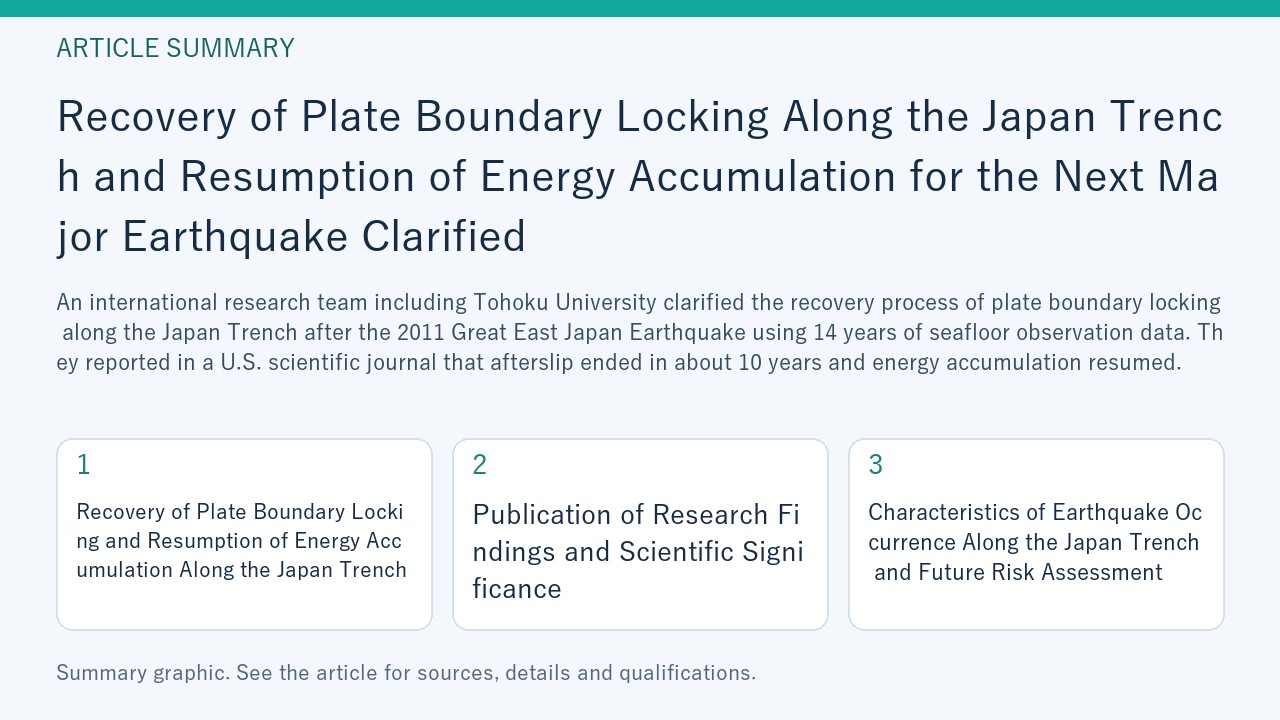
An international collaborative research team from the International Research Institute of Disaster Science at Tohoku University and others revealed that the plate boundary along the Japan Trench, which had loosened after the 2011 Great East Japan Earthquake, recovered its locking over approximately 10 years, and energy accumulation toward the next major earthquake has resumed. This finding was published on November 5, 2026, in the U.S. scientific journal Science, based on analysis of crustal deformation data observed over 14 years at 26 seafloor sites. Continuous observation going forward is considered important. [1] [2] [3]
Recovery of Plate Boundary Locking and Resumption of Energy Accumulation Along the Japan Trench
An international collaborative research team centered at the International Research Institute of Disaster Science, Tohoku University, conducted a detailed analysis of the behavior of the plate boundary along the Japan Trench following the 2011 Tohoku-oki earthquake (M9.0). They used 14 years of seafloor crustal deformation observation data obtained by the GNSS-Acoustic (GNSS-A) method at 26 sites, along with land-based observation data. This analysis revealed that the afterslip, which continued after the earthquake, had mostly ceased after about 10 years, and that the plate boundary locking had recovered to the state prior to the earthquake. [1] [3]
Afterslip refers to the phenomenon where the region surrounding the rupture area continues to slip slowly after a major earthquake, releasing strain accumulated before the earthquake. Locking, in contrast, refers to a state where the plates are strongly adhered by friction, accumulating strain. The observations confirmed the cessation of afterslip and the recovery of locking, indicating that energy accumulation toward the next earthquake has resumed at the plate boundary. Continued seafloor crustal deformation observation is necessary going forward. [1] [3]
Publication of Research Findings and Scientific Significance
The research team from Tohoku University, the Japan Agency for Marine-Earth Science and Technology (JAMSTEC), and the Earthquake Research Institute at the University of Tokyo published their findings in the U.S. scientific journal Science on November 5, 2026. Their work scientifically demonstrated that the plate boundary along the Japan Trench has relocked and begun accumulating energy that could trigger the next major earthquake. The research was conducted through international collaboration based on long-term seafloor observation data spanning 14 years. [2]
This research holds important scientific significance by providing long-term observations of plate boundary behavior after the Great East Japan Earthquake, deepening understanding of earthquake generation mechanisms. In particular, by demonstrating the recovery of plate boundary locking and resumption of energy accumulation, it offers new insights for risk assessment of the next major earthquake. Continuous observation and analysis remain essential for disaster prevention measures. [2]
Characteristics of Earthquake Occurrence Along the Japan Trench and Future Risk Assessment
Along the Japan Trench, it is understood that mega-earthquakes occur at intervals of approximately 500 to 900 years, but the plate boundary relocks soon after an earthquake and begins accumulating energy again. This study is the first to detail this relocking process using observational data. According to the long-term evaluation by the Headquarters for Earthquake Research Promotion, the probability of an M9-class mega-earthquake of the Tohoku-oki type occurring within the next 30 years is nearly 0%, but large earthquakes of magnitude 7 to 8 are predicted with a high probability of over 70 to 90% off the coasts of Miyagi and Fukushima prefectures. [2] [3]
The research team’s numerical simulations suggest that due to the viscoelastic properties of Earth's interior, the plate boundary efficiently accumulates energy early after an earthquake. They also note that the possibility of a major earthquake recurrence interval shorter than past cycles cannot be ruled out. Continuing high-precision seafloor crustal deformation observations to monitor changes in plate boundary locking is indispensable for disaster prevention strategies. [1] [3]
Sources and references
- [1] 2011年東北地方太平洋沖地震後の プレート間固着の回復過程を解明 ―プレート境界におけるエネルギー蓄積の再開を示唆― — www.tohoku.ac.jp
- [2] 次の大地震へエネルギー再蓄積=日本海溝沿い、プレート境界固着―東北大など | 防災・危機管理ニュース | リスク対策.com | 新建新聞社 — www.risktaisaku.com
- [3] 東日本大震災の震源域で固着が回復、次の地震へひずみ蓄積再開 東北大などが海底観測 — jpjj.jp
This English edition was translated and reviewed using AI against the Japanese original and cited sources. Source titles remain in their original language.

コメント