



English translation of the Japanese article.
- Key points
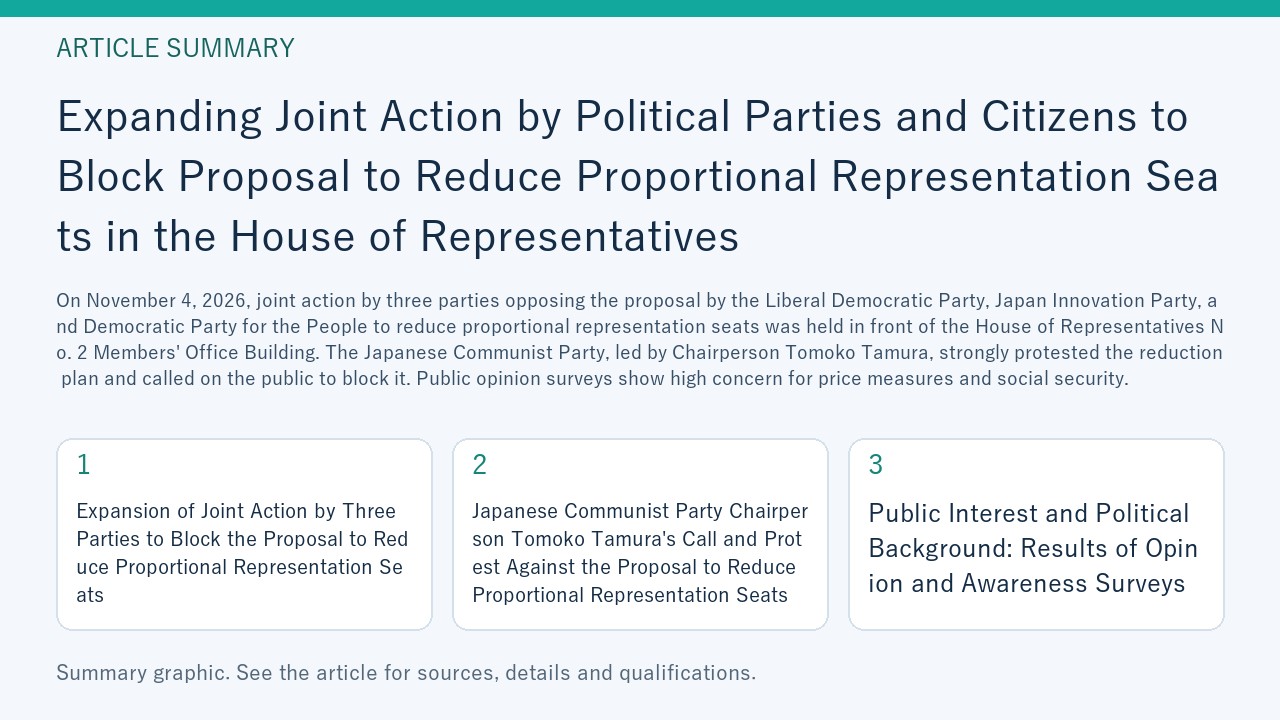
- Expansion of Joint Action by Three Parties to Block the Proposal to Reduce Proportional Representation Seats
- Japanese Communist Party Chairperson Tomoko Tamura's Call and Protest Against the Proposal to Reduce Proportional Representation Seats
- Public Interest and Political Background: Results of Opinion and Awareness Surveys
- Sources and references
Key points
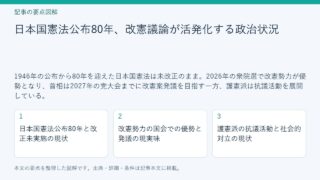
On November 4, 2026, a regular joint parliamentary action was held in front of the House of Representatives No. 2 Members' Office Building by the Liberal Democratic Party, Japan Innovation Party, and Democratic Party for the People, aiming to block their agreed proposal to reduce the number of proportional representation seats in the House of Representatives by 31. The Japanese Communist Party and multiple civic groups also participated, appealing for the preservation of democracy and protection of citizens' livelihoods. The proposal to reduce proportional seats is criticized for making it harder for citizens' voices to reach the Diet and undermining the foundation of democracy, with opposition voices spreading. According to a Cabinet Office public opinion survey, measures against rising prices ranked first for the fourth consecutive year at 72.5%, and social security development also showed high interest at 61.9%. [1] [2] [4]
Expansion of Joint Action by Three Parties to Block the Proposal to Reduce Proportional Representation Seats
On November 4, 2026, a regular joint parliamentary action was held in front of the House of Representatives No. 2 Members' Office Building. This action opposed the proposal agreed upon by the Liberal Democratic Party, Japan Innovation Party, and Democratic Party for the People to reduce the number of proportional representation seats in the House of Representatives by 31, aiming to block it while appealing for the protection of democracy and citizens' livelihoods. The event was organized by multiple groups including the National Movement Executive Committee, with participation from the Japanese Communist Party and civic organizations. Representatives from the National Federation of Farmers' Movements, the Saitama Prefecture branch of the New Japan Women's Association led by Chairperson Mieko Takada, and the vice-chairperson of the Tokyo Construction General Union spoke, demanding measures against rising prices and enhancement of social security, reflecting the expansion of joint movements. [1]
In Nagano City, an emergency publicity event was held at the call of the "Prefectural Citizens' Dialogue to Open the Future of Japan and Shinshu," where citizens opposing the reduction of proportional seats criticized the disregard of public opinion. In Utsunomiya City, prefectural and city assembly members of the Japanese Communist Party gave street speeches, expressing concerns that reducing proportional seats would make it harder for diverse public opinions to be reflected in the Diet and could accelerate authoritarian politics. These movements are spreading nationwide and are attracting attention as political efforts to maintain democracy and improve citizens' lives. [1]
Japanese Communist Party Chairperson Tomoko Tamura's Call and Protest Against the Proposal to Reduce Proportional Representation Seats
Japanese Communist Party Chairperson Tomoko Tamura held press conferences inside the Diet on October 28 and 30, 2026, firmly protesting the proposal to reduce proportional representation seats by 31. Tamura pointed out that reducing the number of Diet members would make it harder for citizens' voices to reach the Diet and weaken the Diet's administrative oversight function. She criticized the three-party agreement as a major deterioration that shrinks the function of proportional representation and strengthens the focus on single-member districts, aiming to increase the ruling parties' seat share. [2] [3]
Chairperson Tamura also criticized the introduction of the modified Sainte-Laguë method accompanying the reduction proposal as obstructing smaller parties from gaining seats, subordinating proportional representation elections to the single-member district system. She argued that the current number of House of Representatives members is historically and internationally low, and that an increase in seats is actually necessary. Furthermore, she stated that the current reduction proposal was brought forward by the Innovation Party aiming to join the coalition government and to divert attention from the Liberal Democratic Party's problems, condemning it as a reckless move toward authoritarian politics. The Japanese Communist Party is calling for nationwide cooperation and expanding efforts to block the proposal both inside and outside the Diet. [2] [3]
Public Interest and Political Background: Results of Opinion and Awareness Surveys
According to a public opinion survey released by the Cabinet Office on October 30, 2026, "measures against rising prices" ranked first for the fourth consecutive year at 72.5% as the issue the government should prioritize. This was followed by "development of social security such as medical care and pensions" at 61.9%, and "economic measures" at 57.0%. The results indicate that concern about rising prices and social security remains high. The survey was conducted by mail targeting 5,000 people aged 18 and over nationwide, with a response rate of 54.4%. [4]
Additionally, a survey published by the NIRA Comprehensive Research and Development Organization on June 30, 2026, showed that political efficacy and political interest have increased compared to the 2024 survey. The proportion of people who desire government economic involvement reached 49%, suggesting heightened political interest. These survey results reflect the public's concerns and expectations underlying the political movement to block the proposal to reduce proportional representation seats. The survey was conducted from February 27 to March 15, 2026, with 2,134 valid responses. [5]
Sources and references
- [1] 比例削減阻止へ共同広がる/国民生活守る政治に | しんぶん赤旗|日本共産党 — www.jcp.or.jp
- [2] 比例定数削減の阻止へ共産党、国民にアピール/田村委員長が発表 | しんぶん赤旗|日本共産党 — www.jcp.or.jp
- [3] 国民的たたかい広げ阻止/定数削減 断固として抗議/田村委員長が会見 | しんぶん赤旗|日本共産党 — jqak8jnh-7nzd.jcp.or.jp
- [4] 政府への要望、物価対策が72.5%で4年連続首位 防災は31.1%から37.5%へ 内閣府世論調査 — jpjj.jp
- [5] 第4回政治・経済・社会に関する意識調査(NIRA基本調査):国内調査(速報)|NIRA総合研究開発機構 — www.nira.or.jp
This English edition was translated and reviewed using AI against the Japanese original and cited sources. Source titles remain in their original language.
コメント