








English translation of the Japanese article.
Key points
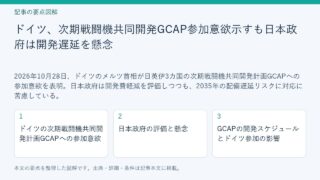
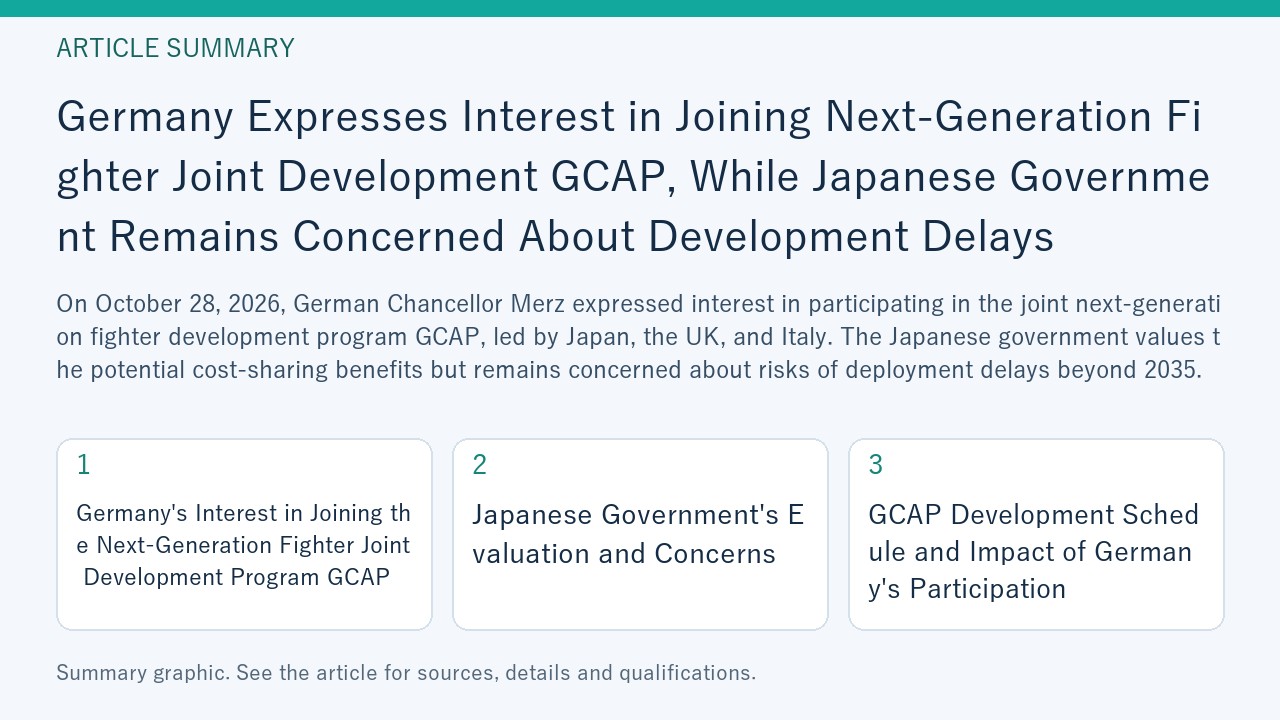
On October 28, 2026, Japanese Prime Minister Sanae Takaichi and German Chancellor Merz met at the Prime Minister's Office, where Chancellor Merz expressed Germany's interest in joining the Global Combat Air Program (GCAP), a joint next-generation fighter development initiative led by Japan, the United Kingdom, and Italy. While the Japanese government appreciates Germany's technological capabilities and the potential reduction in development costs, it remains cautious due to concerns over possible delays in deploying the first aircraft by 2035. Future negotiations will be closely watched.
Sources: Newsweek Japan Edition, Jiji Press, ryoron.com [1] [3]
Germany's Interest in Joining the Next-Generation Fighter Joint Development Program GCAP
On October 28, 2026, Japanese Prime Minister Sanae Takaichi and German Chancellor Merz met at the Prime Minister's Office, where Chancellor Merz clearly expressed Germany's interest in joining the Global Combat Air Program (GCAP), a joint next-generation fighter development project currently pursued by Japan, the United Kingdom, and Italy. Chancellor Merz stated, "We would like to consider whether joint development is possible." This move follows the collapse of Germany's previous joint development plan with France and Spain, positioning GCAP as a new option for Germany. [1] [3]
Additionally, on October 8, 2026, UK Prime Minister Rishi Sunak met with Chancellor Merz, revealing Germany's positive stance toward joining GCAP. The UK anticipates that Germany's participation will help reduce development costs and has expressed intentions to promote the program in cooperation with Italy and Japan. This development increases the likelihood of GCAP expanding into a four-nation framework.
Sources: nihonnews.jp.net, news.mixi.jp, newsweekjapan.jp [4] [1]
Japanese Government's Evaluation and Concerns
The Japanese government values the potential reduction in development cost-sharing and the utilization of Germany's technological capabilities through its participation in GCAP. A senior official from the Ministry of Defense noted, "Leveraging Germany's technological capabilities is significant," emphasizing the financial benefits. However, the government remains cautious due to the risk of delays associated with Germany's involvement. The deployment of the first aircraft by 2035 is a top priority, and any delay is considered unacceptable. [3] [1]
Specifically, if Germany joins the existing development framework established by Japan, the UK, and Italy, renegotiations regarding aircraft design and development workload distribution will be necessary. This could pose a serious risk of delaying the overall schedule. The Japanese government is placing great importance on this risk and has refrained from making an official announcement regarding whether it will accept Germany's participation.
Sources: www.sbbit.jp, news.mixi.jp, newsweekjapan.jp [5] [3] [1]
GCAP Development Schedule and Impact of Germany's Participation
Japan, the United Kingdom, and Italy are advancing GCAP with the goal of deploying a successor to the Japan Air Self-Defense Force's F-2 fighter starting in 2035. GCAP is a development program for a sixth-generation fighter featuring advanced stealth and networked combat capabilities, symbolizing international defense cooperation. [2] [3] [1] [4] [5]
While Germany's participation offers the advantage of reducing development costs, it also requires reallocation of work assignments, raising concerns about delays in the planned 2035 deployment. Japanese government officials have indicated that Germany's involvement could delay the program by up to ten years, raising concerns about a capability gap following the retirement of the F-2. Negotiations among Japan, the UK, Italy, and Germany are expected to continue.
Sources: news.mixi.jp, ryoron.com, newsweekjapan.jp [3] [2] [1]
Sources and references
- [1] 日独首脳が会談、戦闘機の共同開発参加にメルツ氏意欲 高市氏はEV問題に強い懸念伝える | ニューズウィーク日本版 オフィシャルサイト — www.newsweekjapan.jp
- [2] 次期戦闘機の日英伊共同開発にドイツが参加? 費用分担の利点か、2035年配備に遅れの不安か | 両論ニュース — ryoron.com
- [3] 次期戦闘機、ドイツの参加意欲に苦慮=日本政府、開発遅れ懸念 (時事通信社 – 10月29日 21:01) — news.mixi.jp
- [4] バーナム英首相、ドイツの次期戦闘機GCAP参加に前向きな姿勢 — nihonnews.jp.net
- [5] 日独首脳会談においてAIハイレベル対話創設と次期戦闘機開発への独参加検討 — www.sbbit.jp
This English edition was translated and reviewed using AI against the Japanese original and cited sources. Source titles remain in their original language.

コメント