




English translation of the Japanese article.
Key points
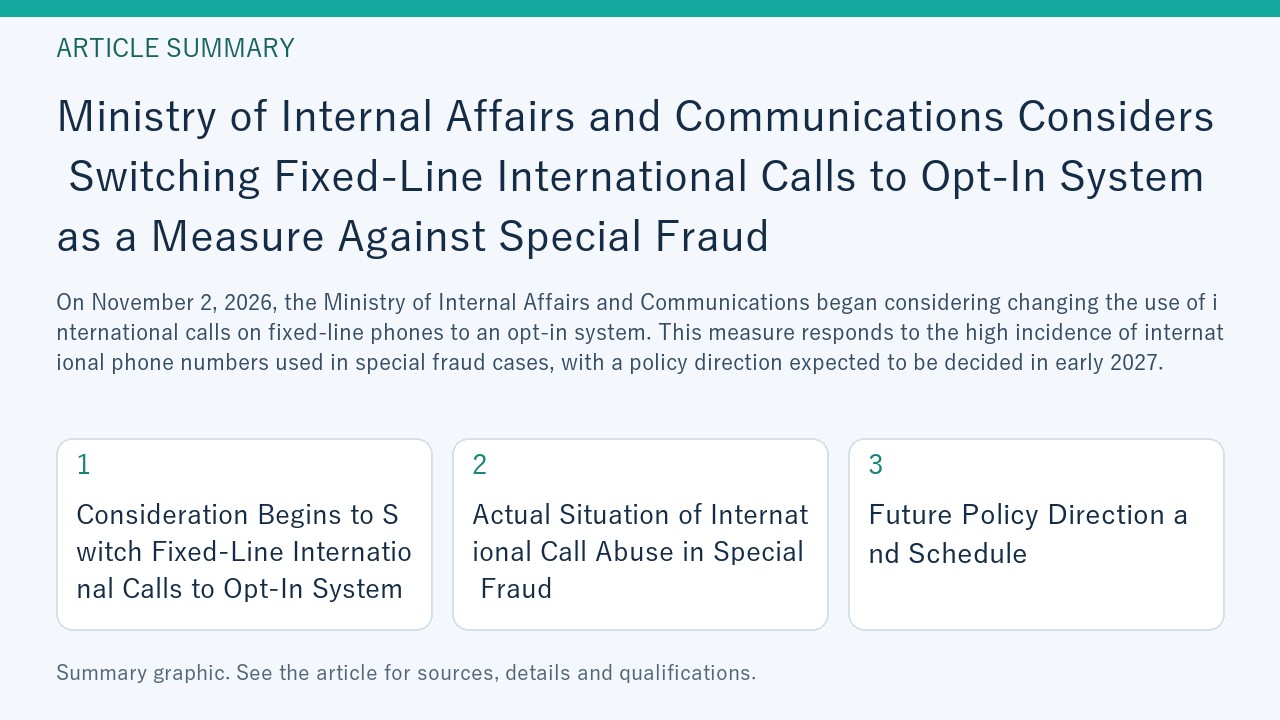
On November 2, 2026, the Ministry of Internal Affairs and Communications established a working group composed of experts to examine switching the use of international calls on fixed-line phones to an opt-in system. This measure addresses the persistent problem of special fraud using international calls. Currently, fixed-line phone contracts automatically include international call capability under a "deemed contract," but the proposal under discussion is to suspend this automatic inclusion and make international call service an optional contract for those who need it. According to a report by the National Police Agency, 70% of phone numbers used in special fraud cases are international numbers, and 70% of victims use fixed-line phones. The working group plans to compile an interim report in early 2027 and decide on the policy direction soon thereafter. [1] [2] [3]
Consideration Begins to Switch Fixed-Line International Calls to Opt-In System
On November 2, 2026, the Ministry of Internal Affairs and Communications established the "Working Group on Measures Against Improper Use," composed of experts, and began considering switching the use of international calls on fixed-line phones to an opt-in system. Currently, fixed-line phone contracts automatically include international call capability under a "deemed contract," but the proposal under discussion is to suspend this automatic inclusion and make international call service an optional contract for those who need it. This aims to create a system where only users who wish to use international calls can access the service. The policy direction is expected to be decided in early 2027. [1] [3]
This consideration is prompted by the increase in special fraud cases exploiting international calls. Under the current system, international calls are automatically included in fixed-line contracts, meaning even users who do not use international calls have access, creating a breeding ground for fraud. The Ministry is reviewing contract terms and legal regulations to seek effective measures that protect users' interests. It is gathering opinions from telecommunications providers, industry groups, and experts while advancing concrete system design. Multiple proposals are being considered, including a system that suspends international calls unless requested by the user. [1] [3]
Actual Situation of International Call Abuse in Special Fraud
According to a report by the National Police Agency, 70% of phone numbers used in special fraud cases are international numbers, and 70% of victims use fixed-line phones. In 2025, the amount lost to special fraud exceeded approximately 320 billion yen, with over 70% of telephone-based fraud involving international phone numbers. The fraud operations are based overseas, with an increase in tactics such as impersonating police officers. Abuse of international calls via fixed-line phones is a major factor in the scale of damage. Many victims are elderly and tend to receive fraudulent calls through fixed-line phones. [1] [2]
Special fraud involves deceiving victims without face-to-face contact to obtain cash or valuables, with fixed-line phones frequently used as a contact method outside of social media. While outgoing international calls are decreasing, incoming international calls are rapidly increasing, with many fraud calls originating from international numbers. The National Police Agency points out the limits of relying solely on arrests and emphasizes the need for comprehensive measures. Although requests to suspend international calls are increasing, they remain a minority compared to the total number of fixed-line contracts. [1] [2]
Future Policy Direction and Schedule
The working group is considering multiple proposals, including making international calls optional in contract terms and suspending international calls unless requested by the user. The main proposal is to abolish the current "deemed contract" that automatically enables international calls with fixed-line contracts and change to a system where users contract individually as needed. This aims to suppress improper use of international calls and reduce special fraud damage. The Ministry is consulting telecommunications providers, industry groups, and experts, planning to compile an interim report in early 2027 and decide on the policy direction soon thereafter. [1] [3]
Regarding methods to promote suspension of international calls, multiple models are under consideration, such as suspending international calls without a request or suspending only upon request. These models will be selected considering the balance between user convenience and safety. For mobile phones, measures focus on device-level solutions, including promoting and enhancing fraud prevention apps. Future discussions will also address legal consistency and methods to inform users. Discussions are expected to continue until around summer 2027. [1] [3]
Sources and references
- [1] 固定電話の国際電話、「申し出なければ休止」も検討 詐欺電話の7割が国際番号 総務省WG — jpjj.jp
- [2] 国際電話、加入希望制へ 総務省、特殊詐欺抑止で検討 — www.kobe-np.co.jp
- [3] 国際電話の「みなし契約」の休止 WG設置設置し検討へ 総務省 — home.kingsoft.jp
This English edition was translated and reviewed using AI against the Japanese original and cited sources. Source titles remain in their original language.

コメント