



English translation of the Japanese article.
Key points
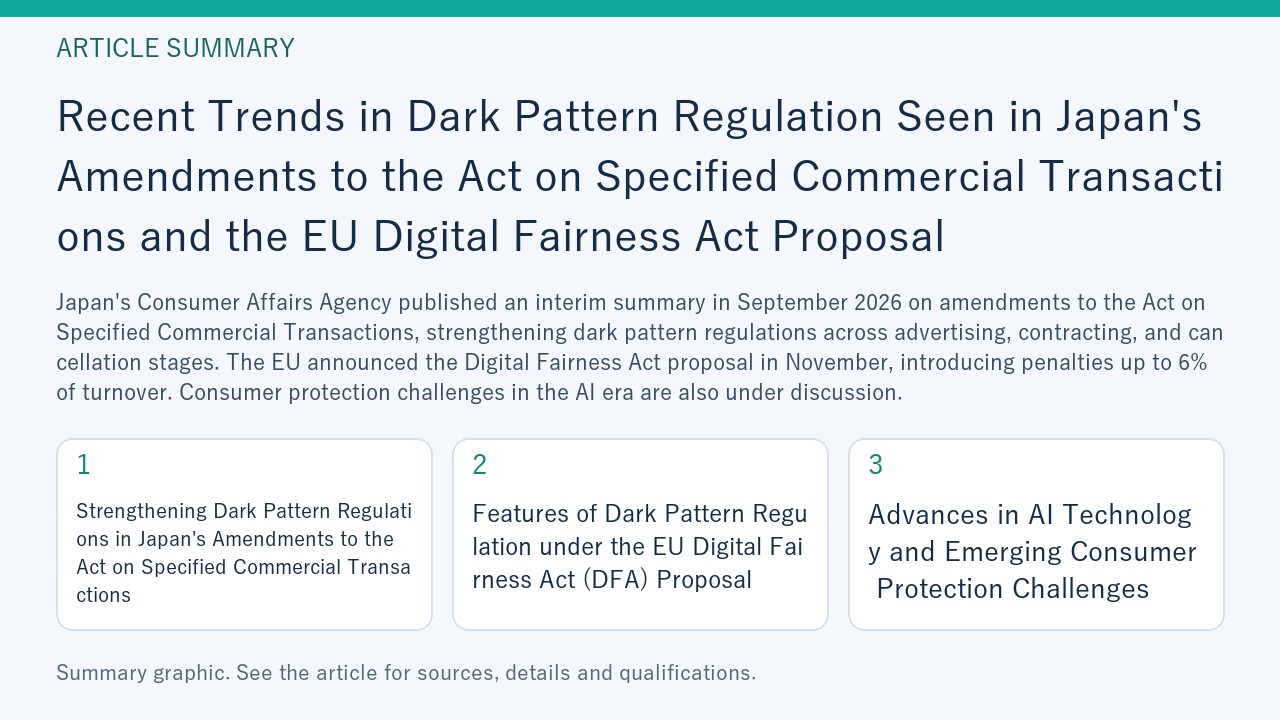
On September 10, 2026, Japan's Consumer Affairs Agency published an interim summary toward amending the Act on Specified Commercial Transactions, indicating plans to strengthen regulations on dark patterns in websites and apps across three stages: advertising, contracting, and cancellation. Meanwhile, on November 11, the European Union (EU) announced the Digital Fairness Act (DFA) proposal, including prohibitions on dark patterns and a penalty system for violating companies. These developments are part of international efforts to enhance regulations preventing consumer misunderstanding and disadvantage, with emerging challenges related to advances in AI technology also coming to light. [1] [2] [3]
Strengthening Dark Pattern Regulations in Japan's Amendments to the Act on Specified Commercial Transactions
The interim summary published by the Consumer Affairs Agency on September 10, 2026, outlined strengthened regulations covering three stages involving dark patterns: advertising, contracting, and cancellation. Specifically, it includes correcting exaggerated advertising, tightening rules on solicitations via social media chats, streamlining cancellation procedures, and establishing new administrative penalties. These measures aim to prevent consumer misunderstanding and disadvantage, promoting transparency in advertising displays and clarity in contracting procedures. Particular emphasis is placed on compliance with display obligations on final confirmation screens and eliminating disparities in effort between application and cancellation processes. [1]
The interim summary serves as the framework for the bill, with plans to submit the amendment proposal to the ordinary Diet session in 2027. Specific prohibited display contents will be detailed in subordinate legislation and guidelines, enabling a flexible regulatory system that can be implemented even before the law is amended. The tightening of rules on solicitations via social media chats responds to a sharp increase in consultations since 2024, requiring prior disclosure of solicitation purposes and application of cooling-off rights. Regarding cancellation procedures, acts that unjustifiably delay or excessively complicate cancellations are expected to become subject to administrative penalties. [1]
Features of Dark Pattern Regulation under the EU Digital Fairness Act (DFA) Proposal
The Digital Fairness Act (DFA) proposal announced by the European Commission on November 11, 2026, regulates both online and offline transaction methods and identifies 42 types of dark patterns as falling under existing unfair commercial practice frameworks. The proposal explicitly prohibits dark patterns and includes sanctions imposing fines up to 6% of annual turnover on violating companies. This strengthens consumer protection within the EU and grants the European Commission direct enforcement authority over cross-border violations. [2] [4]
Under the DFA proposal, dependent designs targeting adults require providers to offer tools allowing consumers to disable such features, while gambling-like functions aimed at minors are prohibited. Representative dark patterns include designs that rush users, bias choices, or make cancellations difficult, categorized into ten types. These regulations aim to create an environment where users can make fair and autonomous decisions. The EU's regulatory strengthening also seeks to protect children, the elderly, and digitally inexperienced individuals as online services become more integrated into daily life. [3] [4]
Advances in AI Technology and Emerging Consumer Protection Challenges
At a Consumer Commission expert panel meeting held on November 5, 2026, changes in consumer issues associated with the spread of AI technology were discussed. The advent of an "AI versus AI" era, where AI agents compare products and conclude contracts on behalf of consumers, may reduce traditional information asymmetries and negotiation power disparities. However, AI supporting consumers may not always prioritize consumer interests, raising new challenges regarding conflicts of interest, legal liability, and regulatory approaches for AI providers. [5]
Professor Akira Etsu emphasized the need for mechanisms to verify AI decision-making processes and conflicts of interest, highlighting the importance of "polycentric distributed governance" involving cooperation between government and private sectors to establish rules and ensure effectiveness. Consumer protection laws in the AI era require responses beyond traditional frameworks, with future legal developments and voluntary corporate initiatives attracting attention. These discussions represent important themes to be advanced alongside strengthening dark pattern regulations. [5]
Sources and references
- [1] 特商法改正2026の中間取りまとめを解説|EC事業者が備えるべき3段階 – アイソル株式会社 — aisol-inc.jp
- [2] EU、ダークパターン禁止など新法案 最大6%の制裁金も — www.watch.impress.co.jp
- [3] その画面設計は大丈夫? EUのDFA案に学ぶダークパターン10類型 — wnkhs.net
- [4] 欧州デジタル公正法(DFA)案 / ダークパターン禁止と依存的設計の規律 / 消費者法の執行欧州デジタル公正法(DFA)案|柳平大樹 | AIと法研究者 | 東京大学法学修士 | JAIST(国立先端科学技術大) — note.com
- [5] 「AI対AI」時代の消費者保護を議論。AIの利益相反や事業者責任が課題に。AI技術の利用と消費者問題専門調査会 | WEB版 日本消費経済新聞 — nc-news.jp
This English edition was translated and reviewed using AI against the Japanese original and cited sources. Source titles remain in their original language.


コメント