





English translation of the Japanese article.
Key points
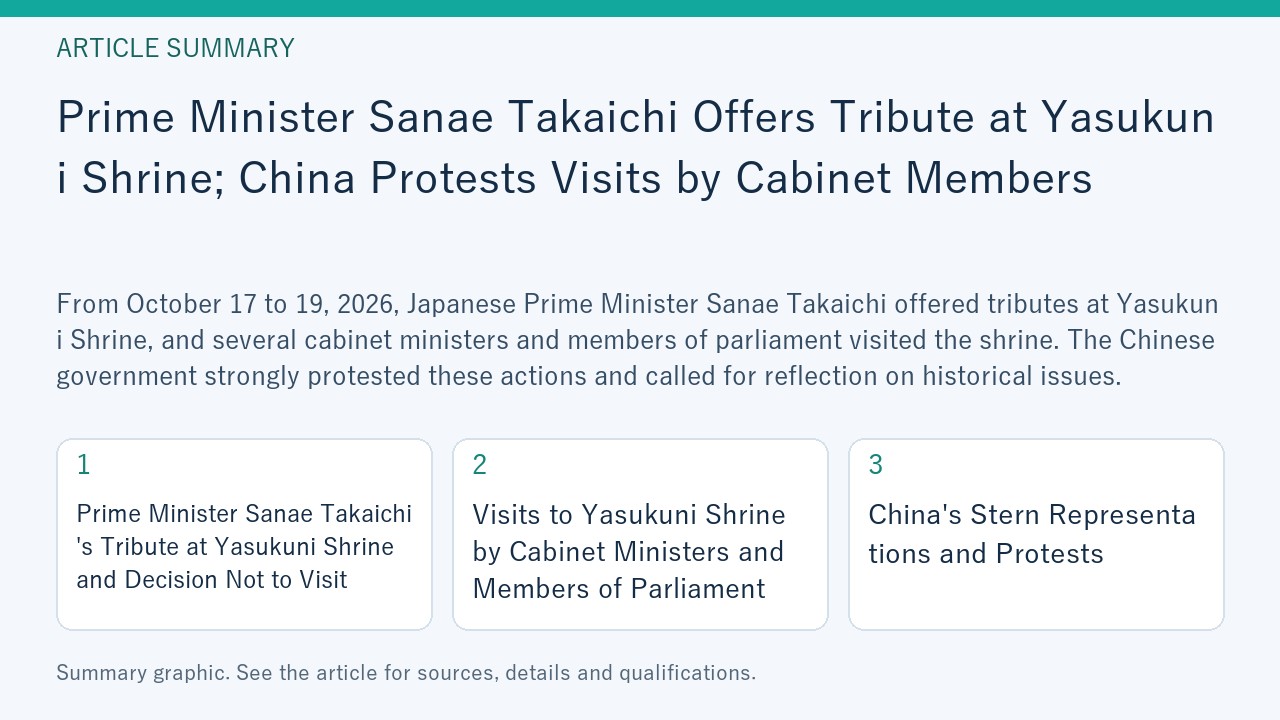
Between October 17 and 19, 2026, Japanese Prime Minister Sanae Takaichi offered a sacred sakaki branch at Yasukuni Shrine's autumn festival and privately donated a tamagushi offering on October 19. However, the prime minister herself refrained from visiting the shrine directly. In addition, multiple cabinet ministers and members of parliament visited Yasukuni Shrine. The Chinese government issued stern representations and strong protests against these actions, demanding reflection on historical issues. Prime Minister Takaichi's tribute and the visits by cabinet members have introduced new tensions into Japan-China relations. [1] [2]
Prime Minister Sanae Takaichi's Tribute at Yasukuni Shrine and Decision Not to Visit
On October 17, 2026, Prime Minister Sanae Takaichi offered a sacred sakaki branch at Yasukuni Shrine in conjunction with the shrine's autumn festival. Furthermore, on October 19, as president of the Liberal Democratic Party, she privately donated a tamagushi offering. However, she refrained from visiting the shrine directly during the autumn festival period. Thus, while the prime minister engaged with Yasukuni Shrine through offerings, she abstained from visiting. The tamagushi offering was presented by Hiroshi Kajiyama, the LDP's Secretary-General, acting as the prime minister's proxy. These actions reflect the prime minister's stance toward involvement with Yasukuni Shrine. [1]
This tribute can be seen as the prime minister expressing a certain respect toward Yasukuni Shrine while avoiding direct visits, reflecting political considerations domestically and internationally. The offering of the sacred sakaki branch is part of the traditional rituals of the autumn festival, and the tamagushi offering is also a form of tribute to the shrine. Such acts often carry political messages, indicating the prime minister's cautious approach. Notably, the prime minister's decision not to visit is significant compared to past precedents. The Chinese government's response has been influenced by this decision. [1]
Visits to Yasukuni Shrine by Cabinet Ministers and Members of Parliament
On October 19, 2026, Minister of Land, Infrastructure, Transport and Tourism Tatsunori Ibari and Minister of the Environment Hiroyoshi Sasagawa visited Yasukuni Shrine. Additionally, Minister in charge of Economic Revitalization Minoru Kono visited on October 17, bringing the total number of cabinet ministers visiting under the Takaichi Cabinet to three. Moreover, approximately 70 members of parliament from multiple parties visited the shrine, including LDP Secretary-General Hiroshi Kajiyama, LDP Election Strategy Committee Chairman Yasutoshi Nishimura, and Naoki Hyakuta, leader of the Japan Conservative Party. These visits indicate multiple engagements with Yasukuni Shrine by cabinet members and parliamentarians. The visits carry political significance and have attracted attention domestically and internationally. [1]
The group of parliamentarians visiting the shrine was bipartisan, including members from the Liberal Democratic Party, Japan Innovation Party, Democratic Party for the People, and the Sanseitō party, totaling about 70 participants. This broad political participation demonstrates that the Yasukuni Shrine issue is a concern transcending party lines. The visits by cabinet members and parliamentarians reflect domestic political trends and have become a source of diplomatic friction with neighboring countries. Together with Prime Minister Takaichi's tribute, these actions affect Japan-China relations. [1]
China's Stern Representations and Protests
At a press conference on October 19, 2026, Mao Ning, spokesperson for the Chinese Ministry of Foreign Affairs, stated that China had made stern representations and lodged strong protests with Japan regarding Prime Minister Sanae Takaichi's tamagushi offering and cabinet ministers' visits to Yasukuni Shrine. China criticized Japanese leaders and politicians for visiting Yasukuni Shrine despite knowing that Class-A war criminals from the International Military Tribunal for the Far East (Tokyo Trials) are enshrined there. China accused them of revealing malicious intent to pave the way for remilitarization. Furthermore, China reiterated its demand that Japan face history squarely and reflect on its wartime crimes. [2]
On the same day, the Chinese Ministry of Foreign Affairs issued a statement strongly condemning Japan's actions related to Yasukuni Shrine and calling for reflection on historical issues. Marking the 80th anniversary of the Tokyo Trials this year, China has been closely monitoring Japan's actions, demanding that Japan confront history honestly, reflect on wartime responsibilities, and halt any moves that regress on historical issues. These protests contribute to heightened tensions in Japan-China relations. China's strong opposition underscores that the Yasukuni Shrine issue remains a diplomatic challenge between the two countries. [3]
Sources and references
- [1] 高市首相、靖国参拝見送り=真榊・玉串料奉納―秋季例大祭 — www.nippon.com
- [2] 中国、高市首相の靖国神社への玉串料奉納などに抗議 — home.kingsoft.jp
- [3] 外交部「靖国神社をめぐる日本側のネガティブな動きを強く非難」–人民網日本語版–人民日報 — j.people.com.cn
This English edition was translated and reviewed using AI against the Japanese original and cited sources. Source titles remain in their original language.


コメント