





English translation of the Japanese article.
Key points
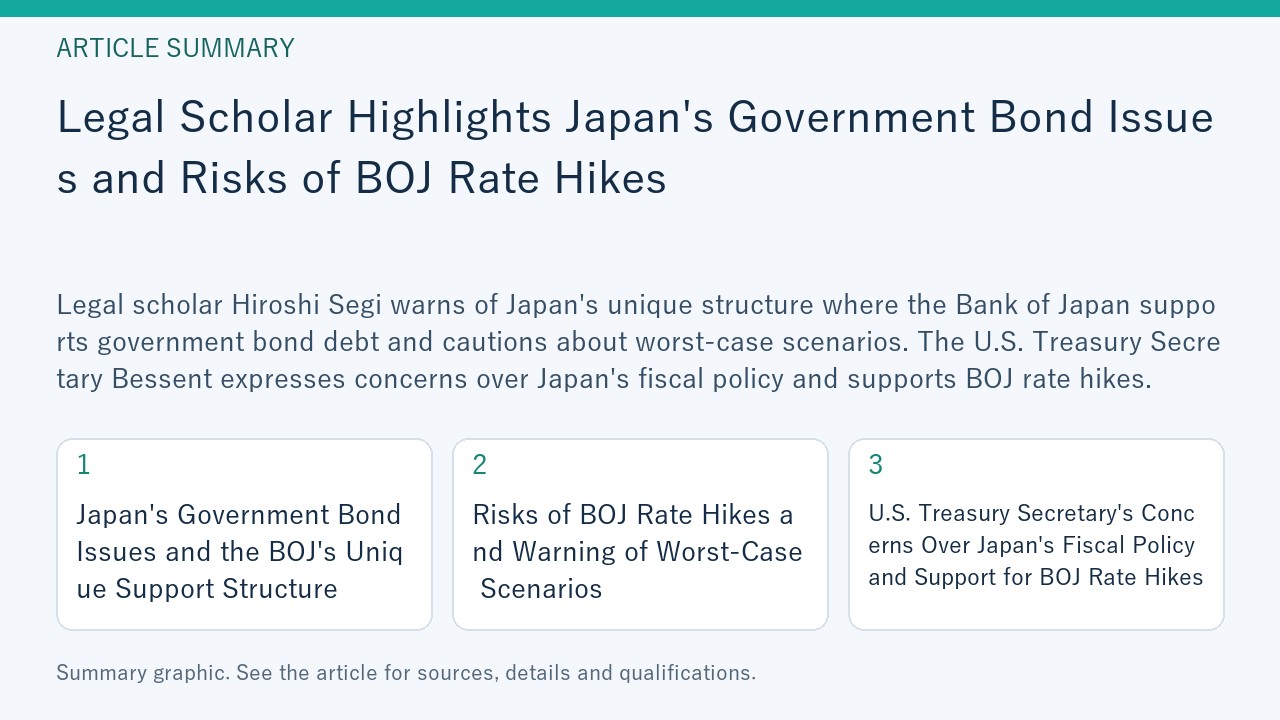
Hiroshi Segi, emeritus professor of law at Meiji University, points out the unique structure in which the Bank of Japan effectively supports Japan's enormous government bond debt, warning that this is a significant cause of the recent sharp depreciation of the yen. Meanwhile, U.S. Treasury Secretary Bessent has expressed concerns about Japan's fiscal policy while supporting the BOJ's rate hikes. The BOJ is expected to raise its policy interest rate at the October 2026 monetary policy meeting, drawing attention to the potential impact on the Japanese economy. Future developments are becoming a critical issue for international confidence and economic sustainability. [1] [3] [5]
Japan's Government Bond Issues and the BOJ's Unique Support Structure
Legal scholar Hiroshi Segi points out that Japan's government debt-to-GDP ratio ranks among the highest globally, with the Bank of Japan effectively supporting this massive debt overhang in a unique structure. He warns that this structure has been a major factor behind the recent rapid depreciation of the yen. Although Japan's economic strength and accumulated wealth currently help avoid a crisis, significant future risks remain. Due to the BOJ's unprecedented monetary easing policies, it has purchased large amounts of government bonds and ETFs, resulting in a marked reduction in policy flexibility and raising the risk that rising interest payments could strain national finances. The costs for redeeming government bonds and paying interest account for about one-quarter of general account expenditures and are projected to reach approximately 30% by fiscal year 2029. [1]
Segi states that as long as the BOJ continues this support, policy flexibility will remain constrained, and the increasing burden of interest payments due to rising rates will inevitably pressure public finances. These factors significantly affect the sustainability of Japan's fiscal situation. The increase in government bond costs is also evident in Ministry of Finance estimates, making it a critical issue for future fiscal management. While the BOJ plays a major role, its limitations have become apparent. There is no direct mention of international credit in this context. [1] [5]
Risks of BOJ Rate Hikes and Warning of Worst-Case Scenarios
Hiroshi Segi warns that the BOJ's balance sheet could fall into a negative spread and become insolvent if interest rates rise sharply. He cautions that this could trigger a downgrade of Japanese government bonds, a significant drop in the yen's exchange rate, and a rapid surge in prices, constituting a worst-case scenario. Furthermore, he suggests that increased foreign currency holdings of assets could cause dysfunction in the government bond market, potentially leading to severe financial instability and a crisis accompanied by rapid inflation. Such a situation could result in the collapse of social security, a sharp rise in unemployment, and social disorder, with particularly severe impacts on the elderly and low-income groups. [1] [2]
In the worst case, a rapid decline in currency value and sustained high inflation could cause prices to multiply several times within a short period. This would effectively collapse social security systems such as pensions and medical insurance, rapidly impoverishing citizens' lives. There are concerns about a sharp rise in unemployment, an increase in homelessness, breakdown of social order, and the rise of extreme political forces. The current aging society in Japan makes recovery more difficult compared to the postwar period. These scenarios are based on historical examples and expert analyses and are recognized as risks that cannot be ignored. [2]
U.S. Treasury Secretary's Concerns Over Japan's Fiscal Policy and Support for BOJ Rate Hikes
U.S. Treasury Secretary Bessent has expressed concerns about Japan's fiscal policy, sending a message to restrain the excessive fiscal expansion under the Takaichi Sanae administration. At the same time, he supports the BOJ's rate hikes, stating that they help support the yen's exchange rate and reduce the need for U.S. Treasury bond sales for market intervention. Bessent has stated that U.S. and Japanese authorities accurately understand coordinated yen-buying interventions and the BOJ's policy trends, signaling a warning to yen-selling traders. The BOJ is expected to raise its policy interest rate by 0.25 percentage points at the October 2026 monetary policy meeting, marking the fastest pace of rate hikes since 1990. [3] [4] [5]
The BOJ's rate hikes may support the yen's exchange rate and bring inflation closer to target levels, but rising government bond yields could make financing more difficult and pose risks to the Takaichi administration's large-scale investment plan exceeding 370 trillion yen. The market is pricing in additional rate hikes, and while the BOJ governor's decision to raise rates is supported, there are cautious views regarding the pace and impact of hikes. Future policy developments represent a critical phase that will significantly affect Japan's economic sustainability and international credibility. [5]
Sources and references
- [1] 今の日本は国際的にみて特異な状態…法学者が警告「日銀支えの"バラマキ借金国"が招く最悪のシナリオ」(プレジデントオンライン) – Yahoo!ファイナンス — finance.yahoo.co.jp
- [2] 今の日本は国際的にみて特異な状態…法学者が警告「日銀支えの"バラマキ借金国"が招く最悪のシナリオ」 (4ページ目) — president.jp
- [3] マクロスコープ:ベセント氏発言、日本への懸念より明示的 財政政策や利上げに影響も(ロイター) – Yahoo!ファイナンス — finance.yahoo.co.jp
- [4] ベッセント長官、円売りに賭けるトレーダーをけん制「胴元は私だ」(Bloomberg) – Yahoo!ファイナンス — finance.yahoo.co.jp
- [5] 日本経済の再生に大きな試練、日銀利上げはバブル崩壊以来のペースへ | TBS CROSS DIG with Bloomberg — newsdig.tbs.co.jp
This English edition was translated and reviewed using AI against the Japanese original and cited sources. Source titles remain in their original language.
コメント