





English translation of the Japanese article.
Key points
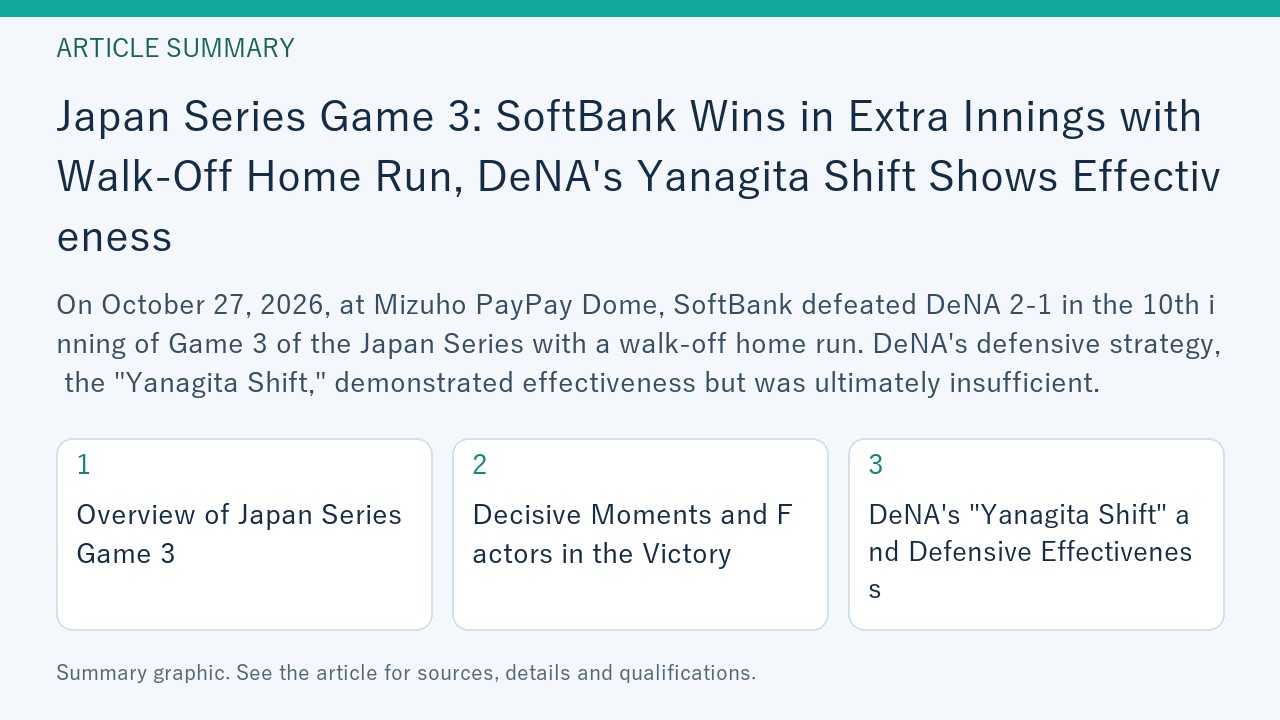
On October 27, 2026, at Mizuho PayPay Dome in Fukuoka, the Fukuoka SoftBank Hawks defeated the Yokohama DeNA BayStars 2-1 in the 10th inning of Game 3 of the professional baseball Japan Series, securing a walk-off victory and taking a 3-0 lead in the series. DeNA employed the "Yanagita Shift" defensive tactic, which showed effectiveness, but SoftBank's Tomoya Masaki hit a walk-off home run in the 10th inning. The game was tense throughout, with starting pitchers Haru Matsumoto for SoftBank and Katsuki Azuma for DeNA. [1] [2] [3]
Overview of Japan Series Game 3
Game 3 of the Japan Series was held on October 27, 2026, at Mizuho PayPay Dome in Fukuoka. Starting pitchers were Haru Matsumoto for SoftBank and Katsuki Azuma for DeNA. The game extended to the 10th inning, concluding with a final score of SoftBank 2, DeNA 1. The game lasted 3 hours and 20 minutes, with an attendance of 36,800 spectators. It was a tightly contested pitching duel that extended into extra innings. Both teams' defenses performed well at critical moments, enhancing the excitement of the game. SoftBank aimed for their second consecutive Japan Series championship, while DeNA sought to claim the title for the first time in two years. [1] [5]
Starting pitcher Haru Matsumoto (SoftBank) threw 101 pitches, allowing 6 hits and 1 run, while Katsuki Azuma (DeNA) delivered a strong performance with 89 pitches, 6 hits allowed, and no runs. Thanks to the efforts of both pitchers, the game remained a close 1-run contest until the late innings. Azuma notably held the opposing team scoreless through seven innings, contributing significantly to DeNA's efforts. The game tested both teams' pitching and defensive capabilities. With this result, the series progressed with SoftBank leading 3-0. [1]
Decisive Moments and Factors in the Victory
In the top of the 10th inning, with no outs and no runners on base, SoftBank's Tomoya Masaki stepped up to bat. Facing DeNA's fifth pitcher, J. Louise, Masaki sharply swung at a 152 km/h two-seam fastball and hit a bouncing walk-off home run over the left-field terrace. This hit secured a 2-1 victory for SoftBank and put them one win away from the championship with a 3-0 series lead. Masaki had established himself as the leadoff hitter midway through the season and recorded 28 home runs during the regular season. This was his first career walk-off home run, contributing dramatically to the team's win. [2]
The bottom of the ninth inning also significantly influenced the game's momentum. Cleanup hitter Ryoya Kurihara hit a right-field double off DeNA's closer S. Reynolds, creating a scoring opportunity to tie the game. After the next batter was retired, pinch runner Itsua Ihine advanced from second to home, sliding in to tie the game. This aggressive baserunning and strategic bench management energized the team and helped lead to the eventual victory in extra innings. SoftBank manager Hiroki Kokubo praised this tactical decision. [2]
DeNA's "Yanagita Shift" and Defensive Effectiveness
DeNA implemented the "Yanagita Shift" against SoftBank's powerful hitter Yuki Yanagita. Shortstop Shuto Naruse positioned himself behind second base, and second baseman Maki shifted toward the area between first and second base, among other defensive adjustments. This shift helped prevent several critical threats, including turning a double play on a ground ball hit by Yanagita during a sixth-inning scoring opportunity. Naruse played a key defensive role by fielding the ball cleanly and completing the double play. Fujita, DeNA's first-team infield defense, baserunning, tactics, and development coach, evaluated that the players followed instructions carefully and moved based on calculated ball trajectories. [3] [4]
DeNA's defense recorded four double plays in the series, tying a series record. Ace pitcher Katsuki Azuma managed to hold runners on base while maintaining scoreless pitching from the first through sixth innings. The infield defense, employing the Yanagita Shift, saw shortstop Naruse cover behind second base and successfully field a ball in the sixth inning, stepping on second base and throwing to first to complete a double play. This defensive effectiveness contributed to keeping the game close and tense. The success of the defensive shift reflected the strategic use of data-driven tactics. [4]
Sources and references
- [1] ソフト、DeNAが調整 日本シリーズ第3戦に向け(共同通信)|熊本日日新聞社 — kumanichi.com
- [2] デイリーリポート(第3戦) | SMBC日本シリーズ2026 — npb.jp
- [3] 【DeNA】残念、そこには成瀬…「ギータシフト」に「近藤シフト」もハマり、再三ピンチ防ぐ – プロ野球 : 日刊スポーツ — www.nikkansports.com
- [4] 【日本シリーズ】DeNAがシリーズタイ記録の4併殺 6回ピンチでは柳田シフトズバリ – ライブドアニュース — news.livedoor.com
- [5] 2026年度SMBC日本シリーズ 試合結果(第3戦) — npb.jp
This English edition was translated and reviewed using AI against the Japanese original and cited sources. Source titles remain in their original language.


コメント