


English translation of the Japanese article.
Key points
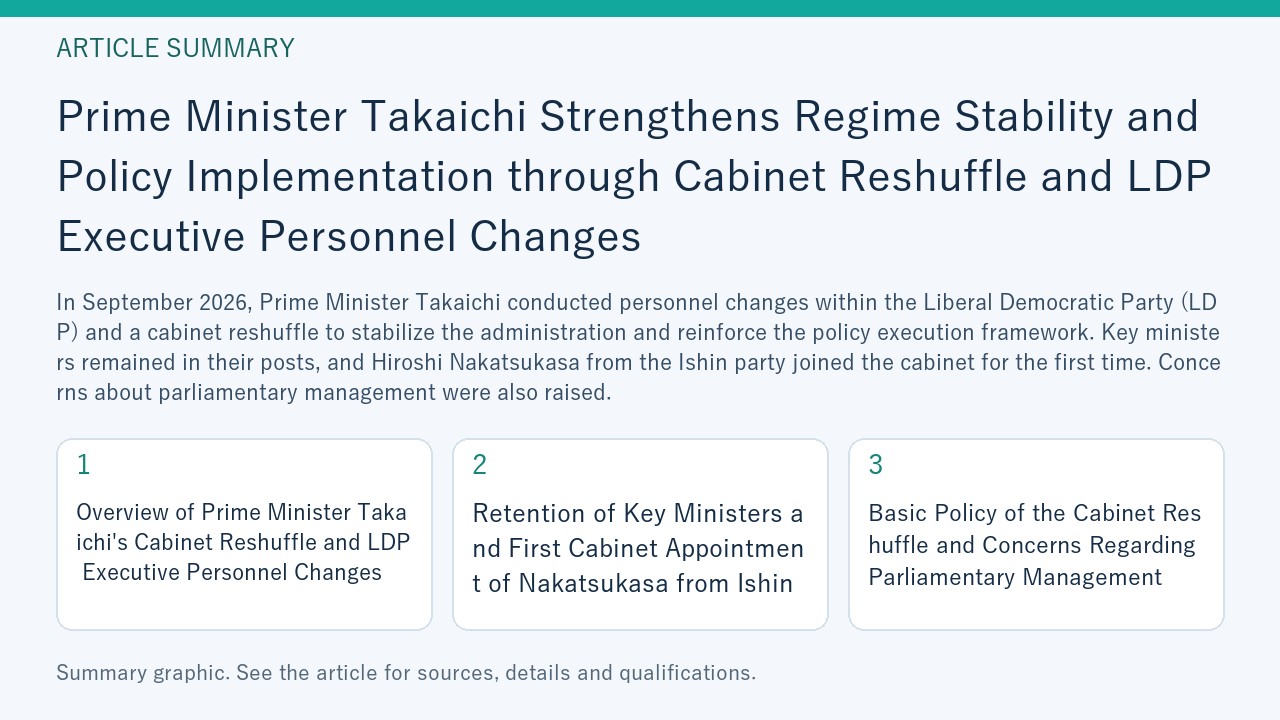
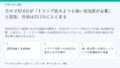
In September 2026, Prime Minister Takaichi decisively implemented personnel changes within the Liberal Democratic Party (LDP) and a cabinet reshuffle, aiming to stabilize the administration and strengthen the policy execution system. Many key ministers retained their positions, and Hiroshi Nakatsukasa from the Ishin party joined the cabinet for the first time. In the LDP executive personnel changes, Vice President Aso and others remained, while Kajiyama was newly appointed as General Council Chairman and Murai as Diet Affairs Committee Chairman. This arrangement reinforced the party's internal foundation and the framework for policy promotion. However, concerns were also expressed regarding disregard for the Diet and suppression of dissent. Attention is focused on the future direction of the administration's governance. [1] [2] [3]
Overview of Prime Minister Takaichi's Cabinet Reshuffle and LDP Executive Personnel Changes
In September 2026, Prime Minister Takaichi implemented personnel changes within the Liberal Democratic Party (LDP) and a cabinet reshuffle to stabilize the administration and strengthen the policy execution system. In the LDP executive personnel changes, Vice President Aso, Secretary-General Suzuki, and Policy Research Council Chairman Kobayashi remained in their posts, while Kajiyama was newly appointed as General Council Chairman and Murai as Diet Affairs Committee Chairman. This advanced the strengthening of the party's internal foundation. Within the party, some pointed out that the personnel changes were "inward-looking," anticipating the LDP presidential election next autumn. The changes also included a renewal of the parliamentary management system. Prime Minister Takaichi expressed enthusiasm, stating that the administration had "entered the stage of full-scale execution." [1] [2]
The LDP executive personnel changes were decided at an extraordinary General Council meeting. While key executives such as Vice President Aso and Secretary-General Suzuki remained, Kajiyama assumed the role of General Council Chairman and Murai was promoted to Diet Affairs Committee Chairman. Murai, a mid-level politician and former Deputy Chief Cabinet Secretary, took the position of Chairman of the House of Councillors Diet Affairs Committee and is expected to serve as a coordinator with opposition parties. This renewed the party's parliamentary management system. The personnel changes also considered strengthening cooperation with the Ishin party. Concerns about disregard for the Diet were also raised. [2] [1]
Retention of Key Ministers and First Cabinet Appointment of Nakatsukasa from Ishin
On September 17, 2026, Prime Minister Takaichi announced the list of ministers for the second Takaichi reshuffled cabinet. Key ministers such as Chief Cabinet Secretary Minoru Kihara, Foreign Minister Toshimitsu Motegi, and Defense Minister Shinjiro Koizumi retained their posts, ensuring policy continuity. From the Ishin party, Hiroshi Nakatsukasa joined the cabinet for the first time as Minister in charge of Regulatory Reform, Administrative Reform, and Child Policy within the Cabinet Office. This appointment aimed to strengthen cooperation with Ishin and marked a new step in cross-party governance. Nakatsukasa's cabinet appointment signaled enhanced cooperation as a coalition partner. [3] [5]
Cabinet cooperation with Ishin was formally confirmed at a party leaders' meeting between Prime Minister Takaichi and Ishin leader Yoshimura. Ishin's first cabinet appointment represented an important move demonstrating the administration's diversity and cooperative spirit. The retention of key ministers intended to promote stable policy implementation, with Economic Minister Akazawa and Minister in charge of Economic and Fiscal Policy Jōnai also continuing in their roles. This maintained the administration's core while allowing for some renewal. The framework for future policy execution was thus established. [5] [3]
Basic Policy of the Cabinet Reshuffle and Concerns Regarding Parliamentary Management
On September 17, 2026, the government approved the basic policy of the second Takaichi reshuffled cabinet at a cabinet meeting. The basic policy set forth four pillars: realization of a strong economy through "responsible proactive fiscal policy," advancement of "robust Japanese diplomacy," strengthening of disaster prevention and public security measures, and enhancement of policy public relations. In economic policy, the administration aimed to promote industrial investment and regional strategies based on growth strategies, targeting a stable reduction of the debt-to-GDP ratio through GDP expansion. In diplomacy and defense, the administration planned to strengthen the Japan-US alliance and review strategic documents. Enhancement of policy public relations was positioned as a new pillar. [4]
On the other hand, regarding parliamentary management, voices called for governance that does not disregard the Diet or suppress dissent. Murai, a mid-level politician appointed as Chairman of the House of Councillors Diet Affairs Committee, had previously proposed reducing cabinet ministers' attendance at Diet sessions. Attention is required for coordination with opposition parties and smooth deliberations. Opposition parties and media expressed concerns that the Prime Minister's Office's priorities might lead to neglect of Diet deliberations. The future direction of parliamentary management is being closely watched. [1]
Sources and references
- [1] 2026年10月27日 異論抑圧せぬ政権運営を 高市改造内閣が発足
| 新聞協会報・紙面モニターから|刊行物|日本新聞協会 — www.pressnet.or.jp - [2] 自民党 新役員人事を決定 高市総理「政策で未来切り開く」 — news.tv-asahi.co.jp
- [3] 第2次高市改造内閣は留任8人 維新から初入閣 閣僚名簿を発表|FNNプライムオンライン — www.fnn.jp
- [4] 高市改造内閣が基本方針を閣議決定 「責任ある積極財政」で強い経済 4本目の柱に「政策広報の充実」 — jpjj.jp
- [5] 高市首相が内閣改造断行、維新・中司氏初入閣で閣内協力体制へ — www.seiji360.jp
This English edition was translated and reviewed using AI against the Japanese original and cited sources. Source titles remain in their original language.
コメント