


English translation of the Japanese article.
Key points
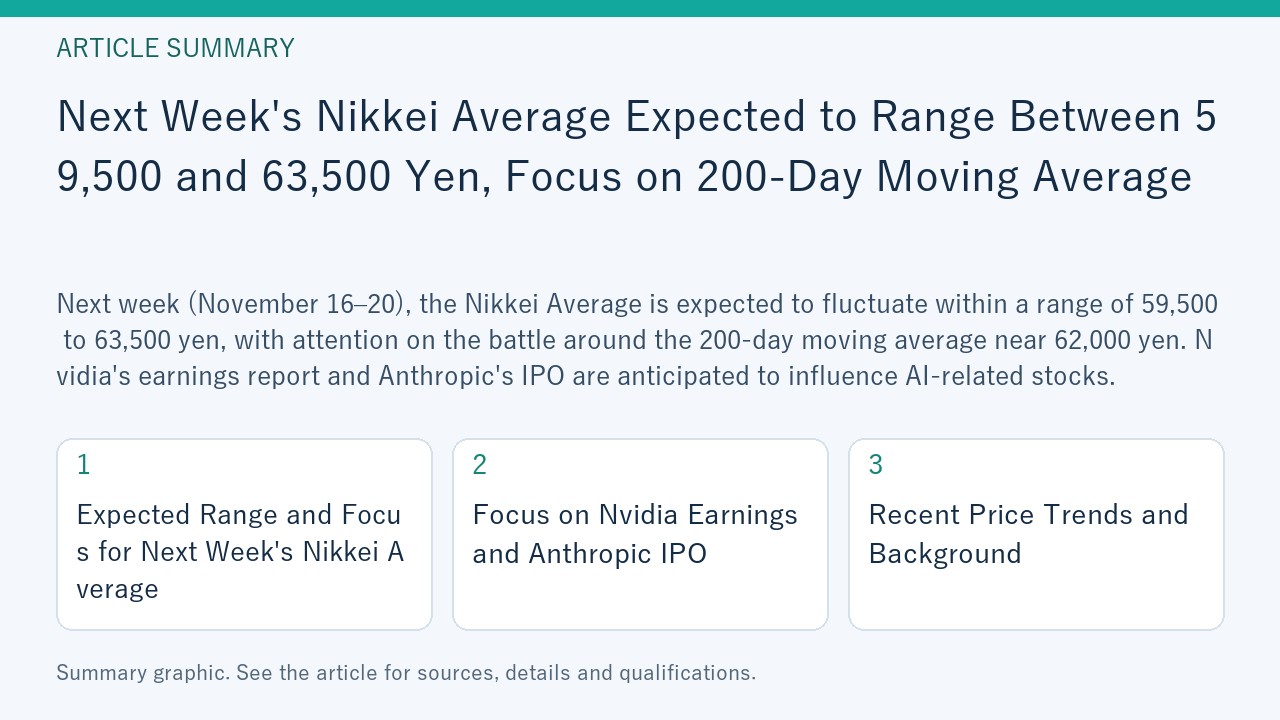
From November 9 to 13, 2026, the Nikkei Average rebounded sharply, recovering into the 60,000 yen range, supported by buybacks in AI and semiconductor-related stocks and strong domestic corporate earnings. Next week (November 16–20), the index is expected to move within a range of 59,500 to 63,500 yen, with the contest around the 200-day moving average near 62,000 yen becoming a focal point. Particularly notable are Nvidia's earnings announcement on November 18 and the IPO of U.S. AI company Anthropic on November 19, events expected to significantly impact the trend of AI-related stocks. [1] [2] [3]
Expected Range and Focus for Next Week's Nikkei Average
The Nikkei Average is forecasted to trade within a range of 59,500 to 63,500 yen during the week of November 16 to 20. Market attention is especially focused on price movements near the 200-day moving average, located around 62,000 yen, where the battle between buyers and sellers is expected to influence the market's direction. The market is anticipated to consolidate in the 60,000 yen range while attempting to break through this moving average. Future price trends will be closely watched within this range. (Sources 1, 2) [2]
This forecasted range takes into account recent price trends, market supply and demand conditions, as well as the impact of domestic and international economic indicators and corporate earnings. The 200-day moving average is a key technical analysis indicator, and the 62,000 yen level serves as a psychological milestone for investors. Depending on upcoming economic data and earnings results, there is potential for the index to break above or below this range. (Sources 1, 2) [2]
Focus on Nvidia Earnings and Anthropic IPO
The most significant events next week are the earnings announcement by U.S. semiconductor giant Nvidia early on November 18 and the initial public offering (IPO) of U.S. AI company Anthropic scheduled for November 19. These events are expected to have a major influence on the movement of AI-related stocks. (Sources 0, 1) [1] [2]
Reports of Nvidia's CEO resignation on November 12 affected the stock price, causing the Nikkei Average to fall by 429 yen; however, on November 13, a rebound occurred with a 322 yen gain due to buybacks. The appointment of Colette Kress, who served as CFO for many years, as interim CEO has provided reassurance to the market. Anthropic's IPO is large-scale among AI-related companies and has attracted significant investor interest. These developments are expected to have a substantial impact on next week's stock prices. (Sources 0, 1) [1] [2]
Recent Price Trends and Background
On November 9, 2026, the Nikkei Average rebounded sharply by 1,340.00 yen from the previous week's close to 58,775.50 yen, marking its first significant rise in six trading days. This was a buyback following the historic plunge of 3,643.00 yen on November 6, with AI and semiconductor-related stocks leading the recovery. Strong domestic corporate earnings and improved stock supply-demand conditions also supported the price. (Sources 0, 2) [3]
Following the November 12 report of Nvidia's CEO resignation, the Nikkei Average declined by 429 yen but rebounded by 322 yen on November 13 due to buybacks. The solid performance of domestic companies and improved stock supply-demand conditions have continued to underpin the market. These movements indicate a gradual improvement in investor sentiment after the adjustment phase following the sharp drop on November 6. (Sources 0, 1, 2) [1] [2] [3]
Sources and references
- [1] 来週の日経平均見通し(11/16~11/20)|6万円台回復で反発続くか?今夜の米PPI・エヌビディア決算・アンソロピック上場に注目 2026年11月13日 – 外為どっとコム マネ育チャンネル — www.gaitame.com
- [2] 来週(11/16~20)の日経平均株価の予想レンジは、5万9500~6万3500円! 6万2000円(200日移動平均線)近辺での攻防や、好決算の内需株・金融株に注目 — diamond.jp
- [3] 日本市場レポート:日経平均が1,340円高と6日ぶり大幅反発、一時2,000円超高も後場は伸び悩み 米半導体株の下げ止まりで買い戻し、プライム9割超が上昇(2026年11月9日) — insight-jp.com
This English edition was translated and reviewed using AI against the Japanese original and cited sources. Source titles remain in their original language.

コメント