


English translation of the Japanese article.
Key points
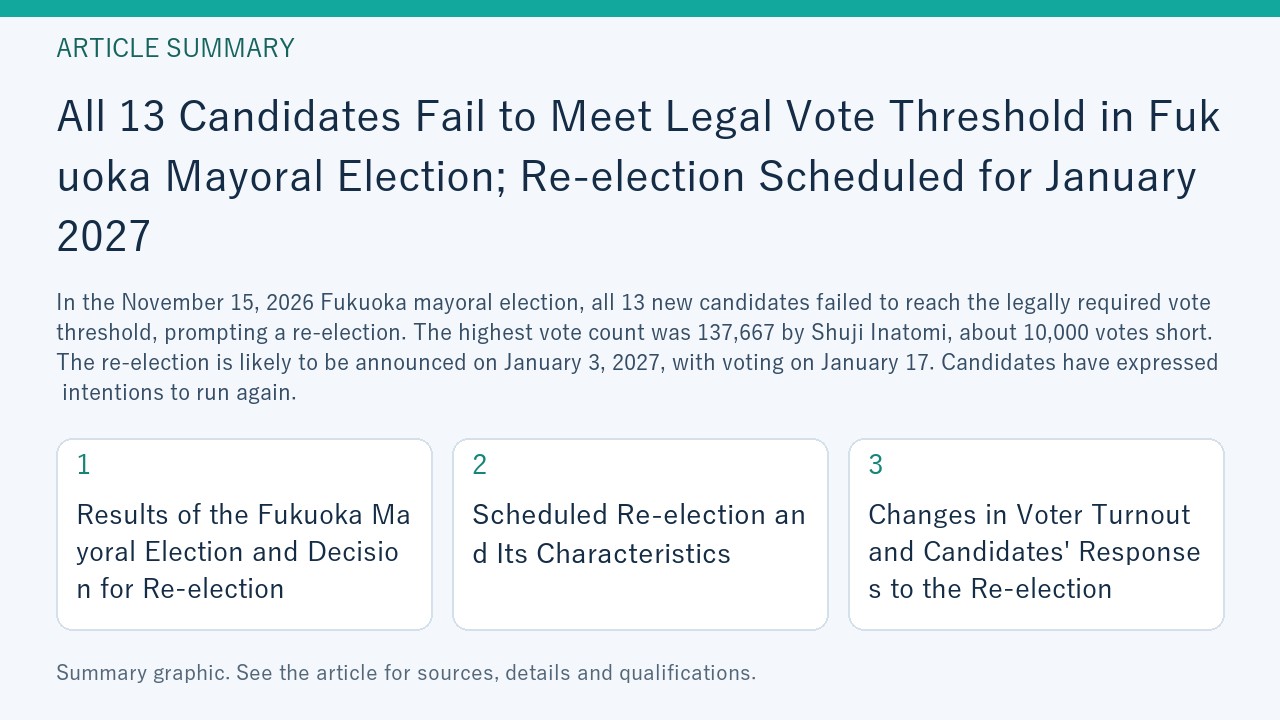
In the Fukuoka mayoral election held on November 15, 2026, all 13 new candidates failed to reach the legally required vote threshold (one-quarter of valid votes) necessary for election, confirming a re-election. The top vote-getter was former House of Representatives member Shuji Inatomi, who received 137,667 votes (23.23%), falling about 10,000 votes short of the legal threshold. Based on the Public Offices Election Act, after the objection period, the re-election is expected to be held within 50 days, likely announced on January 3, 2027, with voting on January 17. [1] [2] [3]
Results of the Fukuoka Mayoral Election and Decision for Re-election
In the Fukuoka mayoral election held on November 15, 2026, all 13 new candidates failed to reach the legally required vote threshold for election, confirming a re-election. The top vote-getter was former House of Representatives member Shuji Inatomi, who received 137,667 votes (23.23%), but this was about 10,000 votes short of the legal threshold, which is one-quarter of the total valid votes. According to Article 95 of the Public Offices Election Act, in mayoral elections, even the candidate with the most votes cannot be elected unless they receive at least one-quarter of the valid votes. [1] [2]
This election featured a record 13 new candidates, resulting in a significant vote split. The voter turnout was 45.58%, rising 11.27 points from the previous 34.31%, surpassing 40% for the first time in 16 years. However, due to the vote split, no candidate reached the legal vote threshold. The large number of candidates and absence of an incumbent complicated the election dynamics, with party endorsements divided and support dispersed. Notably, incumbent Mayor Soichiro Takashima did not seek a fifth term nor endorse a successor, influencing the election landscape. [1] [2] [3]
Scheduled Re-election and Its Characteristics
The re-election will be held within 50 days after the objection period, as stipulated by the Public Offices Election Act. The Fukuoka City Election Management Committee officially decided on the re-election on November 16, 2026. The objection period runs from November 17 to 30, lasting 14 days. If no objections are filed, the re-election is expected to be announced on January 3, 2027, with voting on January 17. This schedule aligns with precedents from re-elections in other designated cities. The re-election is not a runoff; new candidates beyond the original 13 may also run, potentially changing the election dynamics. [2] [3]
The re-election mechanism applies when no candidate reaches the legal vote threshold in the initial election, requiring a fresh candidacy filing and election process. A deposit of 2.4 million yen is required again, and candidates who received less than one-tenth of the votes previously may forfeit their deposit. The re-election imposes additional administrative costs and workload on the city. Since the re-election period overlaps with the year-end and New Year holidays, it may affect campaign preparations and voter turnout. [2] [3]
Changes in Voter Turnout and Candidates' Responses to the Re-election
The voter turnout in this Fukuoka mayoral election was 45.58%, up 11.27 points from the previous 34.31%, exceeding 40% for the first time in 16 years. This increase indicates heightened public interest, but the large number of candidates caused vote splitting, preventing any candidate from reaching the legal vote threshold. Shuji Inatomi, who received the most votes, has expressed a positive attitude toward running again. Second-place candidate Yu Niimura and third-place Kentaro Mori have also indicated intentions to run in the re-election. Other candidates are also considering running again. [1] [4]
Candidates' responses to the re-election vary: Shuji Inatomi stated he is "considering it positively," Motoki Jinno declared he "will definitely run," while Keiko Yoshitomi is awaiting her party's decision. Takashi Osamu and Ayano Sasaki have either reserved judgment or are in discussions. The re-election may lead to candidate consolidation or alliances, which could significantly influence the outcome. The official re-election schedule and candidates' declarations will be key focuses going forward. Changes in voter turnout will also be closely watched, as voter behavior in the re-election is expected to impact the results. [4]
Sources and references
- [1] 稲富修二氏が最多得票でも再選挙へ 福岡市長選で見えた「分散」の正体|選挙インサイト — senkyo-insight.com
- [2] 福岡市長選はなぜ再選挙に?13人全員が届かなかった「4分の1」の壁 | seiji.tokyo — seiji.tokyo
- [3] 福岡市長選は再選挙へ、13人全員が法定得票数に届かず 再選挙はいつ行われ誰が出られるのか、札幌市長選以来の政令市の前例と得票結果 — mediadogs.jp
- [4] 【続報】福岡市長選の再選挙へ候補者の動きが活発化 最多得票の稲富修二氏は再出馬に「前向き」、神野元基氏は「必ず出る」 吉富景子氏は参政党の判断待ち | lilvest NEWS — lilvest.com
This English edition was translated and reviewed using AI against the Japanese original and cited sources. Source titles remain in their original language.

コメント