


English translation of the Japanese article.
Key points
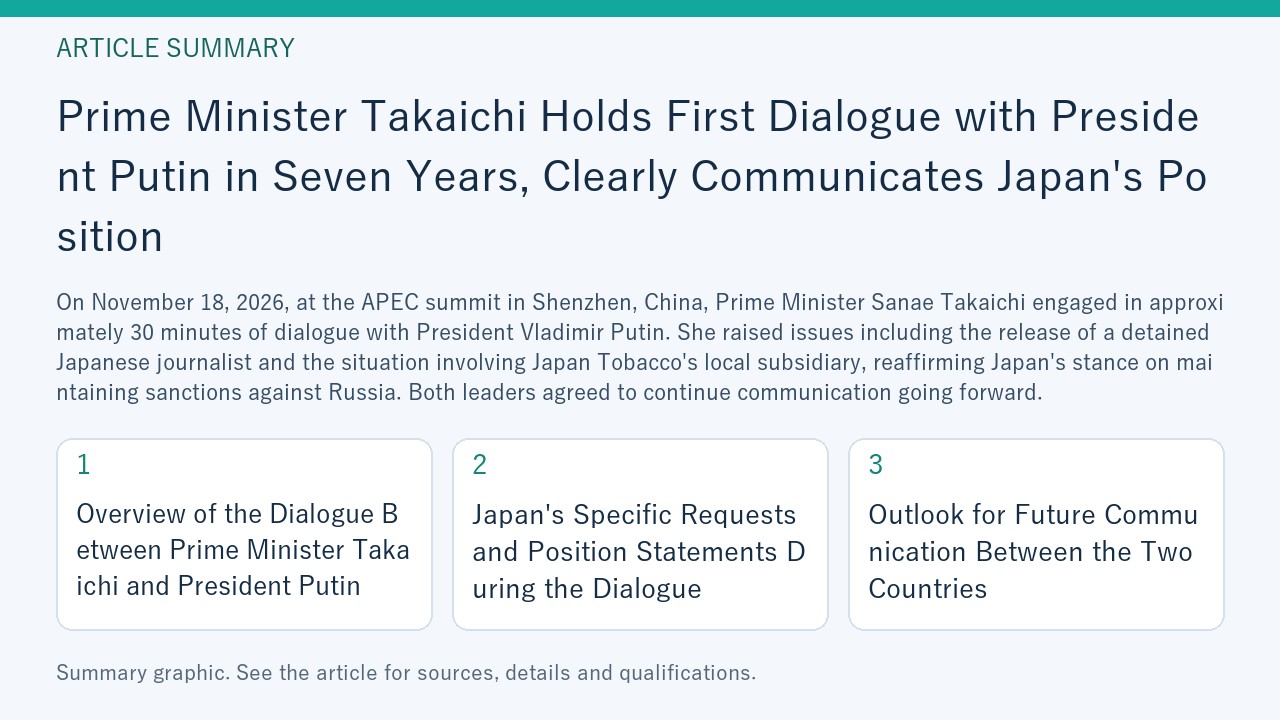
On the evening of November 18, 2026, at the welcome dinner of the APEC summit held in Shenzhen, China, Prime Minister Sanae Takaichi held a direct dialogue lasting about 30 minutes with Russian President Vladimir Putin. This marked the first direct summit-level dialogue in approximately seven years since September 2019, and the first since Russia's invasion of Ukraine in 2022. Prime Minister Takaichi clearly conveyed Japan's position regarding the immediate release of a detained Hokkaido Shimbun journalist and issues concerning Japan Tobacco's local subsidiary in Russia, demonstrating a firm stance on maintaining sanctions against Russia while upholding principles of humanitarianism and human rights. [1] [3]
Overview of the Dialogue Between Prime Minister Takaichi and President Putin
On the evening of November 18, 2026, at the welcome dinner of the APEC summit held in Shenzhen, China, Prime Minister Sanae Takaichi and Russian President Vladimir Putin engaged in a direct dialogue lasting approximately 30 minutes. This was the first direct summit-level dialogue in about seven years since September 2019, and the first since Russia's invasion of Ukraine in 2022. The event holds significant diplomatic importance. Both leaders agreed to continue communication at various levels going forward, raising expectations for ongoing dialogue and the maintenance of diplomatic relations between Japan and Russia. [1] [3] [4]
Although brief, this dialogue represented an important contact amid ongoing tensions between the two countries. Since Russia's invasion of Ukraine in 2022, Russia has opposed Japan's sanctions and increased pressure on Japan. This dialogue attracted attention as a move to explore easing tensions in bilateral relations. President Putin's attendance at the APEC summit is also seen as an attempt to break out of international isolation. The dialogue is positioned within this international context. Japan demonstrated a flexible diplomatic stance by keeping communication channels open. [3] [4]
Japan's Specific Requests and Position Statements During the Dialogue
During the dialogue, Prime Minister Takaichi strongly demanded the immediate release of Hokkaido Shimbun journalist Hiroki Imai, who is detained by Russian authorities. She also requested the revocation of the presidential decree placing Japan Tobacco's local subsidiary under Russian company management. These issues were clearly conveyed as important concerns for Japan. Although the approximately 30-minute dialogue did not result in concrete agreements, it served as an opportunity to raise these matters. The Japanese Ministry of Foreign Affairs explained that exchanges were conducted based on Japan's position regarding these issues. [2] [3] [4]
Furthermore, Prime Minister Takaichi clearly expressed Japan's fundamental stance of maintaining sanctions against Russia while not compromising on principles related to humanitarian and human rights issues. Utilizing the opportunity to speak frankly, she conveyed a strong message domestically and internationally that dialogue would continue but without concessions. This stance is notable as a basic approach to future diplomacy with Russia amid difficult bilateral relations. The dialogue both realized communication and clarified Japan's diplomatic position. [3]
Outlook for Future Communication Between the Two Countries
At the conclusion of the dialogue, both leaders agreed to continue communication at various levels going forward. This raises expectations for maintaining diplomatic relations and continuing dialogue aimed at easing tensions between Japan and Russia. Although concrete outcomes from the brief dialogue were limited, it holds important significance as groundwork for future negotiations and discussions. The Japanese government intends to continue dialogue with Russia toward resolving issues. Attention will focus on developments regarding the detained journalist's release and the Japan Tobacco matter in the coming weeks to months. [1] [2] [4]
This dialogue served as an opportunity to resume diplomatic contact amid the cooled relations between Japan and Russia following the 2022 invasion of Ukraine. Japan has maintained sanctions against Russia while demonstrating a flexible diplomatic stance by keeping communication channels open. Going forward, it will be necessary to build concrete achievements centered on cooperation with the United States. Depending on changes in the international situation and Russia's responses, there may be opportunities to explore improvements and easing of tensions in Japan-Russia relations. Future developments will be closely watched. [3]
Sources and references
- [1] 高市首相、プーチン氏と対話 「日本の立場」伝える — www.afpbb.com
- [2] 高市首相、ロシア大統領と意見交換=7年ぶり直接対話、記者解放要求 | nippon.com — www.nippon.com
- [3] 7年ぶりの日ロ対話、高市首相が突きつけた「記者解放」要求の真意 — www.kaguyapress.com
- [4] 高市首相がプーチン氏と対話、邦人拘束などでやりとり 意思疎通継続で一致=官房長官 | ニューズウィーク日本版 オフィシャルサイト — www.newsweekjapan.jp
This English edition was translated and reviewed using AI against the Japanese original and cited sources. Source titles remain in their original language.
コメント