


English translation of the Japanese article.
Key points
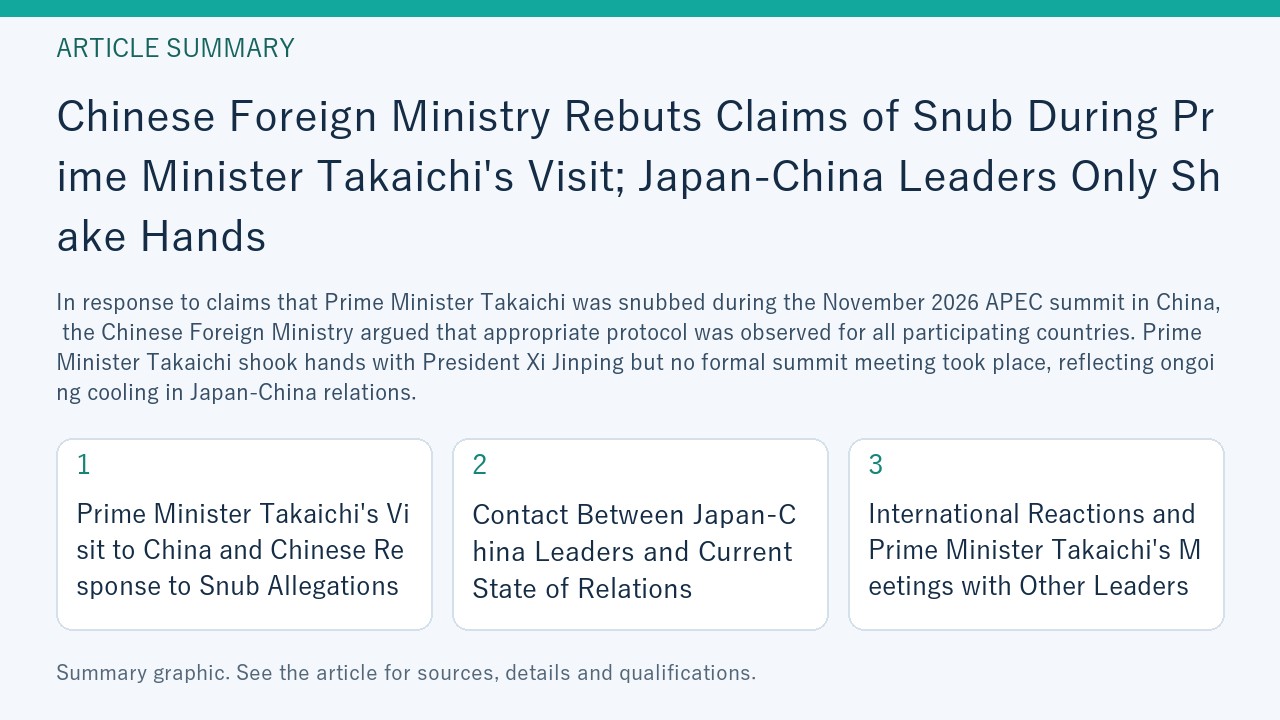
On November 18, 2026, Prime Minister Sanae Takaichi arrived in Shenzhen, China, to attend the APEC summit. Following reports alleging that she was snubbed by Chinese officials, the Chinese Foreign Ministry countered that appropriate ceremonial arrangements were made for all participating countries. Prime Minister Takaichi shook hands twice with President Xi Jinping and spoke briefly for about ten seconds, but no formal summit meeting occurred. Japan-China relations remain strained. This visit marked Prime Minister Takaichi's first to China since taking office, and she expressed a desire to build a constructive and stable relationship. [1] [2]
Prime Minister Takaichi's Visit to China and Chinese Response to Snub Allegations
On November 18, 2026, Prime Minister Sanae Takaichi arrived in Shenzhen, China, to attend the APEC summit. The reception at the airport was simpler compared to those for other heads of state, lacking flower bouquets and welcome performances. Additionally, there was a significant step between the government aircraft's exit and the boarding stairs, leading to allegations of a snub. South Korean media also reported the treatment as insulting. Former Defense Vice Minister Yasuhide Nakayama, a member of the House of Representatives, expressed safety concerns and called for an explanation from the Chinese side. The official who greeted Prime Minister Takaichi was an ambassador in charge of protocol rather than a cabinet-level official, and there were no young dancers or other welcome performances seen for other leaders. [3] [4]
In response, at a press conference on November 19, 2026, the Chinese Foreign Ministry stated that as the host country, it arranged appropriate ceremonial protocols for all participating countries based on international customs. The Chinese side denied that Prime Minister Takaichi was snubbed and asserted that all participants were treated fairly. Some view the response as reflecting the current state of Japan-China relations. Differences in the rank of welcoming officials and the scale of welcome events may reflect diplomatic considerations and the current relationship. South Korean media coverage has amplified the issue internationally, aligning with reactions within Japan. [1] [3] [4]
Contact Between Japan-China Leaders and Current State of Relations
During the APEC summit, Prime Minister Takaichi shook hands twice with President Xi Jinping and spoke briefly for about ten seconds. Although this was a significant increase from the 'one-second handshake' on the 18th, no formal summit meeting took place. President Xi confirmed that he shook hands with all attendees and was seen moving his lips slightly during the handshake with Prime Minister Takaichi, but no meeting followed. Prime Minister Takaichi expressed gratitude at banquets and meetings and indicated a willingness to pursue dialogue aimed at building a constructive and stable relationship. [5] [2]
The Chinese Foreign Ministry avoided directly addressing the possibility of a Japan-China summit meeting, stating that China's position on Japan-China relations is clear. Prime Minister Takaichi completed her first visit to China since taking office, aiming to communicate on shared issues and build a constructive and stable relationship. However, since a parliamentary response in November 2025 regarding a Taiwan contingency, Japan-China relations have cooled. During this visit, contact between the leaders was limited to handshakes, and no summit meeting occurred. Prime Minister Takaichi stated that there has been no change in the status of political documents between Japan and China. [1] [2]
International Reactions and Prime Minister Takaichi's Meetings with Other Leaders
China's treatment of Prime Minister Takaichi has drawn attention not only within Japan but also in South Korean media. South Korea's Munhwa Broadcasting Corporation (MBC) reported the Chinese response as an insult beyond a mere snub and stated that President Xi refused dialogue. South Korean media emphasized footage of Prime Minister Takaichi disembarking and differences in welcome ceremonies, offering critical coverage of China's actions. This has brought international focus to tensions in Japan-China relations. Within Japan, Prime Minister Takaichi's resolute response has been praised, with some likening her strength and flexibility to that of a Kansai aunt. [3] [4]
Meanwhile, at the APEC summit, Prime Minister Takaichi held a meeting lasting over 30 minutes with Russian President Vladimir Putin, which she cited as a significant achievement in establishing direct communication. This meeting is considered an important outcome of her foreign trip and is expected to serve as a foundation for future bilateral communication. Concurrently, summit meetings among the leaders of the United States, China, and Russia attracted international attention. Despite cooling relations with China, Prime Minister Takaichi has demonstrated a commitment to dialogue with other countries. These developments are positioned as part of Japan's diplomatic strategy. [5]
Sources and references
- [1] 中国「適切な儀礼上の手配している」 高市総理「冷遇」に反論 — news.tv-asahi.co.jp
- [2] 高市総理 初の訪中終え「建設的かつ安定的な関係構築する」 — news.tv-asahi.co.jp
- [3] 「冷遇超えて侮辱」高市首相への中国の対応を韓国メディア続々報道 「呆気にとられる光景」と評したシーン — www.j-cast.com
- [4] 高市総理「冷遇」跳ね返す振る舞いに「関西のおばちゃんってすごい」経済専門家ら関心 | 文化放送 — www.joqr.co.jp
- [5] アメリカ・中国・ロシアの“歴史的会談”始まる 高市総理は習主席と“10秒握手” ホスト国・中国が“冷遇”か 中国側は「適切」|FNNプライムオンライン — www.fnn.jp
This English edition was translated and reviewed using AI against the Japanese original and cited sources. Source titles remain in their original language.


コメント