









English translation of the Japanese article.
Key points
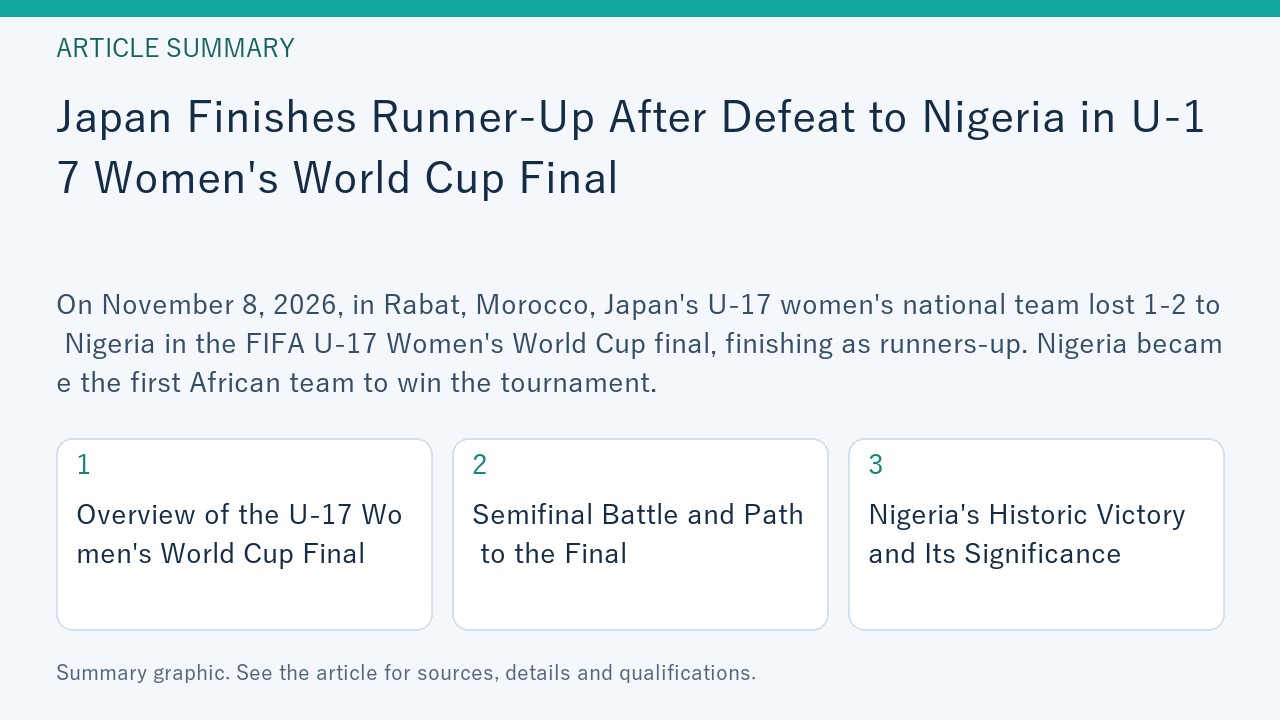
On November 8, 2026, Japan's U-17 women's soccer national team was defeated 1-2 by Nigeria in the FIFA U-17 Women's World Cup final held at the Mohammed VI Football Complex in Rabat, Morocco, finishing as runners-up. The match kicked off at 3:30 a.m. Japan Standard Time. Japan's Fuki Ito scored her first goal of the tournament in the 80th minute, but it was not enough. Nigeria became the first African team to win the tournament. [1] [2]
Overview of the U-17 Women's World Cup Final
The FIFA U-17 Women's World Cup final took place on November 8, 2026, at the Mohammed VI Football Complex in Rabat, Morocco. Japan's national team lost 1-2 to Nigeria, finishing as runners-up. The match kicked off at 3:30 a.m. Japan Standard Time. Japan reached the final for the first time in 10 years but narrowly missed out on the championship. The venue for the final was changed from the originally announced location to Pitch 3. The Japan Football Association streamed the match on DAZN. [1] [2] [3]
Japan conceded one goal in the first half and another two minutes into the second half, falling behind by two goals. In the 80th minute, Fuki Ito scored her first goal of the tournament to reduce the deficit to one. Japan continued to attack until the end but could not overturn the score, finishing the match 1-2. Japanese players were seen shedding tears on the pitch after the final whistle. Nigeria scored two goals for the first time in this tournament and became the first African team to win the title. Japan previously won the tournament in 2014 and finished as runners-up in 2016. [1] [3]
Semifinal Battle and Path to the Final
In the semifinals, Japan faced North Korea. The match ended 1-1, with North Korea scoring an own goal near the end to equalize. Japan then won the penalty shootout 4-1, advancing to the final for the first time in 10 years. Goalkeeper Kokoro Katowaki made several key saves, and Azumika Tanaka successfully converted a penalty kick, contributing to the victory. Japan progressed steadily from the group stage, defeating Kenya in the round of 16 and Ghana in the quarterfinals. Nanami Kurita scored the winning goal in the quarterfinal match. [1] [2]
The Japanese team consisted of players developed at the JFA Academy Fukushima and various clubs and schools across the country. Players shared defensive and offensive roles, demonstrating team cohesion that helped them advance. The coach praised the unity among players and staff and reflected that their never-give-up attitude led to victory. These efforts culminated in reaching the final for the first time in a decade. Japan has participated in nine of the last ten tournaments, maintaining its status as a global powerhouse. [2]
Nigeria's Historic Victory and Its Significance
Nigeria became the first African team to win the U-17 Women's World Cup in this tournament. Although they lost their opening match, they won five consecutive games to reach the final. In the semifinals, Nigeria defeated strong contender Brazil 3-1. In the final, they scored two goals against Japan to claim their first title. Nigeria's attack was characterized by balanced scoring from multiple players, reflecting the team's overall strength. This first African victory is a historic achievement in the tournament's history and holds great significance for the development of women's soccer in the region. [1] [2]
Nigeria's championship demonstrates the increasing diversity and competitiveness in women's soccer worldwide. Previously dominated by European and South American teams, the tournament's top spot going to an African team is an important milestone for FIFA. Nigeria's success symbolizes improvements in the region's development environment and competitive level, raising expectations for future international tournaments. Many players scored throughout the tournament, and the team's overall strength was key to their victory. The final against Japan was a closely contested match between two evenly matched teams. [2]
Match Broadcast and Japan Football Association's Response
The Japan Football Association provided free live streaming of the U-17 Women's World Cup final domestically on DAZN. After the match, the official Twitter account announced the result, allowing many fans to watch in real time. The broadcast required free membership registration. Details about on-demand availability or viewing deadlines were not disclosed. Throughout the tournament, the Japan Football Association worked to convey the appeal of women's soccer to domestic fans. They plan to continue supporting young players and promoting the growth of women's soccer. [3]
The DAZN broadcast aimed to increase interest in women's soccer among younger audiences by offering free access to all matches. Japan's team's performance attracted significant viewer attention and generated discussion on social media and in the media after the match. The Japan Football Association intends to actively share information about domestic and international tournaments to contribute to the development of women's soccer. The final provided a valuable opportunity to observe the growth of young players. Expectations are high for future tournaments and the continued success of these athletes. [3]
Sources and references
- [1] “リトルなでしこ”、12年ぶりの大会制覇ならず 涙の準優勝 アフリカの“強豪ナイジェリアはアフリカ勢初優勝【U-17女子W杯】 | TBS NEWS DIG (1ページ) — newsdig.tbs.co.jp
- [2] 終了間際の同点弾から世界の決勝へ――U-17日本女子代表、ナイジェリアとの頂上決戦 — japan.co.jp
- [3] U-17女子ワールドカップ/日本準優勝|おかあさんのおうち — art-pi.com
This English edition was translated and reviewed using AI against the Japanese original and cited sources. Source titles remain in their original language.


コメント