













English translation of the Japanese article.
Key points
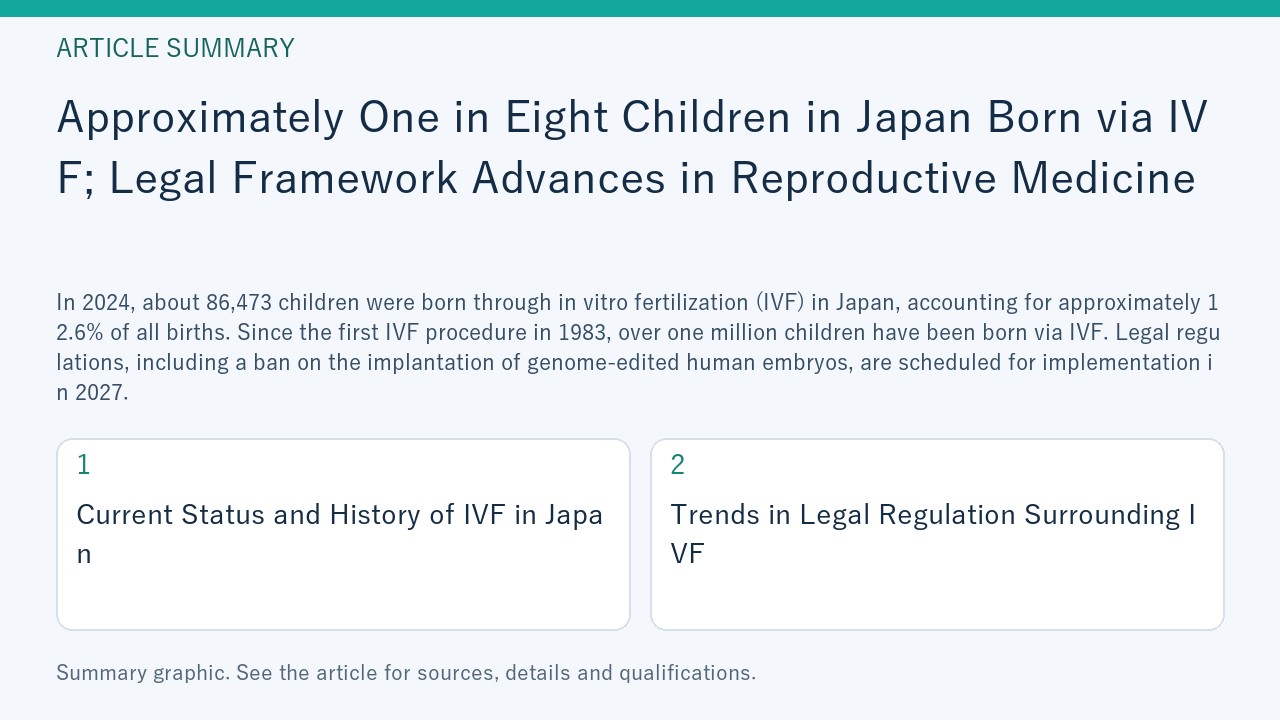
In 2024, the number of children born through in vitro fertilization (IVF) in Japan reached approximately 86,473, representing about 12.6% of all births—roughly one in eight children—the highest on record. Since IVF was first performed in Japan in 1983, more than one million children have been born using this method. Furthermore, in October 2026, draft guidelines concerning the handling of genome-edited human embryos will be issued, and from July 24, 2027, legal regulations prohibiting the implantation of genome-edited human embryos into humans or animals will be enacted. [1] [2]
Current Status and History of IVF in Japan
In 2024, approximately 86,473 children were born via in vitro fertilization (IVF) in Japan, accounting for about 12.6% of all births—roughly one in eight children—setting a new record. These figures are based on population statistics from the Ministry of Health, Labour and Welfare and the 2024 ART Data Book published by the Japan Society of Obstetrics and Gynecology. The data clearly show that IVF plays an important role in births in Japan. The total number of births in 2024 was 686,173, and while the proportion of IVF births is increasing, the total number of IVF treatments decreased compared to the previous year. [2]
IVF was first performed in Japan at Tohoku University in 1983. Since then, by 2023, over one million children have been born through IVF. IVF is an infertility treatment that fertilizes eggs and sperm outside the body before transferring the embryo back into the uterus. It has become a vital medical procedure supporting pregnancy and childbirth in Japan. Medical quality improvements continue while adapting to diversification of treatments and changes in patient backgrounds. The peak number of treatments is concentrated among women aged 39 to 42. [1]
Trends in Legal Regulation Surrounding IVF
In October 2026, the Children and Families Agency, Ministry of Education, Culture, Sports, Science and Technology, and Ministry of Health, Labour and Welfare will issue draft guidelines concerning the handling of genome-edited human embryos. These guidelines are based on the Act on Regulation of Handling of Genome-Edited Human Embryos (Act No. 70 of 2026), scheduled to come into effect on July 24, 2027. The law prohibits the implantation of genome-edited human fertilized embryos or germ cells into humans or animals, with violations punishable by imprisonment of up to 10 years or fines of up to 10 million yen. [3]
This legal framework aims to ensure the safety and ethical standards of reproductive medical technologies, including IVF. The draft guidelines limit research uses of genome-edited human embryos and impose strict conditions on handling human embryos within 14 days post-fertilization. After research concludes, embryos must be discarded, and researchers are required to prepare handling plans and submit them to the competent minister. Preparations for enforcement are progressing through public comments and ministerial ordinances. These developments highlight the importance of political action in establishing legal regulations. [3]
Sources and references
- [1] 8人に1人が体外受精児―日本産科婦人科学会 : 1985年以降、100万人以上誕生 | nippon.com — www.nippon.com
- [2] ART(生殖補助医療)出生児は過去最多8万6,473人、約8人に1人に — prtimes.jp
- [3] ゲノム編集したヒト胚を人の胎内に移植する行為、来年7月24日から禁止 違反は10年以下の拘禁刑か1000万円以下の罰金 研究の指針案が合同会議に示される — jpjj.jp
This English edition was translated and reviewed using AI against the Japanese original and cited sources. Source titles remain in their original language.

コメント