


English translation of the Japanese article.
Key points
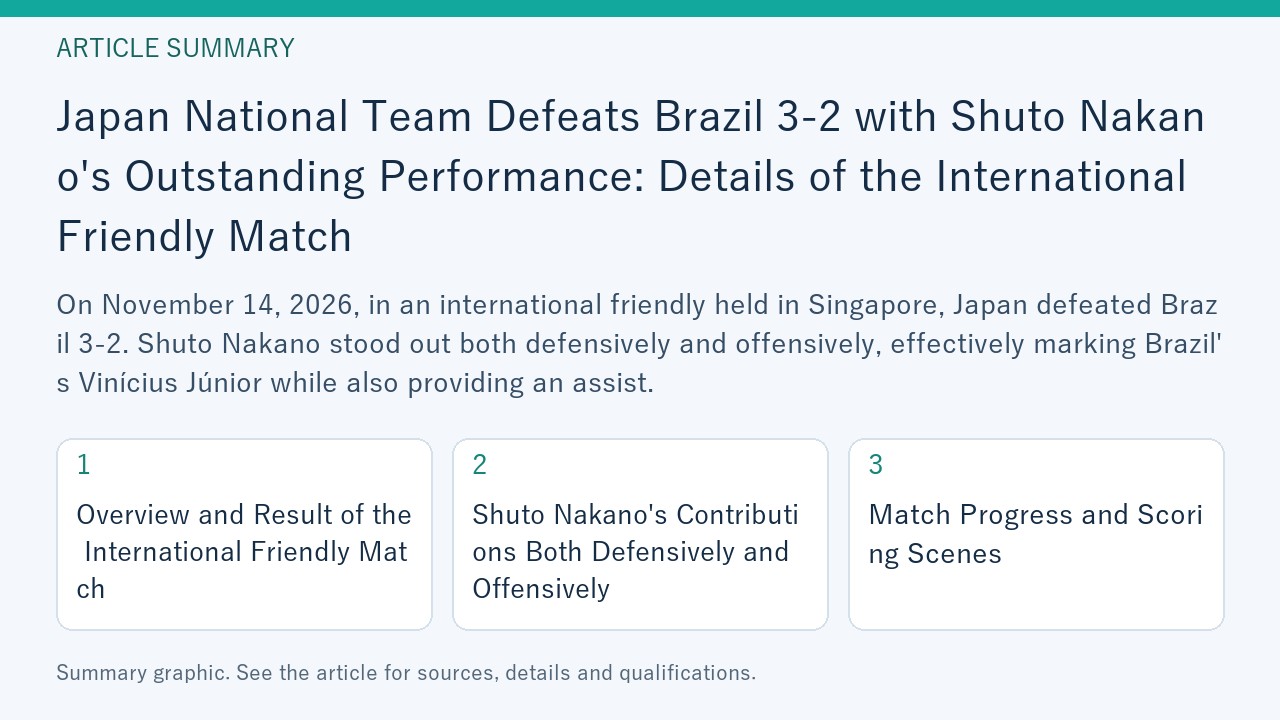
On November 14, 2026, at the Singapore National Stadium, the Japan national team secured a 3-2 victory over Brazil in an international friendly match. Right-back Shuto Nakano played a key role, restricting Brazil's Vinícius Júnior defensively and assisting Keito Nakamura's goal, earning high praise from Ritsu Doan and coach Moriyasu. The match took place under cloudy skies with a temperature of 28.5°C and humidity at 81%. [1] [2] [3]
Overview and Result of the International Friendly Match
The international friendly between Japan and Brazil was held on November 14, 2026, at the Singapore National Stadium under cloudy conditions with a temperature of 28.5°C and humidity of 81%. The match started at 19:16, featuring intense offense and defense from both teams. Japan took an aggressive approach from the start, with Takefusa Kubo scoring the opening goal at 15 minutes. At 19 minutes, Keito Nakamura extended the lead following a cross from Shuto Nakano. [1] [4]
Brazil responded at 33 minutes with a goal by Vinícius Júnior, narrowing the gap to one goal. Vinícius Júnior scored again at the 75th minute to equalize. However, in stoppage time, Tatsuhiro Sakamoto scored the winning goal, securing a 3-2 victory for Japan. The match was a significant achievement for the Japan national team amid fierce competition. It was held at the Singapore National Stadium under cloudy skies with a temperature of 28.5°C and humidity of 81%. [1]
Shuto Nakano's Contributions Both Defensively and Offensively
Starting as the right-back and the only domestic league player in the starting lineup, Shuto Nakano applied constant pressure on Brazil's Real Madrid forward Vinícius Júnior from the beginning, limiting his freedom on the pitch. Nakano maintained close marking and demonstrated a strong defensive presence. His performance earned high praise from teammate Ritsu Doan and coach Hajime Moriyasu. Offensively, at 19 minutes, Nakano broke through on the right flank and delivered a low cross to the front of the goal, which Keito Nakamura converted into a goal. [2] [3]
Nakano expressed pride in representing domestic players and credited his growth at Sanfrecce Hiroshima for his current form. Facing world-class opponents, he contributed an assist and pledged to continue improving and performing for the national team. His all-around performance was a major factor in Japan's victory. Nakano also expressed determination to continue delivering results in the upcoming match against Paraguay. [3]
Match Progress and Scoring Scenes
At 15 minutes, Takefusa Kubo scored with his left foot to give Japan the lead. At 19 minutes, Keito Nakamura scored a second goal from a cross by Shuto Nakano, making it 2-0. Brazil's Vinícius Júnior responded with a powerful shot at 33 minutes, reducing the deficit. He scored again at the 75th minute to level the match. The game remained tense and competitive. In stoppage time, Tatsuhiro Sakamoto received a cross from the right side and scored the winning goal, securing a 3-2 victory for Japan. [1] [4]
Both teams engaged in intense offensive and defensive battles. Despite Brazil's strong forward line, Japan's defense posed challenges. Japan disrupted Brazil's rhythm with high pressing and quick attacks, creating scoring opportunities. Shuto Nakano's contributions on both ends were particularly notable and directly linked to the team's success. The match at Singapore National Stadium attracted significant spectator attention and was a high-quality game. The result boosted the morale of the Japan national team ahead of future international matches, with expectations for continued exciting developments. [1]
Sources and references
- [1] 【公式】日本 vs ブラジルの試合結果・データ(代表親善試合:2026年11月14日) | Jリーグ公式サイト — www.jleague.jp
- [2] 「J1で抜きんでているんじゃないですか」ビニシウスに立ち向かったDF中野就斗を堂安律&森保監督も高評価 アシストに好守備 (2026年11月14日掲載) – ライブドアニュース — news.livedoor.com
- [3] 「広島の代表、国内代表として出た」先発唯一のJリーガー中野就斗、ブラジル撃破で見せた意地とプライド – 超WORLDサッカー! — web.ultra-soccer.jp
- [4] 【公式】日本 vs ブラジルの試合結果・データ(代表親善試合:2026年11月14日) | Jリーグ公式サイト — www.jleague.jp
This English edition was translated and reviewed using AI against the Japanese original and cited sources. Source titles remain in their original language.

コメント