


English translation of the Japanese article.
Key points
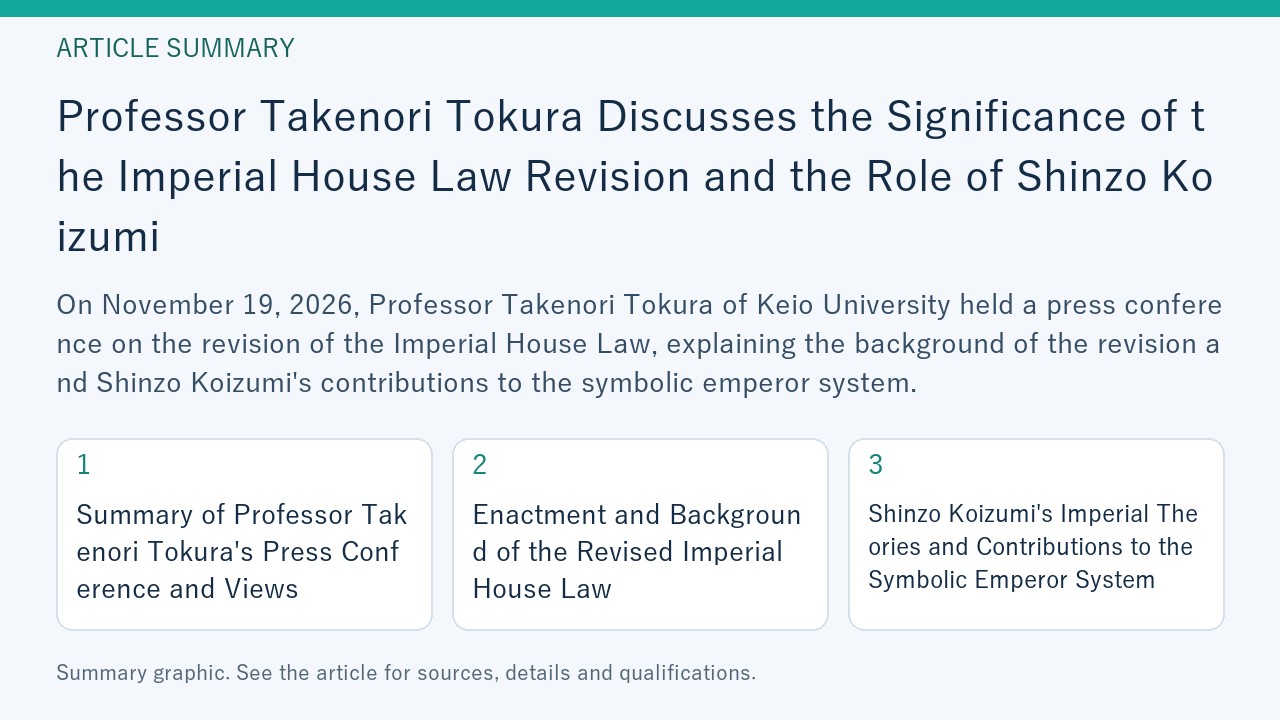
On November 19, 2026, Professor Takenori Tokura of Keio University held a press conference at the Japan National Press Club titled "Considering the Future of the Imperial Family from the Imperial Theories of Yukichi Fukuzawa and Shinzo Koizumi," where he expressed his views on the revision of the Imperial House Law. Professor Tokura pointed out that increasing the options for imperial succession and eliminating doubts about legitimacy are essential for stable succession. He also explained the background of the revised Imperial House Law enacted in July 2026 and Shinzo Koizumi's contributions to the construction of the symbolic emperor system. His remarks provide important insights for considering the future of the Imperial Family. [1] [3] [4]
Summary of Professor Takenori Tokura's Press Conference and Views
On November 19, 2026, Professor Takenori Tokura of Keio University held a press conference at the Japan National Press Club titled "Considering the Future of the Imperial Family from the Imperial Theories of Yukichi Fukuzawa and Shinzo Koizumi." Regarding the revision of the Imperial House Law, Professor Tokura emphasized the importance of increasing the options for imperial succession and eliminating doubts about legitimacy. Quoting Yukichi Fukuzawa, he stated that discussions about the Imperial Family are necessary. The content of this press conference was also reported by nippon.com on the same day. [1] [2]
Professor Tokura stated that for stable imperial succession, two points are indispensable: (1) increasing the options for succession, and (2) eliminating doubts about legitimacy. He believes these measures will stabilize the Imperial Family and deepen public understanding. Quoting Fukuzawa's phrase, "Only by viewing things lightly can one become lively," he encouraged the revitalization of discussions concerning the Imperial Family. These points provide important perspectives for future discussions on revising the Imperial House Law. [1]
Enactment and Background of the Revised Imperial House Law
On July 17, 2026, the revised Imperial House Law, which includes measures to secure the number of imperial family members, was enacted. This revision allows female imperial family members to retain their imperial status after marriage and permits the adoption of male-line male descendants from the former eleven princely houses. These measures were not permitted under the current Imperial House Law. This revision is the first substantial one since the postwar period, with discussions having begun during the administration of Prime Minister Junichiro Koizumi in 2005. [3]
Discussions on revising the Imperial House Law began during the Koizumi administration in 2005. At that time, the next generation of imperial family members consisted mainly of females, such as Princess Mako and Princess Kako of the Akishino family and Princess Aiko, daughter of the Crown Prince couple. Since the current law allows only male-line males to ascend the throne, there were concerns about a shortage of successors. In response, an expert panel was established to consider proposals allowing female emperors and female-line emperors, as well as maintaining male-line succession through reinstatement of former imperial family members. The panel ultimately concluded that "there is no gender in the symbol," indicating a direction toward accepting female and female-line emperors. However, subsequent political developments caused the discussions to stall temporarily. [3]
Shinzo Koizumi's Imperial Theories and Contributions to the Symbolic Emperor System
After World War II, Shinzo Koizumi supported the Imperial Family during a period of instability as the person fully entrusted with the education of the Crown Prince. He is known as a liberal who laid the foundation for the symbolic emperor system, including welcoming Empress Michiko. His role was crucial in stabilizing the Imperial Family amid the postwar upheaval. His life and thoughts are detailed in a book published by Chuokoron-Shinsha in 2018. [4] [5]
Before the war, Shinzo Koizumi was a liberal economist and intellectual known for his criticism of Marxism. Despite suffering severe burns from air raids during the war, he devoted himself after the war to the education of the Crown Prince and the stability of the Imperial Family. His ideology as an old liberalist helped him navigate the turbulent era marked by the rise of nationalism, war, and defeat, significantly contributing to the foundation of the symbolic emperor system. His life and philosophy are thoroughly introduced in the 2018 publication. [4]
Sources and references
- [1] 「皇室典範を考える」(2) 都倉武之・慶応義塾大学教授 | 日本記者クラブ JapanNationalPressClub (JNPC) — www.jnpc.or.jp
- [2] 【動画】【ノーカット】「皇室典範を考える 福沢諭吉・小泉信三の皇室論から考えるこれからの皇室」都倉武之・慶応大教授が会見 | nippon.com — www.nippon.com
- [3] 「特集」罪深きイデオロギー先行 皇室典範改正 — www.kyodo.co.jp
- [4] CiNii 図書 – 小泉信三 : 天皇の師として、自由主義者として — ci.nii.ac.jp
- [5] CiNii Books – 小泉信三 : 天皇の師として、自由主義者として — ci.nii.ac.jp
This English edition was translated and reviewed using AI against the Japanese original and cited sources. Source titles remain in their original language.


コメント