










English translation of the Japanese article.
Key points
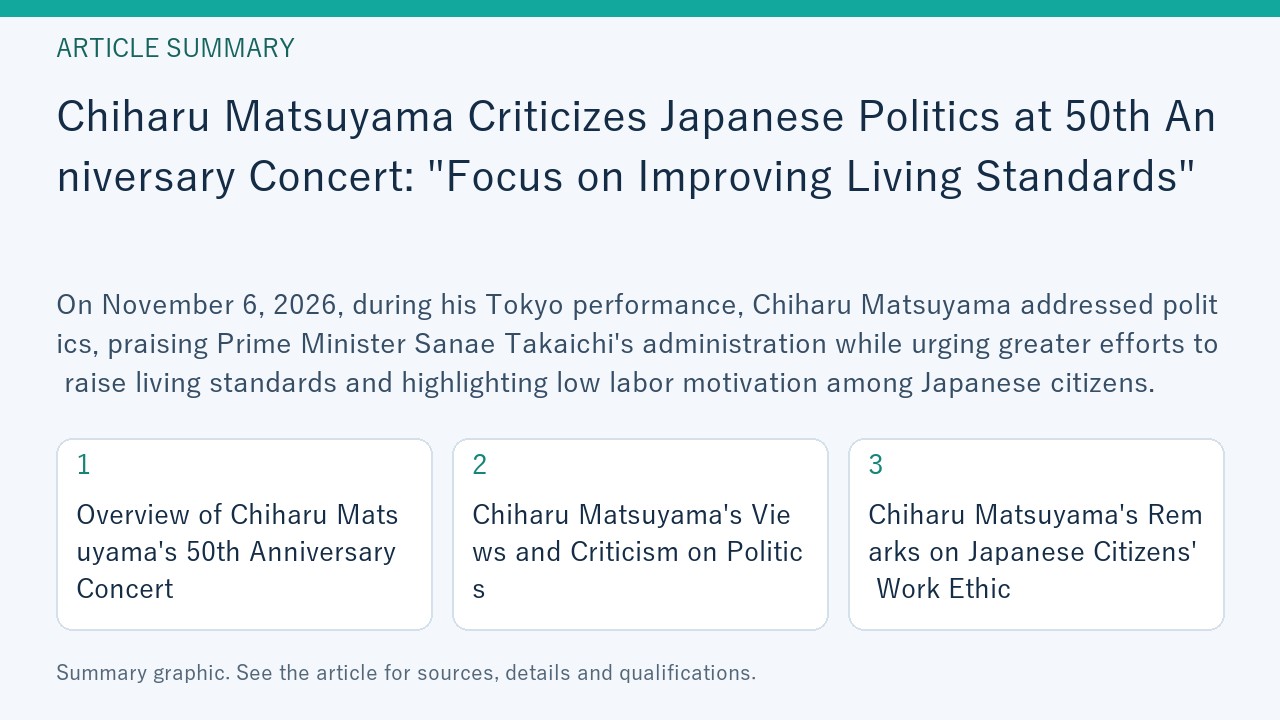
Singer-songwriter Chiharu Matsuyama voiced criticism of Japanese politics on November 6, 2026, at the Tokyo International Forum during the Tokyo leg of his 50th anniversary tour. While acknowledging that politics under Prime Minister Sanae Takaichi is progressing smoothly, he called for more political focus on improving living standards. He also commented on the low work ethic among Japanese people, emphasizing the importance of labor. Matsuyama's remarks have been widely covered in the media. [1] [2]
Overview of Chiharu Matsuyama's 50th Anniversary Concert
On November 6, 2026, Chiharu Matsuyama held the Tokyo performance of his 50th anniversary tour at the Tokyo International Forum. The concert was divided into two parts: the first focusing on love stories, and the second addressing social issues. According to multiple reports, singer Noriko Sakai also appeared that day and interacted with Matsuyama. The event was a grand celebration of Matsuyama's milestone year, with the tour scheduled to continue. [1] [2] [3]
Noriko Sakai appeared on stage during the double encore of the concert and received encouragement from Matsuyama. She shared the interaction on her Instagram, drawing significant responses from fans. Sakai, a veteran singer and actress who debuted in 1986, attended partly to celebrate Matsuyama's 50th anniversary. This exchange symbolized the bond between artists of the same generation in the music industry and was a poignant moment for fans. It also marked an important event reflecting on Matsuyama's long career. [3]
Chiharu Matsuyama's Views and Criticism on Politics
During the concert's MC segment, Chiharu Matsuyama stated that politics under Prime Minister Sanae Takaichi is progressing smoothly. He expressed his hope for Japan to be a peaceful and prosperous country and spoke about the importance of paying taxes properly. At the same time, he criticized political parties other than the Liberal Democratic Party for lacking clear policies, expressing concern about the current political situation. [1] [2]
Matsuyama further emphasized, "I want them to devote their efforts to raising everyone's living standards." He positioned improving quality of life as the most important political issue and called for policies directly linked to citizens' happiness. This message reflects a political demand focused on economic prosperity and stable living conditions, resonating with many citizens. His words attracted attention as a direct appeal to politicians. He also touched on the results of the U.S. midterm elections, showing interest in international political developments. [1]
Chiharu Matsuyama's Remarks on Japanese Citizens' Work Ethic
Matsuyama pointed out the low work ethic among Japanese citizens, stating, "Because people don't work, Japan has come to a level where it might lose to China and India." He stressed the importance of working and urged people to "work, work, and live happy lives." This comment links Japan's declining international competitiveness to issues with labor motivation and is seen as a call to enhance societal vitality. Matsuyama expressed a stance valuing individual effort and social development. [1]
He concluded by saying, "We all help each other, but we only live once. You all made a good choice by coming to Chiharu Matsuyama's concert today. That is a commendable and good choice." These words conveyed the importance of living positively with awareness of life's finiteness, warmly enveloping the concert atmosphere. His heartfelt message resonated with fans. Such remarks are based on his long experience and social perspective and may influence future political and social discussions. [1]
Sources and references
- [1] 松山千春 コンサートで日本政治に苦言「生活水準を上げることに、力をそそいでほしい」 – 音楽 : 日刊スポーツ — www.nikkansports.com
- [2] 松山千春 コンサートで日本政治に苦言「生活水準を上げることに、力をそそいでほしい」 (2026年11月6日掲載) – ライブドアニュース — news.livedoor.com
- [3] 酒井法子、松山千春50周年コンサートに登壇「人生色々あるけれど、頑張れよ」 — www.today-jp.com
This English edition was translated and reviewed using AI against the Japanese original and cited sources. Source titles remain in their original language.

コメント