








English translation of the Japanese article.
Key points
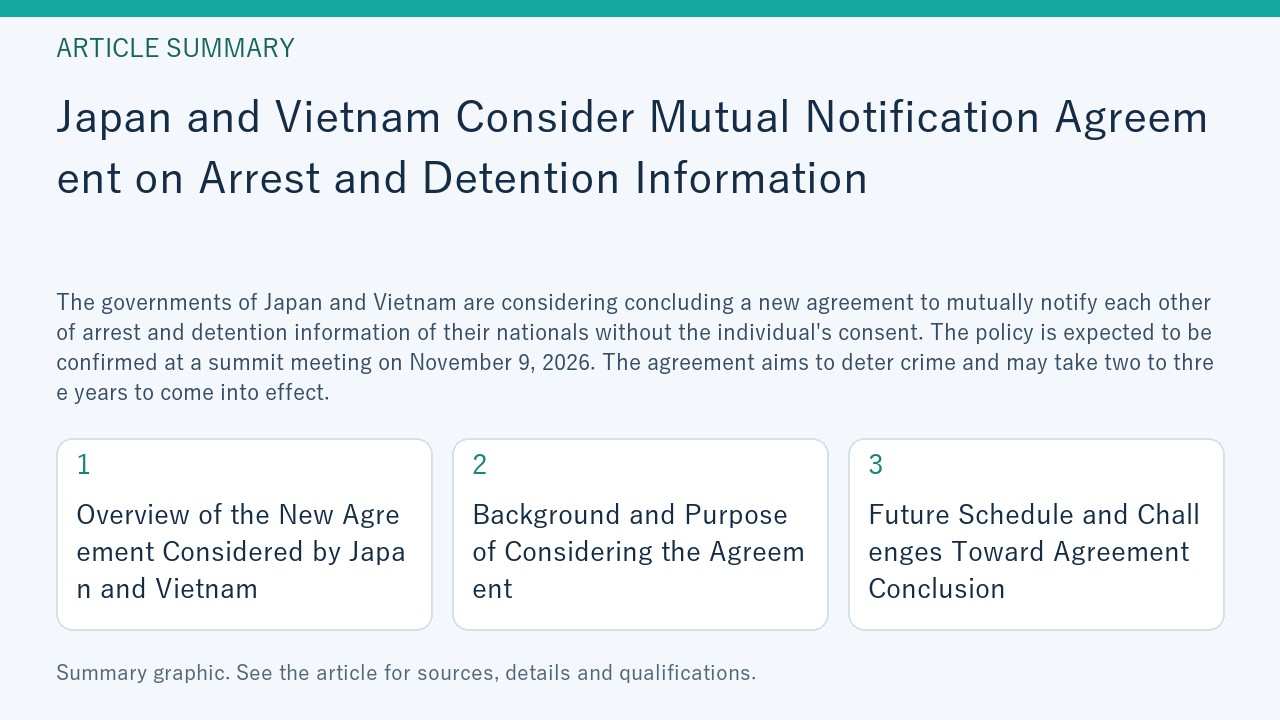
The governments of Japan and Vietnam have revealed that by November 3, 2026, they are considering concluding a new agreement to mutually notify each other of information regarding nationals arrested or detained within their territories without requiring the individual's consent. This agreement primarily aims to deter crimes committed by Vietnamese nationals, which have been increasing in Japan. The leaders of both countries are expected to confirm the policy for concluding the agreement at a summit meeting on November 9, 2026. The specific contents and effective date of the agreement will be decided through future discussions, and it may take two to three years before it comes into effect. [1] [2] [4]
Overview of the New Agreement Considered by Japan and Vietnam
The governments of Japan and Vietnam are considering concluding a new agreement to mutually notify each other of information about nationals arrested or detained within their territories without requiring the individual's consent. Unlike the traditional consular notification system, this agreement aims to establish an automatic notification system that does not require the individual's consent. Both countries have already concluded a mutual legal assistance treaty, and this new agreement is a framework specialized in notifying arrest and detention information. Japan has similar notification agreements with countries such as the United States, the United Kingdom, and China. The Japan-Vietnam agreement adopts the principle of reciprocity, whereby information is notified when nationals of either country are arrested in the other. [1] [2] [3] [4]
Through this new agreement, information about Japanese nationals arrested in Vietnam will also be promptly notified to the Japanese government, potentially aiding consular protection and safety confirmation. Previously, the consular notification system only notified information if the arrested or detained individual requested it, but the new agreement allows notification without the individual's consent, which is a significant feature. This is expected to enhance crime deterrence. Specific provisions regarding the scope of cases subject to notification, the range of information, and personal data protection measures will be decided through future discussions. [2] [4]
Background and Purpose of Considering the Agreement
The background for considering the new agreement includes an increase in crimes committed by Vietnamese nationals in Japan. According to statistics from the National Police Agency, in 2025, the number of arrests of Vietnamese nationals visiting Japan, excluding permanent residents, was approximately 10,773 cases, an increase of about 11% compared to the previous year, accounting for over 40% of all crimes committed by foreign nationals visiting Japan. The Japanese government expects that the Vietnamese authorities' prompt acquisition of arrest and detention information will contribute to crime deterrence. The organization and internationalization of crime are also progressing, necessitating strengthened criminal justice cooperation between countries. [1] [2] [3]
However, it should be noted that being arrested does not mean the individual has been convicted, and the principle of presumption of innocence applies. Notifying arrest information without the individual's consent requires careful system design from a human rights protection perspective. Issues such as correction in cases of mistaken arrest, information retention periods, and notification to the individual are challenges. Balancing individual rights protection and crime deterrence is emphasized. The current agreement is being considered with such human rights considerations in mind. [3]
Future Schedule and Challenges Toward Agreement Conclusion
On November 9, 2026, Prime Minister Sanae Takaichi and Communist Party Secretary General and State President Võ Văn Thưởng are expected to meet and confirm the policy for concluding the new agreement. Specific provisions of the agreement, the scope of cases subject to notification, and information handling will be decided through future discussions. The agreement's enforcement requires negotiations between the countries and domestic procedures, and since it involves revising principles of the Vienna Convention, it may take two to three years to come into effect. This is due to international legal procedures and human rights considerations, requiring careful system design. [1] [2] [3] [4]
This agreement will not be established solely by an agreement between the leaders but requires drafting provisions between the governments and domestic ratification procedures. In Japan, parliamentary approval is generally required. Since the agreement allows notification of arrest and detention information without the individual's consent, it is necessary to fully consider consistency with domestic laws and protection of individual human rights. Future discussions will also consider the scope of cases and information subject to notification and procedures for correction in cases of mistaken arrest. The agreement will come into effect only after these challenges are addressed. [3] [4]
Reciprocity and Expectations for Consular Protection
The new agreement adopts the principle of reciprocity, so when Japanese nationals are arrested or detained in Vietnam, information will also be promptly notified to the Japanese government. This enables Japanese consular authorities to quickly grasp the facts and provide safety confirmation and consular assistance. It is expected to be a system that helps protect the rights of Japanese nationals abroad. Reciprocity is based on mutual trust between the two countries and contributes to ensuring the safety of nationals of both countries. [2] [3]
This mutual notification system enables prompt information sharing when nationals of either country are arrested or detained in the other, contributing to enhanced consular protection. When Japanese nationals are detained in Vietnam, the Japanese government can quickly understand the situation, facilitating appropriate support and safety confirmation. This strengthens the trust relationship between the two countries and is expected to balance international crime deterrence and human rights protection. Specific operational methods are expected to be decided in future discussions. [2]
Sources and references
- [1] Japan and Vietnam consider new pact to prevent crimes — www.japantimes.co.jp
- [2] 日越が逮捕情報の相互通報協定を検討 本人同意なし、11月9日首脳会談で確認へ – JP-NewsFocus — jp-newsfocus.com
- [3] なぜ日本政府はベトナム人の逮捕情報を本国に通報する協定を検討するのか――国際刑事司法、国家主権、人権保障から読み解く日越協定の意味|仲島池哉@仲池屋 — note.com
- [4] 日本とベトナム、逮捕情報の相互通報を検討 新協定で何が変わる? : にゃんころジャーナル — jijiscope.blog.jp
This English edition was translated and reviewed using AI against the Japanese original and cited sources. Source titles remain in their original language.

コメント