


English translation of the Japanese article.
Key points
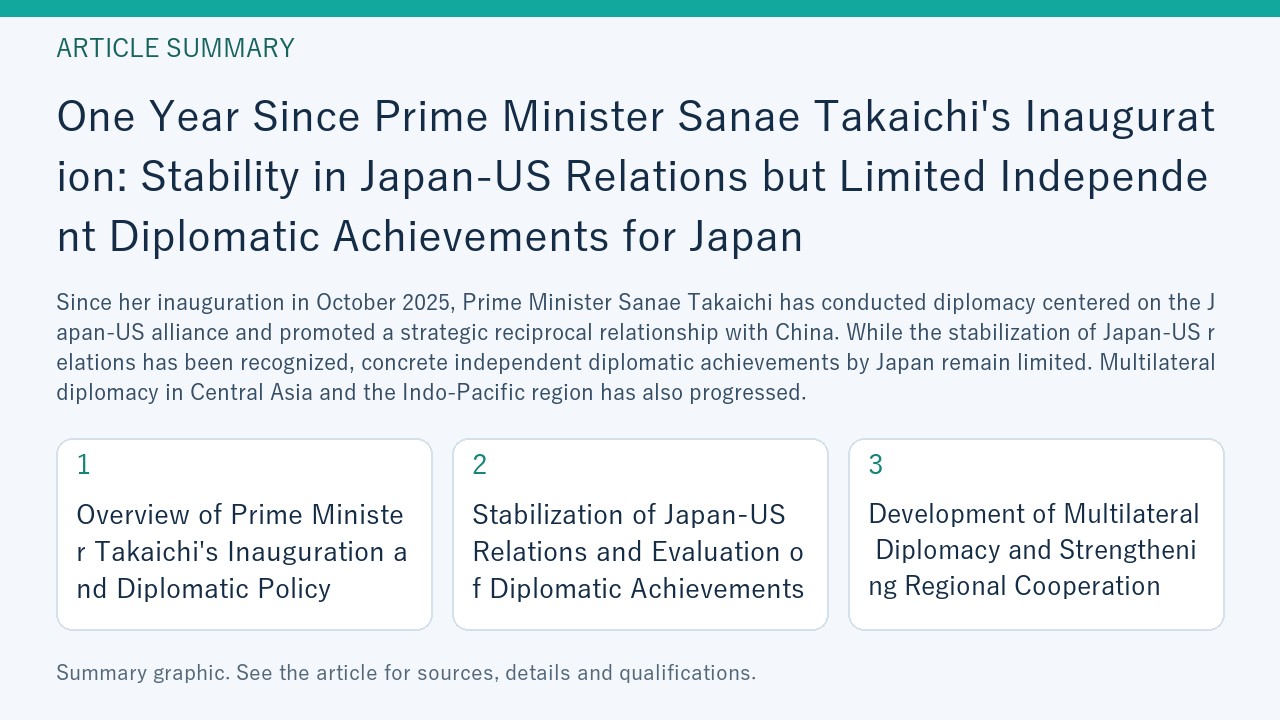
Prime Minister Sanae Takaichi took office on October 21, 2025, as Japan's first female prime minister. In her policy speech to the Diet in February the following year, she declared that diplomacy and security policies would be developed based on the Japan-US alliance. As of November 2026, the stabilization of Japan-US relations has received some recognition, but concrete realizations of Japan's independent diplomatic achievements remain limited. Political dialogue with China has stagnated, and mechanisms for managing tensions in the East China Sea and Taiwan Strait have not functioned adequately. Multilateral diplomacy has advanced through summit meetings with the five Central Asian countries and efforts to strengthen economic security in the Indo-Pacific region. [1] [2] [6]
Overview of Prime Minister Takaichi's Inauguration and Diplomatic Policy
Prime Minister Sanae Takaichi assumed office on October 21, 2025, becoming Japan's first female prime minister. On February 20, 2026, she delivered a policy speech to the House of Representatives, outlining a plan to develop diplomacy and security policies centered on the Japan-US alliance. She emphasized deepening multilateral security cooperation with countries sharing fundamental values such as freedom, democracy, human rights, and the rule of law, and explicitly stated the promotion of a strategic reciprocal relationship with China. This stance indicated an aim to strengthen cooperation among Japan, the US, South Korea, Australia, and India. [2] [6]
This diplomatic policy aims to protect Japan's independence and peace amid the most severe postwar security environment, while guiding a world increasingly divided and confrontational toward openness and cooperation. The Takaichi administration pursues "responsible Japanese diplomacy," seeking to actively fulfill Japan's role in the international community. Regarding relations with China, it aims to build a constructive and stable relationship while responding calmly and appropriately from the perspective of national interests. This forms the foundation of Takaichi's diplomacy. [6]
Stabilization of Japan-US Relations and Evaluation of Diplomatic Achievements
In its first year, the Takaichi administration's stabilization of Japan-US relations has received some recognition. Success in building relations with the Trump administration and strengthening the Japan-US alliance are acknowledged as diplomatic achievements. However, many point out that concrete results linking this stabilization to Japan's independent diplomatic goals have been limited. Japan has not yet restored political dialogue with China nor presented an independent order concept directed at Asia and the world. This is considered the current extent of Takaichi's diplomacy. [1]
Although the administration advocates a "strategic reciprocal relationship" with China, political dialogue has stagnated, and diplomatic channels for managing tensions in the East China Sea and Taiwan Strait have not functioned sufficiently. On October 31, 2026, Prime Minister Takaichi held her first summit meeting with President Xi Jinping, directly conveying concerns including the East China Sea issues involving the Senkaku Islands, rare earth export controls, and the detention of Japanese nationals. However, fundamental resolutions were not achieved. These circumstances remain challenges for Japan's diplomatic strategy. [1] [3]
Development of Multilateral Diplomacy and Strengthening Regional Cooperation
On December 20, 2025, Prime Minister Takaichi held the first summit meeting in Tokyo with the five Central Asian countries (Kazakhstan, Kyrgyzstan, Uzbekistan, Tajikistan, and Turkmenistan), adopting the "Tokyo Declaration." The declaration emphasized promoting mutually beneficial projects focused on three areas: greening, resilience, connectivity, and human resource development, highlighting strengthened cooperation with Central Asia. The goal is to implement private-sector projects totaling approximately 3 trillion yen over the next five years. [5]
In May 2026, she visited Vietnam and Australia, expressing the evolution of a "free and open Indo-Pacific." Emphasis was placed on strengthening economic security, including support for crude oil procurement at Vietnam's Nghi Son refinery, reinforcement of rare earth supply chains, and cooperation in the AI field. These moves are positioned as strategic responses to China's economic coercion. Additionally, Japan has advanced arms exports to neighboring countries and sought to strengthen defense cooperation. [4]
On October 31, 2026, Prime Minister Takaichi held her first summit meeting with President Xi Jinping, directly conveying various concerns including East China Sea issues. After the meeting, she stated that both sides confirmed the broad policy of a strategic reciprocal relationship and building a constructive and stable relationship. Meanwhile, China requested implementation of political agreements related to historical issues, highlighting ongoing challenges between the two countries. These developments in multilateral diplomacy are part of Japan's efforts to enhance its international presence. [3]
Sources and references
- [1] 日米関係の安定を、日本独自の外交成果に変えられたか
言論フォーラム「高市外交1年、日本は世界で何を実現できたのか」―米中主導の力の政治と失われた日本の存在感―
/ 特定非営利活動法人 言論NPO【「議論の力」で強い民主主義をつくり出す】 — www.genron-npo.net - [2] Premiership of Sanae Takaichi – Wikipedia — en.wikipedia.org
- [3] 高市総理 初の日中首脳会談で東シナ海問題など懸念を直接伝える | TBS CROSS DIG with Bloomberg — newsdig.tbs.co.jp
- [4] 高市総理「自由で開かれたインド太平洋」進化へ 経済安保で各国と連携も 中国は反発 — news.tv-asahi.co.jp
- [5] 【速報】高市首相 中央アジア5カ国と初の首脳会合で成果強調「互恵的協力関係を一層引き上げる」 中露を意識し関係強化へ 「東京宣言」を採択|FNNプライムオンライン — www.fnn.jp
- [6] 【速報】“高市内閣2.0”施政方針演説(5)外交・安全保障 「「平和と繁栄を創る『責任ある日本外交』」を展開」 全ての拉致被害者の帰国「私の任期中に実現したい」と決意表明|FNNプライムオンライン — www.fnn.jp
This English edition was translated and reviewed using AI against the Japanese original and cited sources. Source titles remain in their original language.
コメント