


English translation of the Japanese article.
Key points
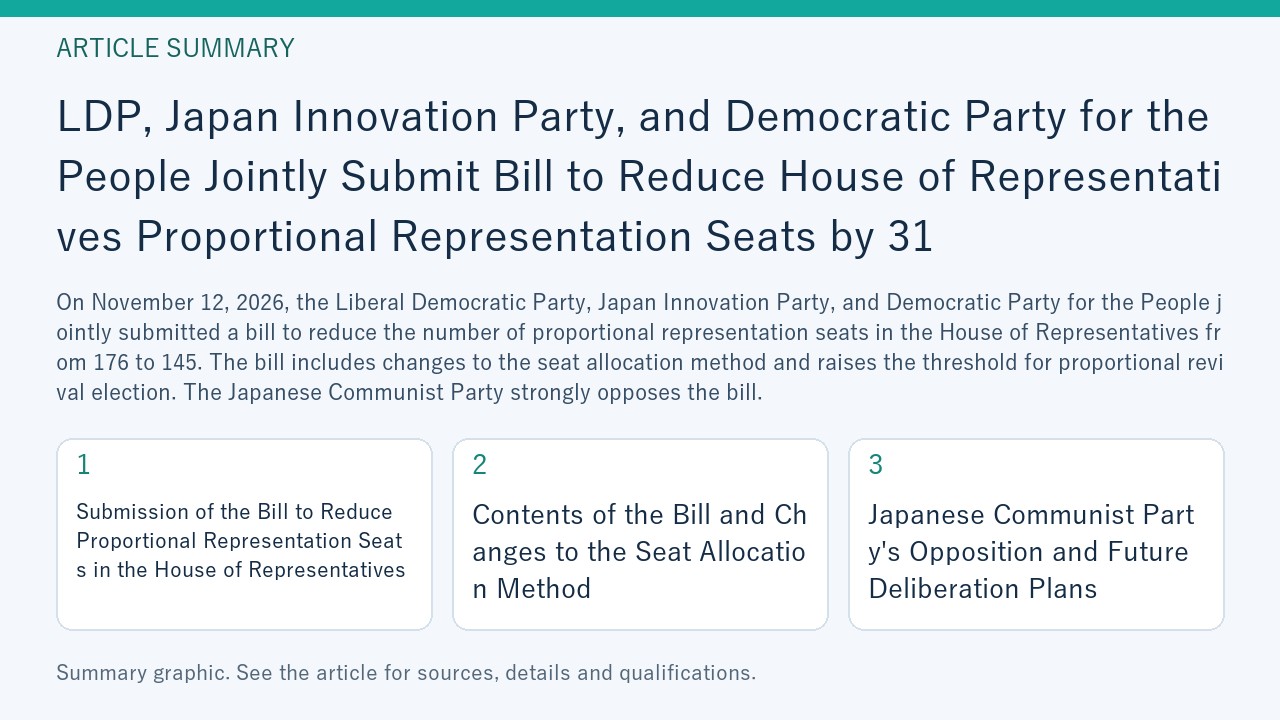
On November 12, 2026, the Liberal Democratic Party, Japan Innovation Party, and Democratic Party for the People jointly submitted a bill to reduce the number of proportional representation seats in the House of Representatives from 176 to 145. This bill is based on the estimated 6.7% population decline projected for 2030 (Reiwa 12), changes the seat allocation method from the D'Hondt method to the modified Sainte-Laguë method, and includes the integration of the Chugoku and Shikoku blocks. The Japanese Communist Party has strongly protested against the bill and demands its withdrawal. The bill aims to be enacted during the current Diet session, with deliberations expected to begin early next week. [1] [2] [3]
Submission of the Bill to Reduce Proportional Representation Seats in the House of Representatives
On November 12, 2026, the Liberal Democratic Party, Japan Innovation Party, and Democratic Party for the People jointly submitted a bill to reduce the number of proportional representation seats in the House of Representatives from 176 to 145, a reduction of 31 seats. This bill is based on the estimated 6.7% population decline projected for 2030 (Reiwa 12) and aims for enforcement in 2027, targeting enactment during the current Diet session. The bill changes the seat allocation method from the traditional D'Hondt method to the modified Sainte-Laguë method and includes the integration of the Chugoku and Shikoku blocks. After the reduction, the number of seats per block will be: Hokkaido 6 (down 2), Tohoku 10 (down 2), North Kanto 16 (down 3), South Kanto 19 (down 4), Tokyo 16 (down 3), Hokuriku-Shinetsu 8 (down 2), Tokai 17 (down 4), Kinki 23 (down 5), Kyushu-Okinawa 17 (down 3), and the combined Chugoku-Shikoku block will have 13 seats. [1] [2] [3] [4]
Regarding the bill submission, LDP's Katsunobu Kato, head of the system reform headquarters, stated that the three parties will work together to strive for enactment. The ruling parties plan to begin deliberations in a special committee early next week and aim to pass the bill through the House of Representatives within the month. Enactment during the current Diet session is anticipated. Opposition parties continue to negotiate, requesting preliminary deliberations on political funding issues. The Japanese Communist Party is particularly strongly opposed to the bill. [1] [6]
Contents of the Bill and Changes to the Seat Allocation Method
The bill changes the proportional representation seat allocation method from the traditional D'Hondt method to the modified Sainte-Laguë method and raises the threshold for proportional revival election of candidates who lost in single-member districts from one-tenth to one-sixth of the total valid votes. It also includes a provision that if the number of candidates listed on the proportional representation list is insufficient, vacancies will be left unfilled. The modified Sainte-Laguë method may make it more difficult for small parties to gain seats, raising the threshold for seat acquisition and thus disadvantaging small and medium-sized parties. After the reduction, the number of seats per block will be: Hokkaido 6 (down 2), Tohoku 10 (down 2), North Kanto 16 (down 3), South Kanto 19 (down 4), Tokyo 16 (down 3), Hokuriku-Shinetsu 8 (down 2), Tokai 17 (down 4), Kinki 23 (down 5), Kyushu-Okinawa 17 (down 3), and the combined Chugoku-Shikoku block will have 13 seats. [2] [3] [5]
With the introduction of the modified Sainte-Laguë method, estimates indicate that the ruling parties' overall seat share will increase, making it more difficult for minority parties to secure seats. Under the traditional Sainte-Laguë method, some small parties had a chance to win seats, but the modified method raises the threshold, potentially preventing small parties such as the Life Party, Japan Conservative Party, and Tax Reduction Japan-Yuukoku Alliance from obtaining seats. This could reduce the function of proportional representation and diminish the reflection of diverse public opinions. [5]
Japanese Communist Party's Opposition and Future Deliberation Plans
On November 12, 2026, Tomoko Tamura, chairperson of the Japanese Communist Party, held a press conference at the Diet, firmly protesting the bill to reduce the House of Representatives proportional representation seats by 31 and strongly demanding its withdrawal. Tamura pointed out that the current number of Diet members is historically and internationally low and argued there is no justification for reducing the House of Representatives seats. She criticized the reduction of proportional representation seats as a regression in reflecting diverse public opinions and as strengthening the single-member district-centered system. Furthermore, she warned that the bill would increase the ruling parties' seat share and create an electoral system that permits authoritarian politics. [2]
Meanwhile, LDP's Katsunobu Kato, head of the system reform headquarters, stated that the three parties jointly submitted the bill and will work toward its enactment. The ruling parties plan to begin deliberations in a special committee early next week and aim to pass the bill through the House of Representatives within the month. Opposition parties continue to negotiate, requesting preliminary deliberations on political funding issues, but the ruling parties aim for enactment during the current Diet session. Future deliberation developments are being closely watched. [1] [6]
Sources and references
- [1] 衆院比例31議席削減法案 自維国3党で午後提出へ — news.tv-asahi.co.jp
- [2] 与党の独裁政治許す比例削減/31削減法案に抗議/田村委員長撤回求める | しんぶん赤旗|日本共産党 — www.jcp.or.jp
- [3] 衆院定数削減法案を国会に提出 | お知らせ | ニュース | 自由民主党 — www.jimin.jp
- [4] 定数削減法案、12日に提出へ 自維国、今国会成立目指す(共同通信)|熊本日日新聞社 — kumanichi.com
- [5] 比例削減 自維国案の狙い | しんぶん赤旗|日本共産党 — www.jcp.or.jp
- [6] 衆議院比例定数31減法案を提出 自維国3党共同で — news.tv-asahi.co.jp
This English edition was translated and reviewed using AI against the Japanese original and cited sources. Source titles remain in their original language.
コメント