














English translation of the Japanese article.
Key points
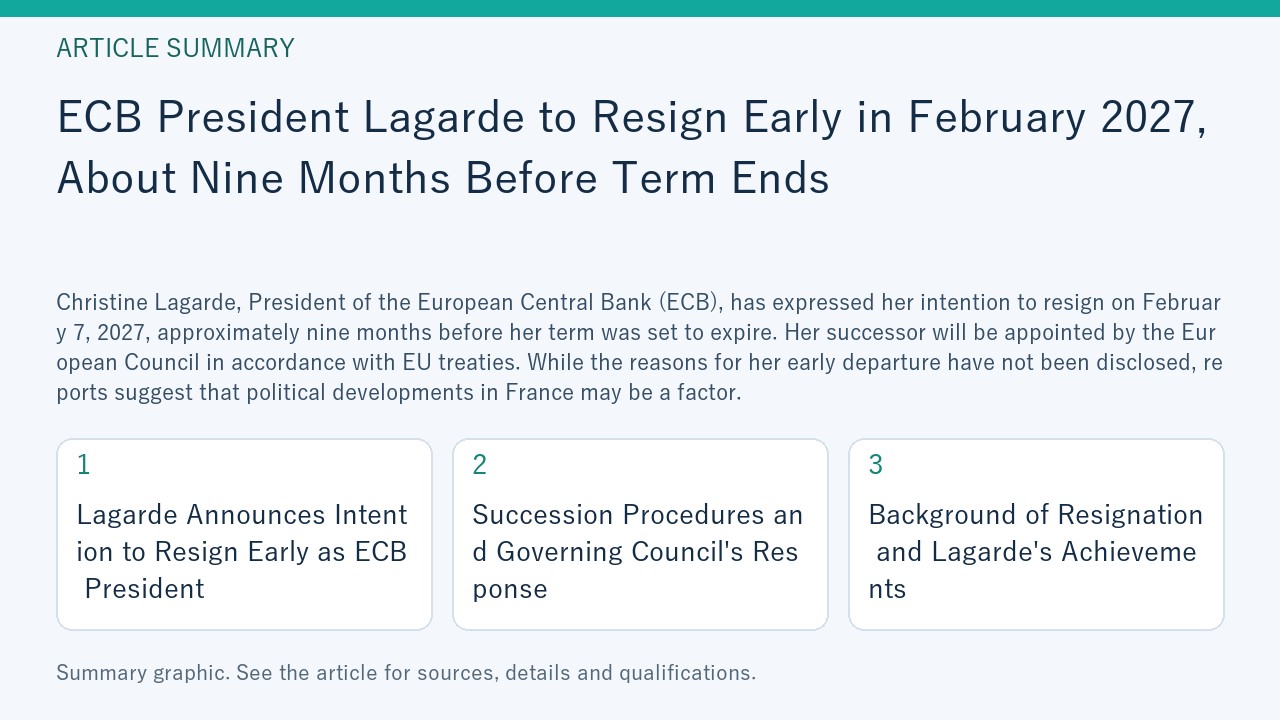
Christine Lagarde, President of the European Central Bank (ECB), has informed the ECB Governing Council of her intention to resign on February 7, 2027, about nine months before her term was due to end in late October 2027. Lagarde took office in November 2019 and has overseen crisis responses including the COVID-19 pandemic and the war in Ukraine. Her successor will be appointed by the European Council following procedures under Article 283 of the Treaty on the Functioning of the European Union. Although no explicit reason for her resignation has been given, reports indicate that escalating political tensions in her home country of France may be a contributing factor. [1] [2] [6]
Lagarde Announces Intention to Resign Early as ECB President
Christine Lagarde, President of the European Central Bank (ECB), has communicated her intention to resign on February 7, 2027, to the ECB Governing Council and Antonio Costa, the permanent President of the European Council. Her original term was scheduled to end in late October 2027, so this represents an early departure by about nine months. This decision is unusual even for the ECB Governing Council. The announcement of her intention was made public on October 29, 2026. Lagarde expressed pride in having served the ECB via social media but did not comment on the reasons for her resignation. [1] [2] [3] [6]
Lagarde assumed the ECB presidency in November 2019 and during her tenure has managed multiple crises faced by Europe, including the COVID-19 pandemic, Russia's invasion of Ukraine, and the energy crisis. Her term is eight years, and she will have served approximately seven years and three months by the time of her resignation. This announcement ends months of speculation regarding her future. [6]
Succession Procedures and Governing Council's Response
Lagarde's successor will be appointed by the European Council following procedures under Article 283 of the Treaty on the Functioning of the European Union. Specifically, the Council of the European Union, composed of ministers from member states, will recommend candidates. The European Parliament and the ECB Governing Council will be consulted, and then the European Council, composed of heads of state or government of member states, will appoint the successor by a qualified majority vote. The appointment requires a certain threshold of support both in terms of the number of member states and population. The term is non-renewable and lasts eight years. Following Lagarde's announcement, Antonio Costa, permanent President of the European Council, declared that the process to select her successor would commence. [1] [3] [5]
The ECB Governing Council expressed gratitude to Lagarde and gave her a prolonged standing ovation. Financial markets have not shown significant reactions, and experts have praised the ECB's organizational stability. Potential successors include Klaas Knot, former President of the Dutch central bank, and Pablo Hernández de Cos, former President of the Bank of Spain. The European Council must appoint a successor before Lagarde's resignation on February 7, 2027. [1] [2] [4]
Background of Resignation and Lagarde's Achievements
Lagarde's early resignation has attracted attention in light of political developments in her home country, France, and concerns about maintaining the ECB's independence. France is scheduled to hold a presidential election between April and May 2027, with far-right candidate Marine Le Pen considered a strong contender. According to sources, Lagarde has expressed her intention to resign in order to regain freedom of political expression. As ECB President, she was expected to maintain the institution's neutrality. [4] [2] [6]
Lagarde, originally a lawyer, served as Managing Director of the International Monetary Fund (IMF) from 2011 to 2019. Since becoming ECB President in November 2019, she has steered European monetary policy through challenging times including the COVID-19 pandemic, Russia's invasion of Ukraine, and the resulting energy crisis. Her experience has contributed to maintaining the ECB's credibility. Her plans after resignation have not been disclosed, though there are rumors about a possible move to the World Economic Forum (WEF). [6] [2]
Sources and references
- [1] ECB President Lagarde to step down on 7 February 2027 — www.ecb.europa.eu
- [2] Europe’s central bank chief Christine Lagarde to step down nine months early — www.theguardian.com
- [3] 📡 Signal|ラガルド ECB 総裁、任期を 9 か月近く残して退任へ — livemakers.com
- [4] ラガルドECB総裁、来年2月7日の退任発表 臆測に終止符 | ニューズウィーク日本版 オフィシャルサイト — www.newsweekjapan.jp
- [5] Christine Lagarde to leave ECB presidency on 7 February 2027, nearly nine months before term ends — 2eu.brussels
- [6] ECBのラガルド総裁、2027年2月に退任表明 — www.digitaltoday.co.kr
This English edition was translated and reviewed using AI against the Japanese original and cited sources. Source titles remain in their original language.


コメント