





English translation of the Japanese article.
Key points
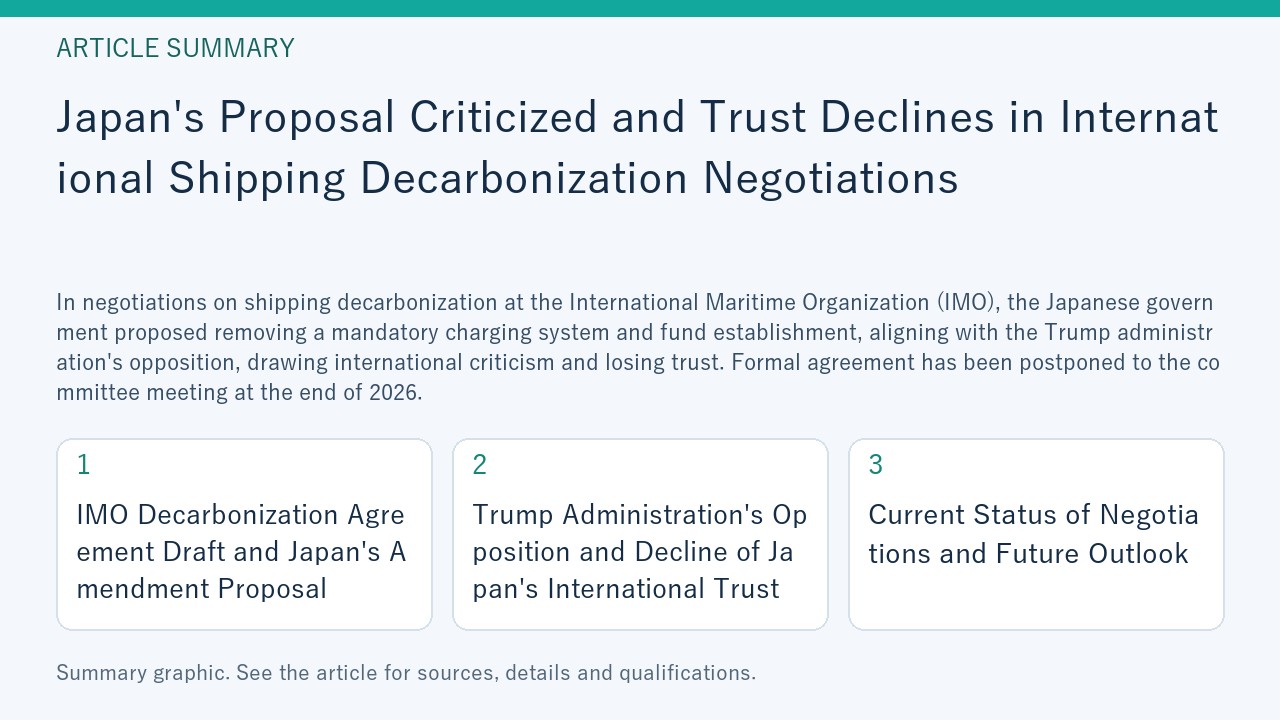
In negotiations on international shipping decarbonization led by the International Maritime Organization (IMO), the Japanese government submitted an amendment in April 2026 to remove the mandatory charging system based on emissions and the establishment of an IMO fund. However, it failed to gain support from many countries and was internationally criticized as aligning with the Trump administration's strong opposition, resulting in a decline in Japan's trust. The formal agreement has been postponed to the committee meeting scheduled from late November to December 2026. The future course of negotiations is attracting attention. [1] [3] [4] [5]
IMO Decarbonization Agreement Draft and Japan's Amendment Proposal
In April 2025, IMO member states in principle approved an international decarbonization agreement draft that included a charging system based on emissions from international shipping. This system was planned to be introduced from 2027, mandating payments according to emissions and allocating the funds to support developing countries and other purposes. Many countries, including Japan, evaluated this agreement as a "historic agreement." At the IMO Marine Environment Protection Committee meeting in April 2026, the Japanese government submitted an amendment to remove the mandatory charging system and fund establishment and to revise emission reduction targets, but it did not gain much support. [1]
Japan's amendment proposed deleting the mandatory charging system and not establishing a fund, instead implementing IMO-certified support projects through voluntary contributions from each country. This raised international concerns that the existing international carbon pricing framework would be undermined. The Japanese government explained that the amendment was a response to changes in the negotiation situation and took into account countries strongly opposing the system, but it failed to gain support from many countries. Domestic maritime industry groups such as the Japan Shipowners' Association initially supported the principle agreement. [1]
Trump Administration's Opposition and Decline of Japan's International Trust
The formal adoption at the IMO meeting in October 2025 was postponed because the U.S. Trump administration suddenly took a strong opposing stance, and oil-producing countries such as Saudi Arabia also opposed it. The Trump administration applied pressure including threats of sanctions and port fees to block adoption. This delayed the realization of the agreement. Japan's amendment was internationally criticized as aligning with the Trump administration's backward actions, and it has been pointed out that Japan's credibility at the IMO is at risk. Experts from the University of London in the UK have also called on Japan to return to its previous position. [1] [3]
Japanese government officials have refrained from making specific comments on negotiation details but stated that considering amendments responsive to changes in the situation and accommodating strongly opposing countries is necessary. Meanwhile, international criticism remains strong, and negotiators supporting the charging system view Japan's proposal as aligning with the Trump administration's backward actions. This has led to a decline in Japan's international reputation, raising concerns about impacts on diplomacy and industrial competitiveness. Japan's loss of trust is making negotiation progress difficult. [1]
Current Status of Negotiations and Future Outlook
Discussions continued at the IMO Greenhouse Gas Working Group in September 2026, aiming for a decision at the MEPC85 committee meeting held from late November to December, but the final agreement remains uncertain. According to researchers at the University of London, the majority support greenhouse gas pricing and a central fund, and Japan's proposal for direct contributions by shipowners was strongly rejected. Many member states support the existing charging system and fund framework. [2] [5]
In October 2026, Japan proposed abolishing the IMO Net Zero Fund. This would eliminate the mandatory charging system based on emissions from ships and instead rely on surplus units and direct industry contributions. This proposal shifts fund management from governments to private companies, raising international concerns about reduced support for developing countries and the possibility that companies might allocate funds within their own supply chains. Japan's proposal has been pointed out as potentially causing delays in negotiations. [4]
IMO negotiations remain difficult, and while agreement at MEPC85 from late November to December 2026 is anticipated, failure to reach agreement could cause further delays. The international community continues to demand effective rules for shipping decarbonization, and future negotiation trends are closely watched. Whether Japan's proposal will lead to recovery of international trust is also an important focus. [2] [4] [5]
Sources and references
- [1] 「船の脱炭素化」国際交渉で日本への信頼が低下も: 「トランプに同調」 – オルタナ — www.alterna.co.jp
- [2] 'Steady progress' in negotiations around shipping's climate rules, despite uncertain outcome — www.rivieramm.com
- [3] Q&A: How countries got the global 'net-zero' shipping deal ‘back on track’ – Carbon Brief — www.carbonbrief.org
- [4] Japan’s plan to drop the IMO Net-Zero Fund | Forwarder News — www.forwardernews.com
- [5] ISWG-GHG 22: UCL Sees Large Majority Continuing to Back GHG Pricing and Centralised Fund — Ship & Bunker — shipandbunker.com
This English edition was translated and reviewed using AI against the Japanese original and cited sources. Source titles remain in their original language.

コメント