


English translation of the Japanese article.
Key points
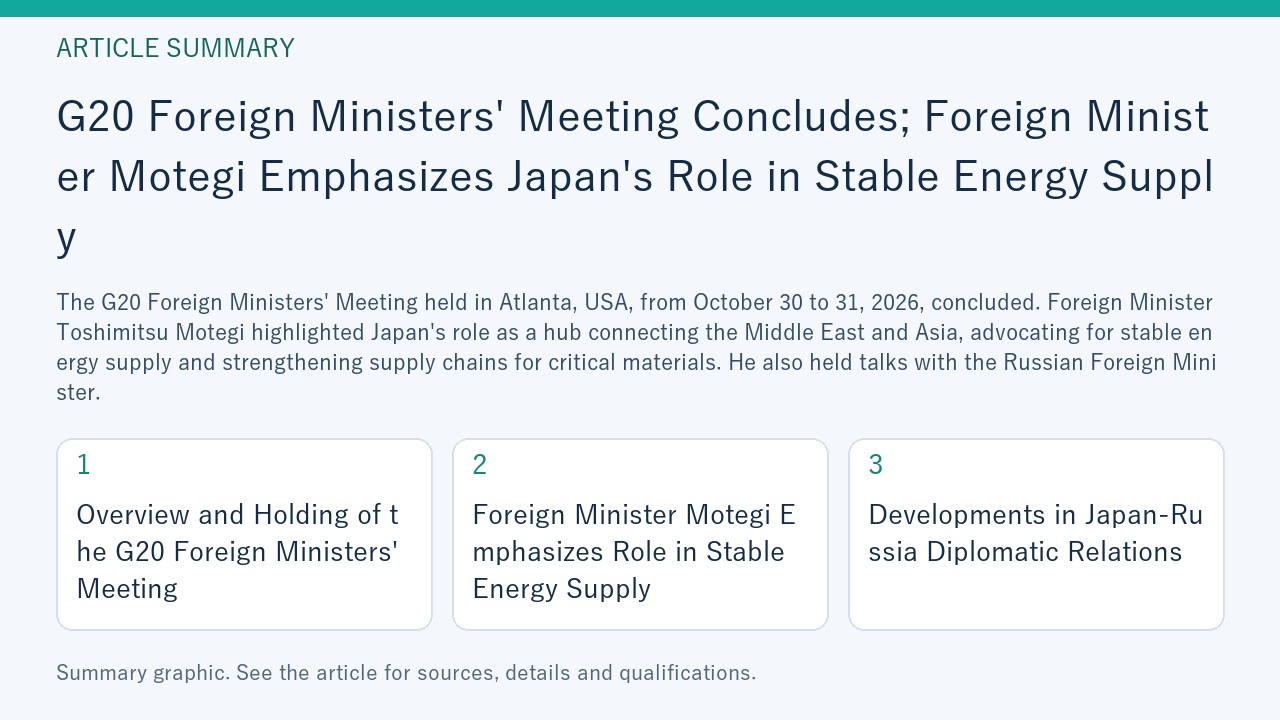
The G20 Foreign Ministers' Meeting, held from October 30 to 31, 2026, in Atlanta, Georgia, USA, has concluded. Foreign Minister Toshimitsu Motegi expressed Japan's proactive stance in contributing to the world's stable energy supply as a hub connecting oil-producing countries in the Middle East and consumer countries in Asia. The meeting discussed responses to the energy crisis caused by escalating tensions in the Middle East and strengthening supply chains for critical minerals. Due to divisions over Russia's invasion of Ukraine and the situation in Iran, no joint communiqué was issued, and the customary group photo was also canceled. [1] [2]
Overview and Holding of the G20 Foreign Ministers' Meeting
The G20 Foreign Ministers' Meeting was held over two days from October 30 to 31, 2026, in Atlanta, Georgia, USA, and concluded after discussions. The meeting was marked by deepening divisions over Russia's invasion of Ukraine and the situation in Iran, preventing agreement on major security issues and resulting in no joint communiqué being issued. Additionally, the customary group photo was canceled due to opposition from European countries to the participation of the Russian Foreign Minister. These factors made it difficult for the G20 to deliver a unified message. [1] [3]
The meeting, chaired by the United States, was divided into three sessions. Participating countries included Japan, the United States, Argentina, Australia, Brazil, Canada, China, France, Germany, India, Indonesia, Italy, South Korea, Mexico, Russia, Saudi Arabia, Turkey, the United Kingdom, the African Union, and the European Union, among others. South Africa was not on the list of participants. Although the outcomes of the meeting were limited, it laid the groundwork for discussions at the upcoming leaders' summit. [2] [3]
Foreign Minister Motegi Emphasizes Role in Stable Energy Supply
Foreign Minister Toshimitsu Motegi emphasized Japan's proactive role in ensuring the world's stable energy supply as a hub connecting oil-producing countries in the Middle East and consumer countries in Asia. In particular, he stressed the necessity of restoring free and safe navigation through the Strait of Hormuz and the Bab-el-Mandeb Strait in response to the energy crisis caused by escalating tensions in the Middle East. He noted that these straits are vital to global logistics and that easing military tensions is important. [1] [2]
Motegi also introduced initiatives such as "Power Asia," launched by Japan in April, explaining efforts to strengthen stockpiles and diversify energy sources among Asian countries. Furthermore, discussions addressed strengthening supply chains for critical minerals, food, and fertilizers. He pointed out that arbitrary export restrictions and non-market policies leading to excess production capacity are weakening global supply chains. Motegi presented Japan's active contributions, including strengthening a rules-based, free, and fair international economic order, proposals to reform WTO subsidy agreements, diversification of supply sources, changes in demand-side behavior, and concrete examples of food assistance. These proposals were recognized as important issues for stabilizing global supply chains. [2]
Developments in Japan-Russia Diplomatic Relations
During the G20 Foreign Ministers' Meeting, Foreign Minister Motegi held talks with Russian Foreign Minister Sergey Lavrov for the first time in about five years. In this meeting, Motegi strongly demanded the immediate release of a Japanese journalist detained on espionage charges. However, details of the discussions were not disclosed due to the involvement of protecting Japanese nationals. Motegi indicated his intention to continue communication with the Russian side and persistently engage in efforts. [1]
This meeting attracted attention as an important diplomatic move amid ongoing international tensions over Russia's invasion of Ukraine. On the other hand, European countries' strong opposition to Russia's participation, which led to the cancellation of the joint communiqué and group photo, symbolized the diplomatic difficulties of this meeting. Adjusting relations with Russia is expected to remain an important issue in Japan's future diplomatic strategy. Additionally, the Quad Foreign Ministers' Meeting of Japan, the United States, Australia, and India was held around the same time, confirming concerns about economic coercion and the importance of maintaining freedom of navigation. These multilateral diplomatic developments are key to regional stability and international cooperation. [3] [2]
Sources and references
- [1] エネルギー安定供給へ 茂木大臣が日本の役割強調 G20外相会合 閉幕 | KSBニュース | KSB瀬戸内海放送 — news.ksb.co.jp
- [2] G20外相会合、茂木外相が3会合で発言 海峡の航行回復と過剰生産を提起 — jpjj.jp
- [3] G-20 foreign ministers end Atlanta meeting without consensus on key issues — www.latimes.com
This English edition was translated and reviewed using AI against the Japanese original and cited sources. Source titles remain in their original language.
コメント