


English translation of the Japanese article.
Key points
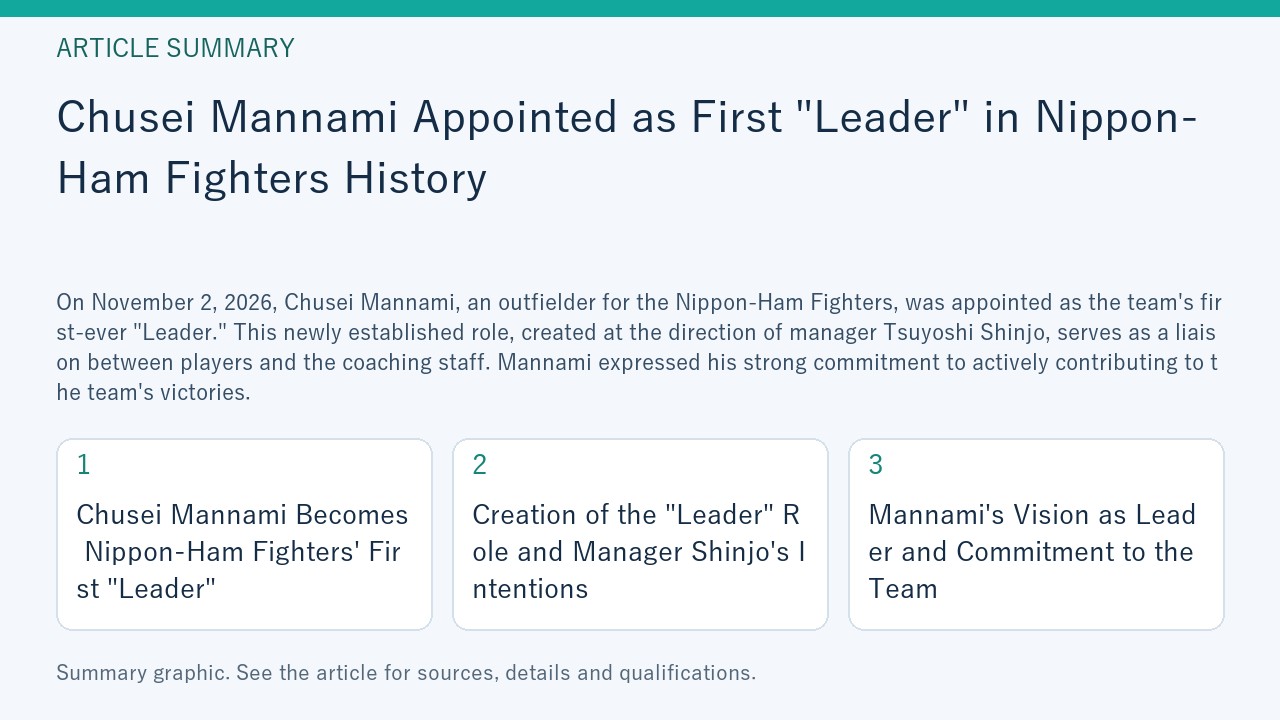
On November 2, 2026, 26-year-old outfielder Chusei Mannami of the Nippon-Ham Fighters was appointed as the team's first "Leader." This position was newly created under the direction of manager Tsuyoshi Shinjo and differs from the traditional captain role. Mannami addressed the team during the autumn training camp, expressing his intention to serve as a liaison to align opinions between players and the coaching staff and to contribute to the team's success. He plans to increase opportunities for player discussions and aims to build a team environment where members can openly confront each other. Manager Shinjo is also considering introducing a "Leader Mark." [1] [2] [4]
Chusei Mannami Becomes Nippon-Ham Fighters' First "Leader"
On November 2, 2026, outfielder Chusei Mannami was appointed to the newly established role of "Leader," the first such position in the Nippon-Ham Fighters organization. He was directly appointed by manager Tsuyoshi Shinjo and greeted the players during the autumn training camp on the same day. Mannami is 26 years old and entering his ninth professional season. This new role represents a different status from the traditional team captain. Manager Shinjo has expressed his intention to strengthen team unity through this position. Mannami is the first player to take on a captain-like role under Shinjo's management. [1] [4]
On the fourth day of the first training camp session, Mannami addressed the team in a huddle and later held a press conference after practice. He stated, "We should all—managers, coaches, and players alike—sit together to discuss with the goal of winning as a team." He expressed his determination to actively work toward the team's victories. Aware of his role as a liaison to align opinions between players and the coaching staff, Mannami also expressed his intention to improve the team's atmosphere. He has already begun communicating with the young pitchers and plans to increase opportunities for discussions among players. [2] [4]
Creation of the "Leader" Role and Manager Shinjo's Intentions
The "Leader" position differs from the traditional captain role and was newly created at the direction of manager Tsuyoshi Shinjo. Shinjo has stated, "I don't want to have a captain like the other 11 teams," seeking a unique title. The introduction of a "Leader Mark" is also under consideration, aiming to establish a distinctive leadership image different from other teams. This initiative is intended to enhance team cohesion and openness. Mannami's selection as the inaugural holder of this new role reflects the manager's trust in him. [1] [3] [4]
Manager Shinjo emphasizes creating a culture where players' opinions can be conveyed to the manager, coaches, and the organization. Mannami is expected to increase player meetings and encourage active discussions. Rather than one-way communication, the goal is to promote multifaceted exchanges of opinions to improve overall team performance. Mannami's appointment as Leader holds significant meaning within Shinjo's unique approach to team management and player utilization. [4]
Mannami's Vision as Leader and Commitment to the Team
Upon his appointment, Chusei Mannami declared his vision, stating he wants to create a team where members can openly confront each other. He aims to serve as a liaison to align opinions between players and the coaching staff, fostering an environment where everyone can participate in discussions easily. Prioritizing team victories, he is strongly motivated to activate communication among players. Mannami has been actively exchanging opinions with young pitchers and is working to strengthen overall team unity. Through these efforts, he seeks to establish an environment where players can engage positively with baseball and push toward winning the league championship. [2] [4]
Mannami has noted that he has often been used in unfamiliar positions and batting orders and felt a lack of communication with the coaching staff. Through this new role, he hopes to improve communication by conveying players' voices to the manager and coaches, creating an environment where players can play with confidence. Manager Shinjo has been receptive to Mannami's proposals and opinions, demonstrating a commitment to two-way communication. Going forward, with Mannami as Leader, the team is expected to foster an environment where all players can perform at their highest level. [1] [4]
Sources and references
- [1] 【日本ハム】万波中正が球団初の「リーダー」就任「みんなが前向きに野球できる状況を作るのが僕の仕事」話し合いを重要視|パ・リーグ.com|プロ野球 — pacificleague.com
- [2] 【日本ハム】万波中正、仮称「リーダー」に就任「むき出しでぶつかり合えるようなチームに」 – プロ野球 : 日刊スポーツ — www.nikkansports.com
- [3] 日本ハム・万波“NPB初”「リーダー」就任 新庄監督が「リーダーマークを思案しているらしいです」 (2026年11月3日掲載) – ライブドアニュース — news.livedoor.com
- [4] 日本ハム・万波 新役職「リーダー」就任 新庄監督から任命「目線をそろえてみんなが優勝に向けてという気持ちでできるように」 選手の意見吸い上げ首脳陣とのパイプ役に意欲 – ライブドアニュース — news.livedoor.com
This English edition was translated and reviewed using AI against the Japanese original and cited sources. Source titles remain in their original language.
コメント