


English translation of the Japanese article.
Key points
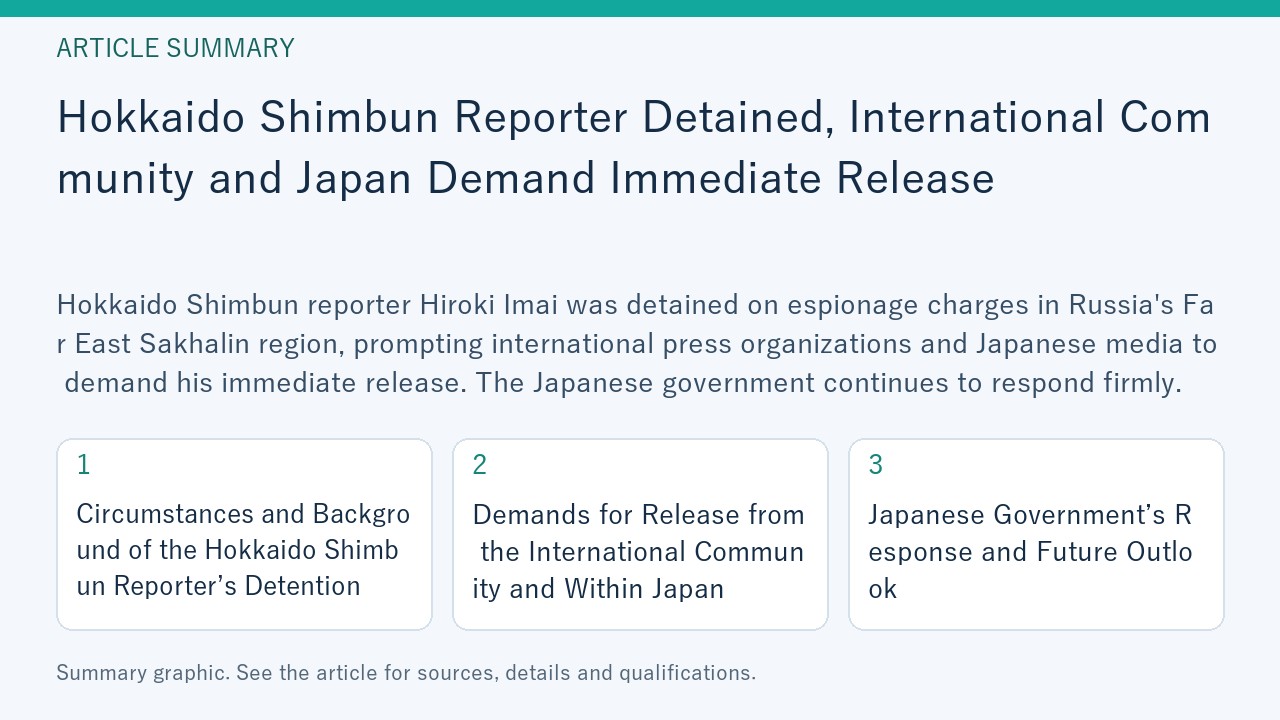
Hiroki Imai, a 34-year-old reporter for the Hokkaido Shimbun, was detained on October 13, 2026, in Russia's Far East Sakhalin region on suspicion of espionage. International press organizations and Japanese media have strongly called for his immediate release, and the Japanese government reiterated this demand on November 12, marking one month since his detention. This article provides a detailed explanation of the circumstances surrounding his detention, the international response, and the government's actions. Imai was stationed at the Yuzhno-Sakhalinsk bureau. His detention has drawn attention as a serious issue concerning press freedom. [1] [2] [3] [4] [5] [6]
Circumstances and Background of the Hokkaido Shimbun Reporter’s Detention
Hiroki Imai, a 34-year-old reporter for the Hokkaido Shimbun, was detained on October 13, 2026, in Russia's Far East Sakhalin region on suspicion of espionage. Imai was stationed at the Yuzhno-Sakhalinsk bureau. Details of the detention have not been disclosed, but the newspaper prioritized his safety and initially reported anonymously. The detention is regarded as a serious challenge to press freedom and has attracted international attention. Future developments are being closely watched. [1] [2] [3]
Imai was responsible for regional reporting at the Hokkaido Shimbun’s Yuzhno-Sakhalinsk bureau. After his detention, the newspaper maintained anonymity out of concern for his safety. However, as one month passed without prospects for his release, on November 12, 2026, the paper switched to reporting his name publicly, judging it necessary to clearly appeal to society. The detention has drawn attention domestically and internationally as an issue involving press freedom and journalist safety. While the detention is reportedly based on espionage allegations by Russian authorities, details remain unclear. [2]
Demands for Release from the International Community and Within Japan
On November 19, 2026, the World Association of Newspapers and News Publishers (WAN-IFRA), composed of media organizations worldwide, strongly reiterated its call for the immediate release of Hiroki Imai at an international conference held in Oslo, Norway. WAN-IFRA includes newspaper publishers, news agencies, and publishers from over 120 countries and is dedicated to protecting press freedom. It had issued a similar statement on November 15, highlighting the detention as a serious case depriving a journalist of the freedom to report, which is internationally regarded as problematic. [1] [5]
Within Japan, media organizations including the Japan Commercial Broadcasters Association (Minpou-ren) issued a protest statement to Russian authorities on November 11, 2026, demanding Imai’s immediate release. The statement emphasized that unjust interference with legitimate reporting activities is absolutely unacceptable and called for ensuring the safety of journalists and a secure environment for media personnel to operate. The Japan Newspaper Publishers and Editors Association and the Japan National Press Club also issued similar statements on the same day. Strong demands for release continue both domestically and internationally. The detention is viewed as a serious challenge to press freedom. [4]
Japanese Government’s Response and Future Outlook
On November 12, 2026, Chief Cabinet Secretary Minoru Kihara held a press conference ahead of the one-month mark since Imai’s detention, expressing the government’s firm stance in demanding his immediate release. Kihara explained that the Japanese government has strongly urged the Russian government for fair and just treatment and immediate release, and will continue to actively engage through various opportunities. The government has confirmed through consular visits that Imai’s health condition is stable. Economic sanctions against Russia remain in place due to its invasion of Ukraine and are unrelated to the detention. [3] [6]
The government’s approach demonstrates a willingness to resolve the detention issue in cooperation with the international community. Diplomatic efforts to ensure Imai’s safety and early release are expected to continue. The detention is a serious issue concerning press freedom, and with increasing domestic and international pressure, resolution is anticipated. Ongoing developments require close monitoring, and international cooperation will be key. The government intends to maintain a firm stance. Many details and the background of the detention remain unclear, and information gathering continues. [6]
Sources and references
- [1] 北海道新聞記者の解放要求 国際報道団体、4日に続き(共同通信)|熊本日日新聞社 — www.kumanichi.com
- [2] 北海道新聞、拘束記者実名に切り替えた経緯掲載「明確に社会に訴えていく必要があると判断」 – 社会 : 日刊スポーツ — www.nikkansports.com
- [3] 木原長官「即時解放を強く求める」道新記者拘束1カ月で — news.tv-asahi.co.jp
- [4] 民放連がロシアに抗議声明 北海道新聞記者の即時解放を要求|FNNプライムオンライン — www.fnn.jp
- [5] 北海道新聞記者の解放要求 国際報道団体、4日に続き — www.kobe-np.co.jp
- [6] 北海道新聞記者の解放要求 木原氏、ロシア拘束1カ月 — www.kobe-np.co.jp
This English edition was translated and reviewed using AI against the Japanese original and cited sources. Source titles remain in their original language.
コメント