









English translation of the Japanese article.
Key points
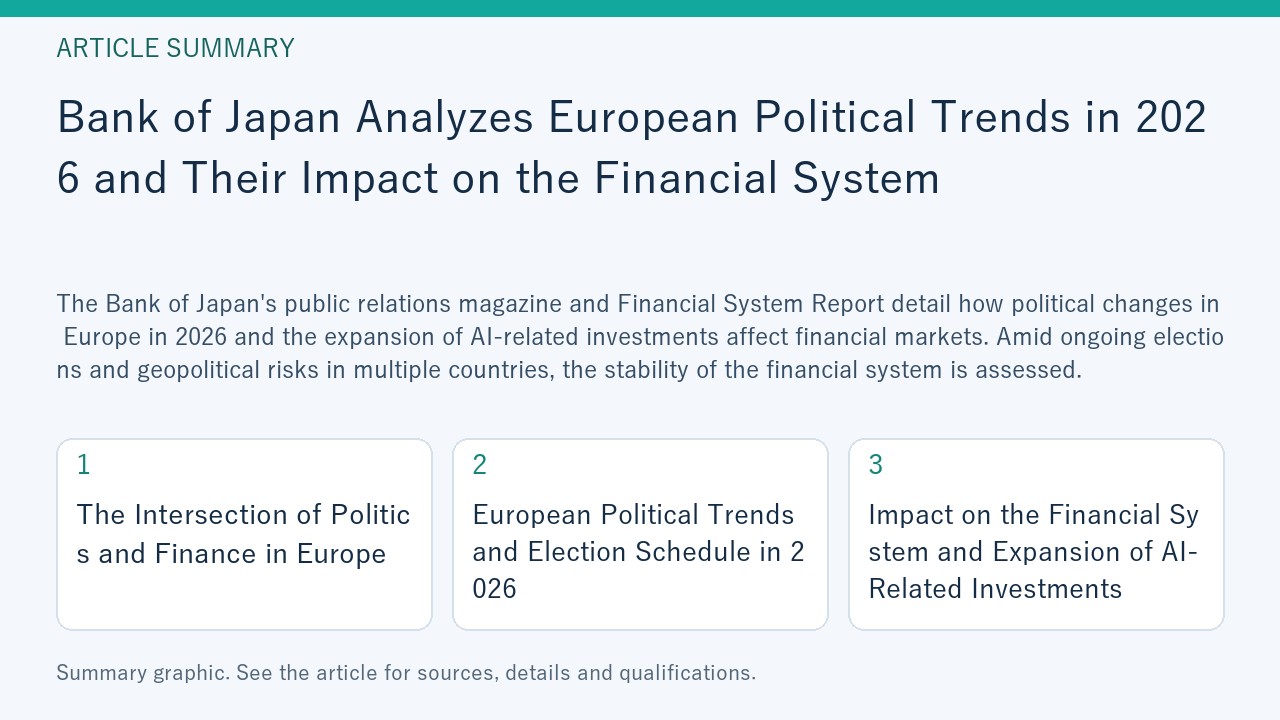
From September to October 2026, the Bank of Japan's public relations magazine "Nichigin" No. 87 (published September 25) and the Financial System Report (October issue) analyzed the relationship between European political trends and financial markets. Multiple elections are scheduled across Europe, while challenging political conditions persist due to Russia's invasion of Ukraine, turmoil in the Middle East, and expanding influence from the US and China. Meanwhile, the growth of AI-related investments has improved market sentiment, contributing to rising stock prices and maintaining low corporate bond spreads. Attention is focused on how these developments affect the stability of the financial system. [1] [3] [2]
The Intersection of Politics and Finance in Europe
The Bank of Japan's public relations magazine "Nichigin" No. 87 (published September 25, 2026) featured a special report interpreting the intersection of politics and finance in Europe. This report provides a framework for understanding how political conditions in Europe influence financial markets. It emphasizes the close relationship between political fluctuations in Europe and financial market trends. The activities of the Bank of Japan's Paris office are also introduced, aiding in grasping the political and economic situation in Europe. From the Bank of Japan's perspective, the interaction between European politics and finance is analyzed in detail. [1]
The special report examines the complex political environment in Europe from multiple angles to understand its impact on financial markets, deepening understanding of monetary policy and market stability. It highlights that political uncertainty in Europe is a factor driving financial market fluctuations and provides information useful for anticipating future policy responses and market trends. By interpreting the relationship between European politics and finance, insights are gained toward maintaining global financial system stability. The Bank of Japan's analysis serves as an important resource for understanding international financial trends. [1]
European Political Trends and Election Schedule in 2026
According to a 2026 European political trends special report by JETRO, numerous elections are scheduled across European countries in 2026, continuing political fluctuations. Presidential elections are planned in Portugal and Bulgaria; parliamentary elections in Slovenia, Hungary, Cyprus, Sweden, Latvia, Bosnia and Herzegovina, and Denmark; and local parliamentary elections in the United Kingdom, Iceland, and eastern German states. These elections have the potential to reshape the political map of Europe and affect regional stability. [3]
Additionally, geopolitical risks such as the prolonged Russian invasion of Ukraine, turmoil in the Middle East, changes in US foreign policy, and China's expanding influence complicate Europe's political environment. These factors impact European policy decisions and international relations, increasing uncertainty in financial markets. Political instability also affects the investment environment and is an important factor influencing financial market trends. European political developments are a significant issue for the global economy. Election outcomes and policy changes in 2026 are expected to have a major impact on future market trends. [3]
Impact on the Financial System and Expansion of AI-Related Investments
The Bank of Japan's Financial System Report for October 2026 analyzes the impact of expanding AI-related investments and trends in overseas non-bank sectors on the financial system, based on information up to the end of September 2026. It shows that growing global demand for AI has improved market sentiment, contributing to rising stock prices and maintaining low corporate bond spreads. In particular, improved performance in the electrical machinery, precision instruments, non-ferrous metals, and machinery sectors has driven the rise in Japanese stocks. In the overseas non-bank sector, private funds and others have increased their presence as providers of capital. [2]
On the other hand, risks related to uncertainties in the Middle East, the profitability of AI-related investments, and trends in the overseas non-bank sector are also noted. The Bank of Japan conducted macro stress tests to examine the impact of these risks on the financial system. The results indicate that the stability of the financial system is currently maintained, but careful ongoing monitoring is necessary. Additionally, the increasing threat of cybersecurity requires responses, and enhancing the resilience of financial institutions is emphasized. [2]
Sources and references
- [1] 日本銀行広報誌「にちぎん」No.87 2026年秋号 : 日本銀行 Bank of Japan — www.boj.or.jp
- [2] 金融システムレポート(2026年10月号) : 日本銀行 Bank of Japan — www.boj.or.jp
- [3] 2026年欧州政治動向 | 特集 – ビジネス短信 ―ジェトロの海外ニュース — www.jetro.go.jp
This English edition was translated and reviewed using AI against the Japanese original and cited sources. Source titles remain in their original language.


コメント